English version
Projects
Diamens – Diagnosis Using Menstrual Blood
“We Are So Free.” – Brewing Culture with Principles
LIT Special Call: Ars Electronica Festival – Making science tangible
Baumwerk Freistadt – A sustainable and affordable housing project
Back in Time Prague – Where history becomes a multisensory experience
České Budějovice – European Capital of Culture 2028
Treffpunkt Atelier – Studios Open Up Borders
lAiKa – Expanding Cultural Opportunities through Local Potential
Art in the City – Site Specific Lab – Art Where Life Happens
About the exhibition
Diamens – Diagnosis Using Menstrual Blood
Diamens is developing an endometriosis test based on menstrual blood, designed to make diagnosis faster, easier to access and centred around the people affected
LEARN MORE
How Diamens Is Rethinking Endometriosis Diagnosis
Seven years. That is how long it takes, on average, for people with endometriosis to receive a diagnosis. Seven years filled with uncertainty, pain and often frustrating visits to the doctor.
The Linz-based start-up Diamens wants to shorten this journey. Its female founders are developing a test that can diagnose endometriosis using menstrual blood – simple, accessible and suitable for use at home. But the innovation involves more than medical research: it is also about design, communication and the question of how to reach women where they are looking for answers.
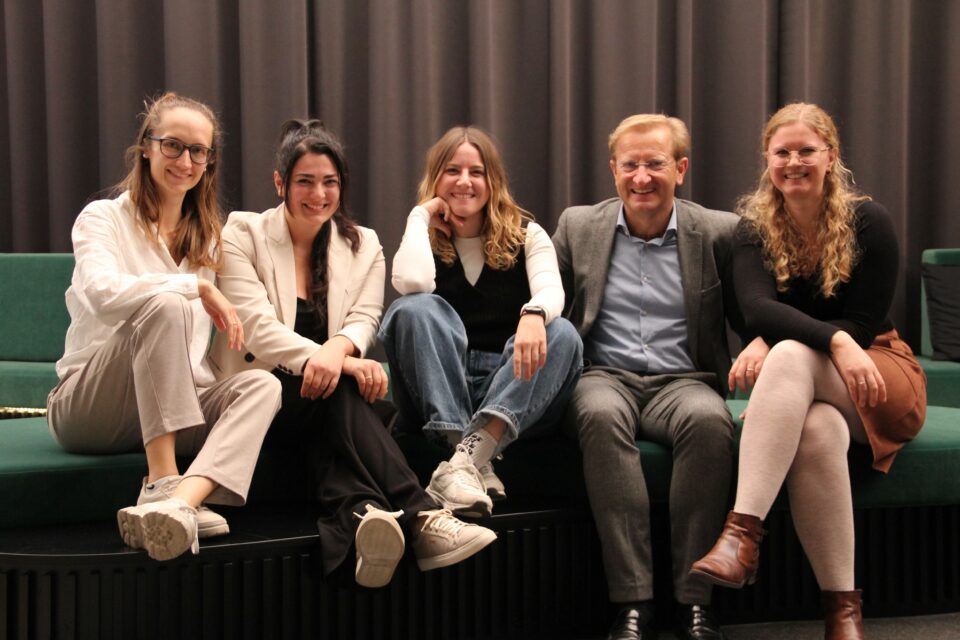
We spoke with co-founder Angelika Lackner about how Diamens came about, the importance of user-centred development and the project’s social impact.
“We realised that there were practically no standards for menstrual blood.”
How did the idea for Diamens originate?
Diamens stands for “diagnosis from menstrual blood”. The idea originated in scientific research: a bioinformatic biomarker identification pipeline revealed potential biomarkers for endometriosis. This raised the question of how they could be used in a way that would be as patient-friendly as possible.
The team of female founders then began exploring menstrual blood as a diagnostic sample material in depth – and discovered that practically no established procedures existed for it. “There are standardised laboratory protocols for skin samples, hair samples and many different types of tissue. For menstrual blood, there was practically nothing.”
This insight became the starting point for developing a diagnostic solution that focuses on the very process from which the condition originates: the menstrual cycle itself.
Combining these two findings led to the idea of harnessing menstrual blood as a diagnostic sample material that had previously received little attention. Due to its close biological connection to the endometrium and the processes associated with endometriosis, it holds considerable potential for non-invasive diagnosis.
A Health Problem with a Long History of Suffering
Endometriosis is one of the most common gynaecological conditions. Nevertheless, it often takes years for those affected to receive a clear diagnosis.
Symptoms are not always correctly identified straight away, the condition can be overlooked even by experienced specialists, and many women attend numerous medical appointments before endometriosis is even suspected. Surgical tissue sampling is still considered the gold standard for a confirmed diagnosis.
This is precisely where Diamens comes in: the test is intended to significantly shorten the path to diagnosis and provide women and gynaecologists with answers sooner.
When (Product) Design Becomes Part of the Solution
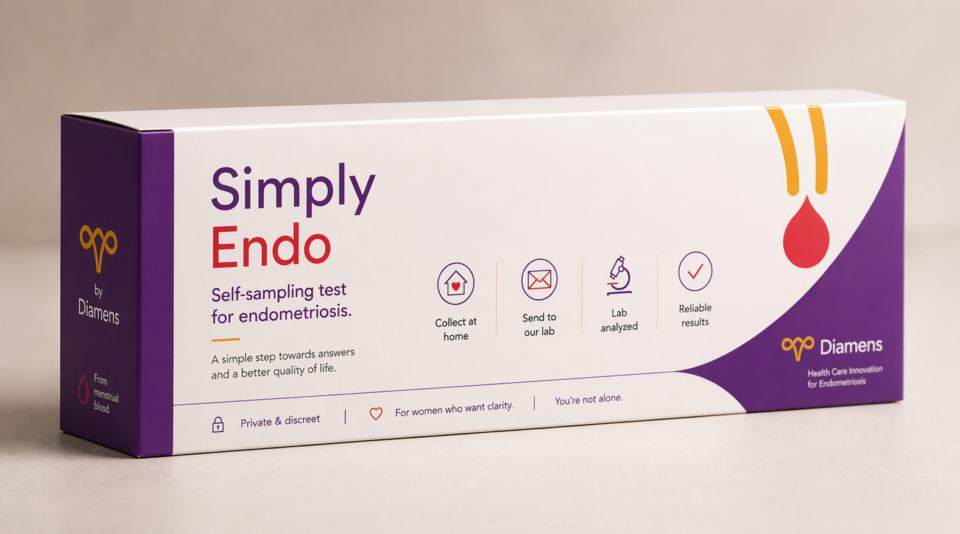
From the outset, the aim was to make sample collection as simple as possible. Users should be able to carry out the test independently, without feeling uncertain or worrying that they might do something wrong. The experience of the pandemic has shown that many people are now familiar with collecting samples themselves.
Communication is particularly important in this context: instructions must be easy to understand, processes must be intuitive, and the packaging must both inspire confidence and meet regulatory requirements.
For the team, this means reducing medical complexity to its essentials. Visual instructions are just as important as the design of the product itself. After all, an innovation can only realise its full potential if people are actually able to use it in their everyday lives.
User-Centred Development as the Top Priority
During the development of the test, more than 350 people with endometriosis were surveyed about their experiences, needs and expectations. The team also gathered feedback from hundreds of other women who had not yet received an endometriosis diagnosis.
These findings directly informed the design of the product and the user journey. Every aspect – from sample collection and packaging to communication – was consistently considered from the users’ perspective.
The level of demand is clear: women regularly contact the company directly to ask about the test or express an interest in participating in studies. Some even want to actively support the project. “How can I help you?” is a comment that frequently appears in the relevant form on the company’s website.
Feedback like this shows just how strong the demand for better diagnostic options is.
Communication as a Bridge Between Research and Everyday Life
Developing the test is only part of the challenge. It is equally important to consider how the people affected will find out about it.
Diamens therefore uses several communication channels simultaneously: from search engines and online research to gynaecological practices, specialist conferences and medical networks.
The idea is simple: women should be reached wherever they begin looking for answers.
Healthcare in particular demonstrates how closely innovation and communication are linked. Even the best technology can only deliver social value if it is visible, understandable and accessible.
An Early Diagnosis Leads to a Better Quality of Life
The potential impact of Diamens extends far beyond diagnosis.
An earlier diagnosis can help ensure that treatment begins sooner, improve quality of life and reduce the condition’s long-term consequences. At the same time, it creates new possibilities for research and the development of treatments.
This is particularly relevant for women trying to conceive. Many only discover during fertility treatment that endometriosis is the cause of their symptoms. Earlier diagnostic testing could save valuable time.
A diagnosis also changes the way the condition is discussed. It raises awareness of symptoms that have long been dismissed as “normal” and makes it clear that severe pain during menstruation should not simply be accepted as a matter of course.
Feedback from women affected by the condition reveals just how deeply these experiences can run:
“My mum had it too. She vomited from the pain every month, but for her, that was simply normal,” Angelika Lackner quotes one woman as saying.
Stories like these illustrate why education, communication and early diagnosis are so closely connected.
“Thank You for Doing What You Do.”
The messages the team receives through its studies and website are particularly moving.
Amid all the data and analyses, there are frequent personal comments from women who want the subject to finally receive more attention.
“Thank you for doing what you do.”
For the founders, this feedback confirms that their work is also an opportunity to bring visibility to a long-standing blind spot in women’s health.
The Next Step
Diamens is currently working towards certification of the product as a medical device. The company itself is already certified as a medical device manufacturer. If the remaining regulatory steps proceed as planned, the test is expected to enter the market in 2027.
Until then, the vision remains the same: to significantly shorten the path to an endometriosis diagnosis and give women the answers they need sooner.
Diamens demonstrates that real impact emerges when research, design and communication work together. Medical knowledge can only create lasting change in people’s lives when it becomes understandable, accessible and suitable for everyday use.
Link: Diamens Website
“We Are So Free.” – Brewing Culture with Principles
Gruppe am Park turned Freistädter Bier’s independence and Mühlviertel roots into a bold brand campaign.
LEARN MORE
“We Are So Free”: How Freistädter Bier Is Evolving Its Brand Without Losing Its Roots
Freistädter Bier has something that cannot simply be reinvented: 250 years of history, deep roots in the Mühlviertel region and a community with a close connection to the brand. When Freistädter Bier and the agency Gruppe am Park began working together, a radical new beginning was therefore never the goal. Instead, they asked: How can a strong brand evolve without losing what makes it special?
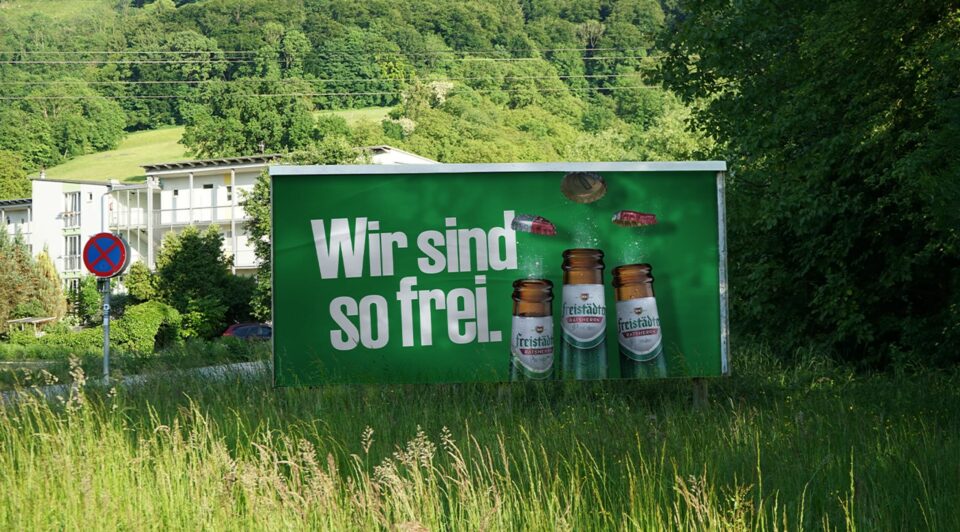
Their answer was “We Are So Free”. The claim brings together independence, regional identity and the brewery’s production principles in one clear stance. In doing so, it deliberately sets Freistädter apart in an Austrian beer market dominated by major corporate brands. Free from genetic engineering, free from additives and without a multinational corporation behind it: the claim sums up what was already part of the brand while creating room for it to evolve.
This stance is consistently translated into communication through pared-back posters, pointed messages and a distinctive presence with character. Above all, however, “We Are So Free” places greater emphasis on the people who have always shaped Freistädter Bier.
We spoke with Paul Steininger of Freistädter Bier and Bernhard Buchegger of Gruppe am Park about carefully evolving a brand, mutual trust, bold decisions and why a strong community is far more than a marketing tool for a regional brewery.
Evolving Rather Than Reinventing
For Gruppe am Park, the starting point called for a close look. What was already working? What must not be lost under any circumstances? And where could the brand be taken one step further?
“The situation at the outset was exciting because there was already an excellent foundation. […] How can we make use of the existing potential while still taking the next step without losing that foundation?” says Bernhard Buchegger, Managing Director of Gruppe am Park, describing the central question at the beginning of the process.
The answer lay not in a radical relaunch, but in many small decisions, from the typography to the way the products are presented in campaigns.
From “Fresh, Free, Freistädter” to “We Are So Free”
“Fresh, Free, Freistädter” had already established a strong positioning, and it remained in place. But Gruppe am Park saw further potential in it: to connect the idea of “free” more strongly with a sense of “we”.
“For us, the potential of the community was a little like a treasure that had yet to be unearthed.”
This led to “We Are So Free”. The new claim builds on the existing brand positioning while opening it up to the people in the company, the brand’s fans, the region and its distinctive character, quirks and rough edges.
Freistädter is particularly well placed to do this because of the brewery’s history. Braucommune Freistadt itself emerged from a community—long before anyone would have used the term in marketing.
“There is hardly another beer brand with community so deeply embedded in its DNA as Freistädter. A community that has existed for 250 years, if you like.”
How Far Can You Go?
Evolving an established brand always means testing its boundaries. How much change can it sustain? When is a step too small to be noticed at all, and when is it so large that people suddenly no longer recognise their brand?
These questions were discussed in depth. Even seemingly minor details became relevant: How much should the typography change? Does the full product always have to appear in a visual? Could even the characteristic green be toned down?
On the last point, the answer quickly became clear.
“When we considered toning down the green, we immediately realised that doing so would be complete madness.”
Instead, the Linz-based agency began to experiment more freely within the existing brand system. Where the classic product shot used to take centre stage, campaigns now feature different crops and products. A digital citylight went one step further: at first there was no product at all, just a headline against a green background.
“We are such a strong brand that we trust people to identify us even when we do not show the product at all.”
Trust as a Prerequisite
The word “trust” runs through the entire conversation. An evolutionary approach to brand development requires sensitivity on both sides.
For Freistädter, this means placing its brand partly in the hands of external creatives. For Gruppe am Park, it means taking seriously the company’s existing knowledge and its close relationship with its own brand.
“For us, it is of course very important to have professionals at our side whom we can trust completely throughout the process,” says Paul Steininger, Managing Director of Freistädter Bier.
It helped to make proposed changes visible at an early stage. Gruppe am Park deliberately uses visualisations of different options, ranging from a cautious step to a bolder one. This makes it possible to discuss together what opportunities a change might create and where something could be lost.
Bernhard Buchegger therefore explicitly regards the success as a joint achievement: “It takes both sides. Otherwise, it cannot work.”
After all, advertising is a field in which almost everyone has an opinion. This makes a shared strategic direction all the more important—one that is not hastily abandoned in response to differing feedback.
A Mural as the First Major Demonstration of Trust
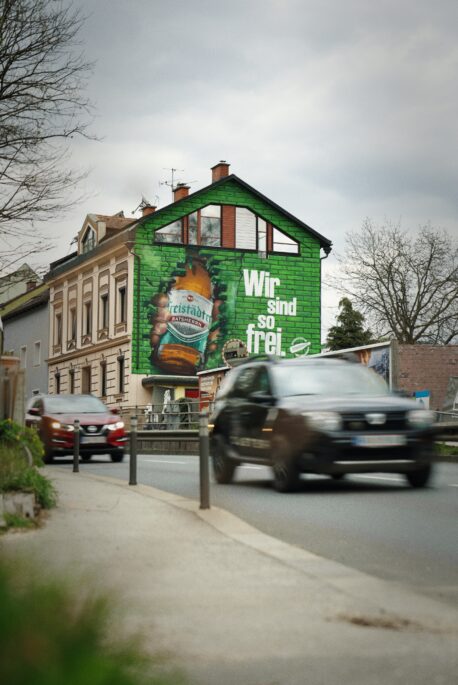
The potential of this collaboration became apparent at an early stage. A mural was created on a large wall beside one of the roads leading into Linz, showing a bottle of Freistädter apparently bursting through the brickwork.
The idea became an early “match” between the brewery and the agency. At the same time, it required a substantial investment and used a form of advertising that was still unusual for the region. Within the company, the mural became an important signal of the new direction. Some employees even made a special trip to see the finished work for themselves.
When People Talk About Advertising of Their Own Accord
Steininger experiences reactions to the brand’s evolution at first hand. Alongside the positive business development, he pays particular attention to how people respond to the communication. What stands out is how often that feedback comes unsolicited. “It is not in response to us asking, ‘So, how do you like the poster?’ People come up to us themselves and say, ‘Your advertising is great. I really like it.’”
The brand remains recognisable across different channels, from posters and social media to the brewery’s trucks. Freistädter’s signature green, in particular, often makes the brand identifiable from a considerable distance.
There has also been clear movement in the digital sphere: 60.3% more followers on Instagram (comparing 2024 and 2025), an almost 50% increase in the interaction rate and reach up by more than 170%. The brand work has also received awards from the communications industry, including a Gold German Brand Award in the Brand Strategy – B2C category.
Yet perhaps the most lasting impact—one that cannot be measured directly—runs deeper: the emotional bond with the brand.
From Beer Brand to Community
This bond was part of the strategy from the outset. In the second year of the collaboration, the community concept was therefore developed even more consistently.
An existing app, previously used mainly to provide information such as the brewery restaurant’s lunch menu, was developed into a community tool. Under the name VIB 1777—VIB stands for “Very Important Biertrinker”, or very important beer drinker ;-)—fans of the brand now have their own platform featuring events, competitions, gamification and other offers.
The aim is not to manufacture a community artificially. It already exists.
“If we manage to give this community, which is already there, a platform and a stage that make its members feel even more closely connected, […] we would be foolish not to do so.”
A community cannot simply be imposed on any brand. It works where people already associate a shared stance, history and identity with a brand. In Freistädter’s case, this connection is quite tangible: fans wear the brewery’s T-shirts and cycling jerseys, put stickers on their cars and get in touch when they move and suddenly cannot find Freistädter Bier in their new home town.
Brand Loyalty as an Economic Factor
For a regional, privately owned brewery, this loyalty is more than a welcome side effect. It is part of its economic foundation.
Freistädter cannot and does not want to compete with the prices and market power of major brewery groups on the same terms. What matters, therefore, is that people do not reconsider which beer happens to be on special offer every time they go shopping.
“We depend on people saying when they shop, ‘Yes, we are buying a green crate of Freistädter, and we are not even going to look at what is on special offer.’”
Community-building thus becomes long-term brand-building. Its effects are not necessarily visible immediately after a single campaign or initiative.
“These are all decisions that do not produce an immediately measurable impact, but instead steadily increase the value of a brand or its emotional resonance.”
A Strong Brand with Room for Humour
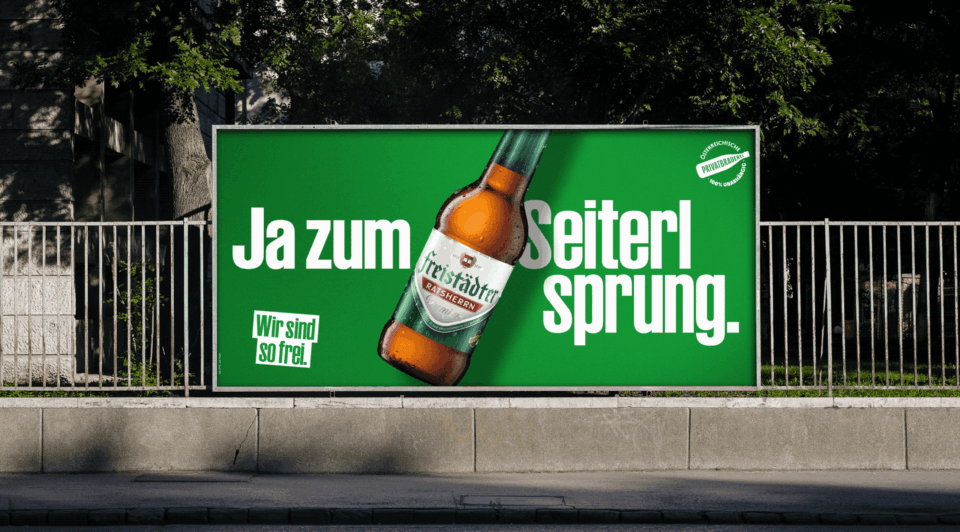
“We Are So Free” provides the framework for this evolution. The phrase leaves room for the character of the Mühlviertel region, humour and short, tongue-in-cheek messages, as well as for different people and products. At the same time, the foundation remains intact: the green, the history, the regional roots, the independence and “Fresh, Free, Freistädter”.
Perhaps this is precisely where the strength of the collaboration between Freistädter Bier and Gruppe am Park lies: in jointly identifying the subtle levers that allow a strong brand to evolve while remaining unmistakably itself. This requires a feel for what already exists, the courage to try something new and, above all, the trust to take this path together.
LIT Special Call: Ars Electronica Festival – Making science tangible
The LIT Special Call brings researchers, students and artists together to turn complex research into interactive experiences for the Ars Electronica Festival.
LEARN MORE
When Science Meets Art: How the LIT Special Call Makes Research Tangible
What happens when science leaves the world of laboratories and conferences behind and encounters artists, festival audiences and entirely new perspectives? Since 2020, the LIT Special Call at Johannes Kepler University Linz has been bringing these worlds together. Researchers and students collaborate with artists to develop projects for the Ars Electronica Festival – with ambitions that go beyond conventional science communication.
This is not about packaging research attractively once the work is complete. It is about creating something that none of the disciplines involved could have developed on their own.
We spoke with Gregor Pechmann and Denise Atteneder, the team behind the LIT Special Call, about why science needs to leave the ivory tower, what art can change in the process and why a festival with an immovable deadline is sometimes exactly the right place for experimentation.
Taking Science Out of the Laboratory
When the JKU campus became one of the main venues of the Ars Electronica Festival for the first time in 2020, the university wanted to contribute more than just space. It also wanted to play an active role in the festival’s programme. The LIT Special Call was created in the context of universities’ so-called “Third Mission”: alongside research and teaching, their responsibilities also include transferring knowledge to society.
The call was intended to create a new platform for this purpose.
“Science should not exist purely for its own sake. The third mission of a university plays a major role here. The first is research, the second is teaching and the third is making it possible to share this knowledge with the public,” Gregor Pechmann explains.
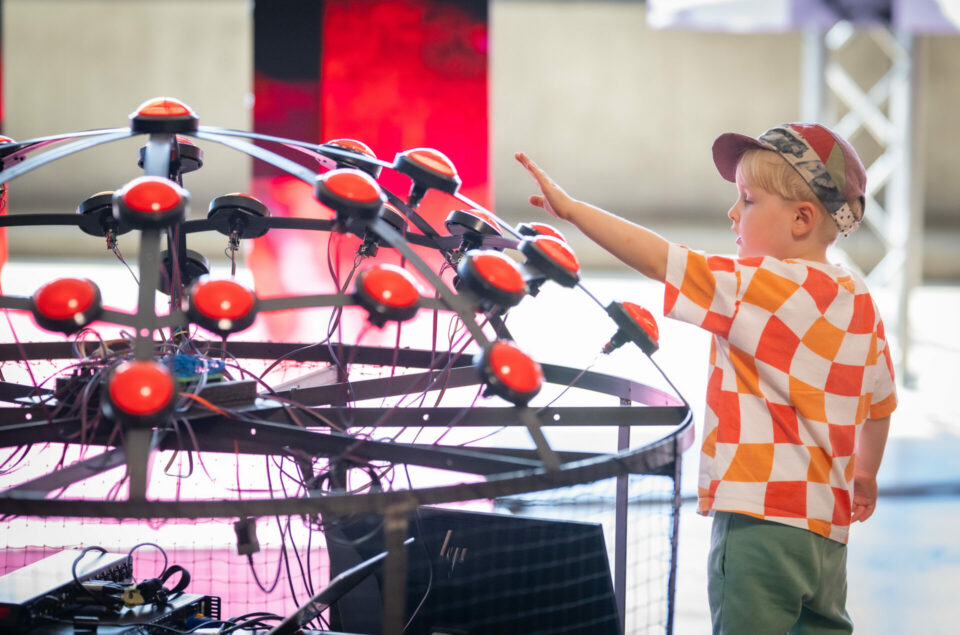
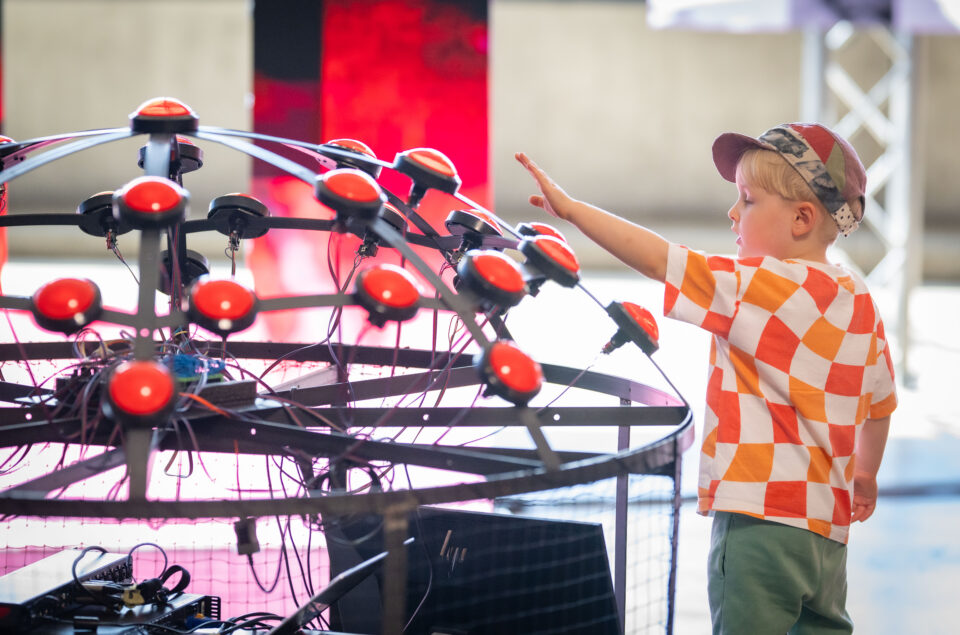
Researchers and students at JKU are therefore invited to submit projects to be presented at the Ars Electronica Festival. The call is deliberately open to all disciplines. Although Ars Electronica may immediately bring AI, computers or robotics to mind, the aim is to highlight the diversity of scientific topics.
More Than “Art, Make It Look Nice!”
Collaboration between science and art is crucial. The creative contribution is not supposed to be added only at the end of the research process to make data look more appealing or give a finished idea an attractive form.
“It is not simply about embellishing something, such as presenting data in a visually appealing way. It is about artists and researchers inspiring one another so that something entirely new can emerge.”
This integration has since become an important selection criterion. While a large number of projects were supported in the first call, the focus has gradually shifted from quantity to quality. Six projects are being realised through the LIT Special Call in 2026.
For the team, the value of art becomes particularly apparent when it adds social and emotional dimensions to scientific questions.
“Art is much closer to people and can evoke different emotions than science can on its own.”
When an Idea Becomes Something Entirely New
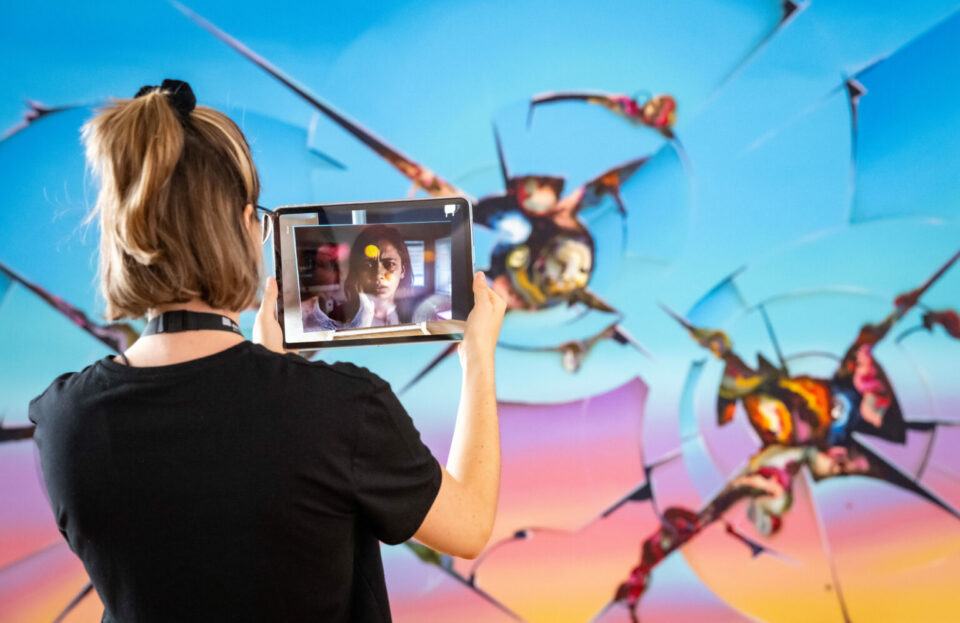
A current project in human genetics shows just how much projects can change through this exchange in the period leading up to the festival. It began with the question of how accurately a person’s appearance can be reconstructed from their DNA. In 2025, the project already explored the fact that our appearance is shaped not only by our genes, but also by our environment, behaviour and experiences.
As the project was further developed for 2026, the collaboration with an artist introduced a new social question: Is violence something encoded in our genes, or does it arise from our experiences and social environment?
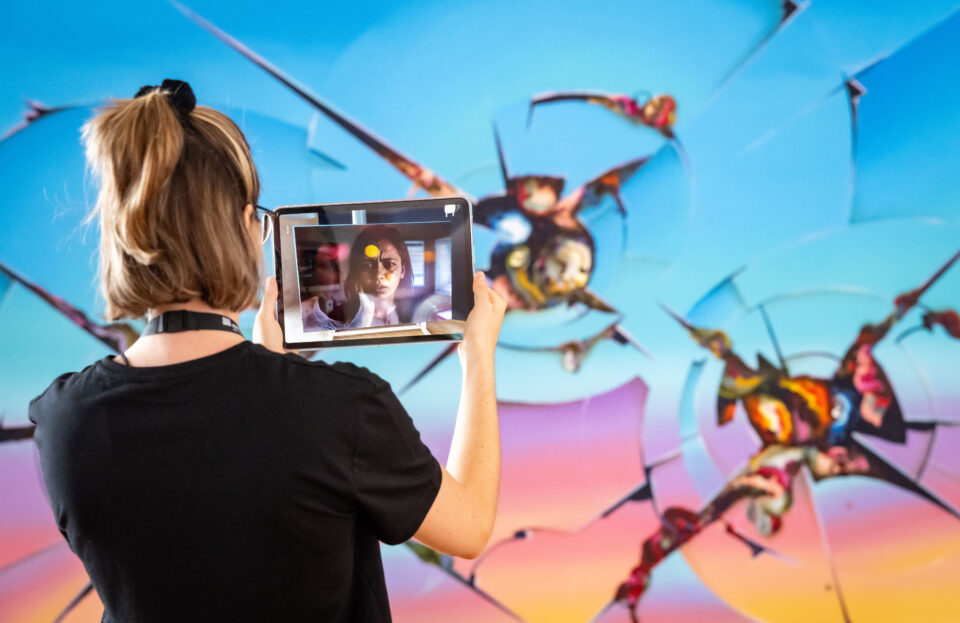
The installation translates this question into altered faces, among other things. Visitors can enter positive or negative experiences, which are then visually transferred onto the faces of project participants using a video installation. At the same time, DNA is translated into music.
The project is an example of what the LIT Special Call aims to achieve: an initial scientific question is expanded and re-examined through an artistic perspective.
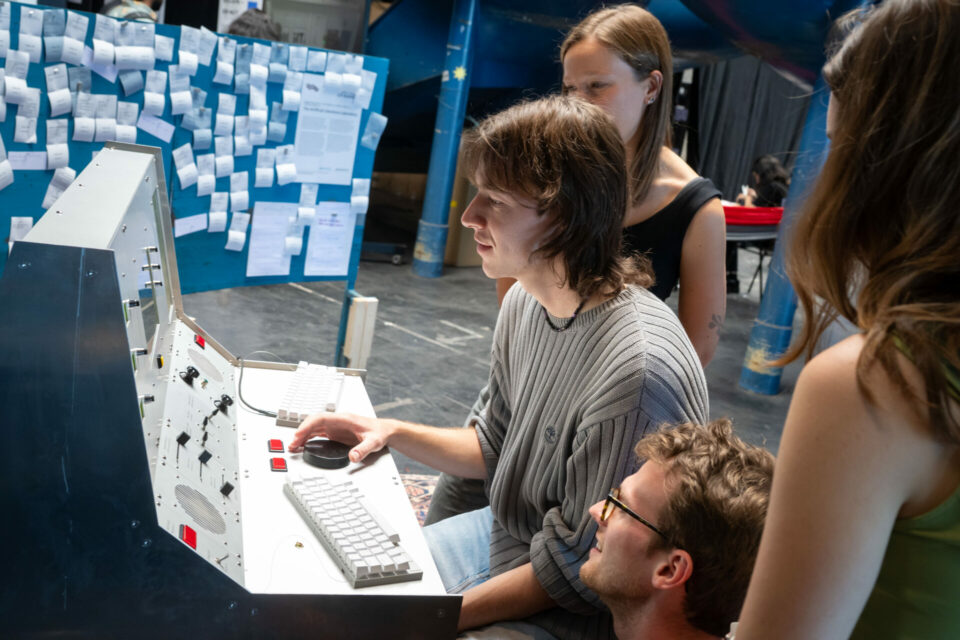
Eleven Months from Application to Festival
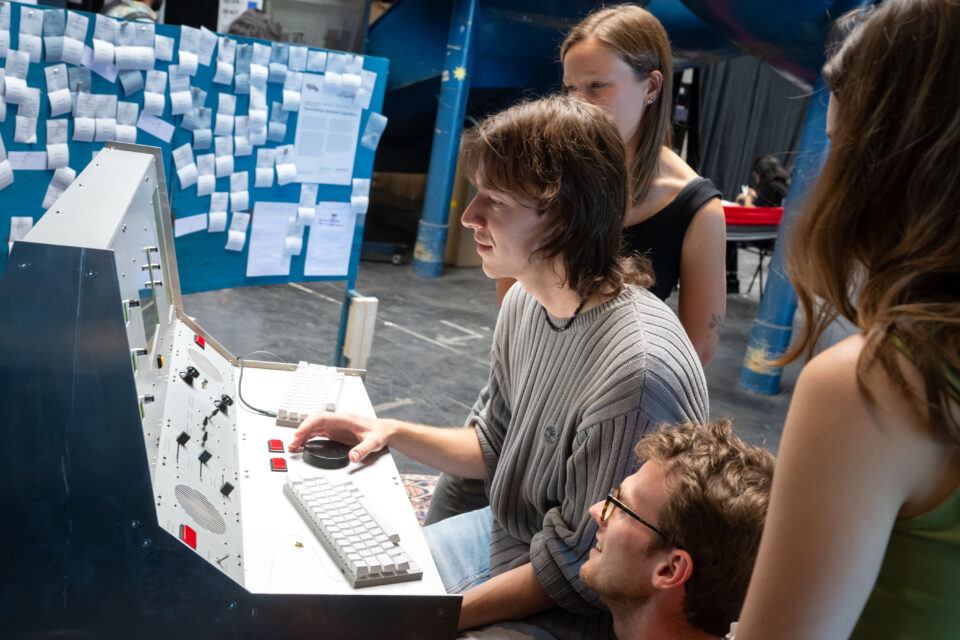
Around eleven months pass between submission and presentation at the Ars Electronica Festival. Once the call is announced, interested participants have several months to submit their ideas. The organising team assists with applications, connects participants with artists and other institutions, and guides the projects through the subsequent selection process. During a hearing, the teams present their proposals to a distinguished jury.
But the proposal rarely represents the finished project.
“The journey from submitting an application, which may still be fairly loosely formulated or contain many unanswered questions, to its actual implementation is a fascinating process that we have the opportunity to follow.”
Some projects continue to change even during the final weeks before the festival. Spaces are only confirmed at a later stage, technical requirements change and collaborations develop differently than planned.
One thing, however, is non-negotiable: something must be ready in time for the festival.
More than 55 projects have been realised since 2020. Despite all the uncertainties, every team has so far managed to present something.
Showing Researchers as People
The team has also experimented with different approaches to science communication. In 2025, it created “Into the JKUniverse – Science Starts with You”, a meeting space at the festival designed to bring science closer to the public.
Formats such as “Meet the Scientist” were deliberately intended to reveal the people behind the research. Audiences were able to look beyond the professors’ academic titles and institutional affiliations. Behind the scientific façade, they suddenly discovered people with hobbies, favourite colours, hopes and dreams – or someone who keeps goats at home and makes their own apple juice.
“Once you recognise this human dimension, you immediately have greater trust in what these people are saying.”
This personal connection is particularly important at a time when scepticism towards science is increasing.
Quantum Physics for Everyone
A project from 2024 demonstrated that even highly complex topics can be made accessible. Data generated through quantum entanglement was translated into musical notes and performed by two organists at St. Mary’s Cathedral in Linz. At first glance, this is hardly a topic that lends itself to accessible science communication.
Yet this is precisely one of the projects’ special qualities: at the Ars Electronica Festival, international experts encounter families, children, art enthusiasts and people who happen to be visiting. As the team puts it, the target audience is simply “everyone”.
Despite this – or perhaps precisely because of it – the project teams repeatedly succeed in communicating their work on very different levels.
“The teams can switch within 30 seconds and transform the same installation […] into an entirely different experience depending on the target audience.”
The researchers themselves are therefore present throughout the festival. They are there not only to explain their installations, but also to discuss their research, answer questions and engage directly with visitors.
A Little Culture Clash Is Part of the Process
Science and art are not the only worlds coming together. JKU and Ars Electronica also operate according to different principles. The LIT Special Call team sits right between them. It coordinates, translates, mediates, solves technical and organisational problems, and supports projects from the initial information sessions through to the finished installation.
At times, this can feel like troubleshooting or firefighting. At the same time, a distinct LIT community has emerged over the years. Project teams exchange ideas, help one another with setup and lend each other materials.
“They also know that they can rely on us and that they are not alone when they have questions. I think that is another thing that makes this call so unique,” says Denise Atteneder.
An Impact That Cannot Always Be Measured in Numbers
But how can you measure whether people are less sceptical of science after visiting a festival? Or whether an installation produces a lasting change in the way someone thinks about research?
It is not easy.
“There is no measurement showing whether people are more or less sceptical of science after visiting the Ars Electronica Festival.”
Part of the impact therefore becomes apparent elsewhere: within the university itself. The number and quality of submissions have developed over the years, researchers now look forward to the next call, and science communication is becoming increasingly important alongside conventional academic metrics.
The LIT Special Call therefore also provides an opportunity to think differently about research: What does one’s own work mean outside the academic system? How can it be discussed with people who are not experts? And what happens when another discipline suddenly asks questions that one would never have considered?
For students in particular, the call offers an opportunity to develop their own research interests in an extraordinary context and present them at one of the world’s best-known festivals for media art.
“It really is about engaging with the public and not simply saying: ‘I am doing something so that I can be cited.’”
When Everything Is Suddenly Over After Five Days
After eleven months of development, countless coordination meetings and an intensive setup phase, the festival itself lasts just five days. Within a few more days, everything is dismantled again.
What remains, however, is more than an installation.
Projects are further developed or presented elsewhere, the collected data forms the basis of academic publications, connections endure and some teams submit another proposal for the next call.
Above all, what remains is the moment when an idea actually becomes something real.
Perhaps this also explains the “post-Ars Electronica depression” mentioned jokingly during the conversation: after months filled with deadlines, culture clashes, last-minute solutions and collaborative work, everything is suddenly over.
Until the next call.
Link: LIT Sonder-Call: Ars Electronica Festival 2025 | LIFT_C, LIT – Linz Institute of Technology
Baumwerk Freistadt – A sustainable and affordable housing project
28 affordable rental homes built almost entirely from wood show how climate-friendly construction and urban living can work together.
LEARN MORE
How Baumwerk Makes Sustainable Housing Affordable
A total of 480 cubic metres of timber was used to construct Baumwerk in Freistadt. The result is 28 rental apartments that combine climate-conscious construction, a high quality of living and rents in line with local market levels.
The project was developed through collaboration between the Upper Austrian Chamber of Agriculture, Tp3 Architekten, regional timber construction companies, specialist planners and communication designers. We spoke with Andreas Henter of Tp3 about how these different areas of expertise came together and why Baumwerk is now attracting interest from other municipalities as well.
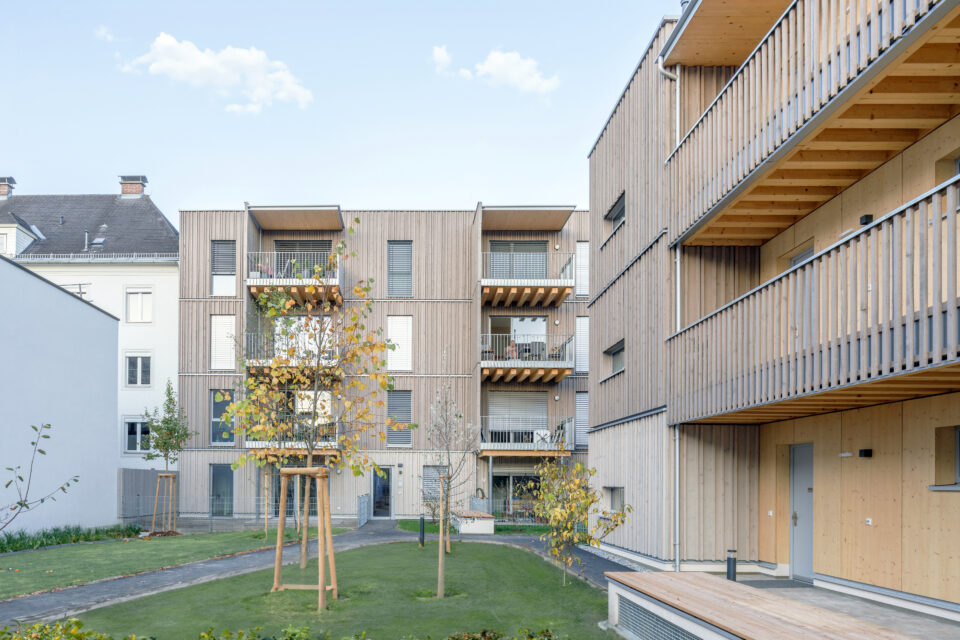
A Shared Commitment as the Starting Point
New housing was to be created on the site of the former Chamber of Agriculture in Freistadt, which had most recently been used primarily as a car park. As part of a planning process, Tp3 Architekten developed the idea for a multi-storey timber building. The Upper Austrian Chamber of Agriculture adopted this approach and linked it to a clear objective: sustainability was to shape the entire project—ecologically, economically and socially.
“The challenge begins when the client says: We really want to build sustainable housing,” explains Andreas Henter. “If the client is serious about it, we also have to implement it consistently. And that is precisely what makes it so rewarding.”
This created a shared foundation. Tp3 developed and assessed a range of spatial solutions. Timber construction companies and specialists in structural engineering, building physics, fire safety and project management translated the design into viable structures. The design advisory board contributed another perspective to the arrangement of the buildings. With legal support, a suitable procurement model was developed to enable the timber to be sourced regionally. Finally, the Fredmansky agency translated the project’s distinctive qualities into a name, a visual identity and an accessible narrative.
Timber as a Consistent Choice
The new buildings were constructed largely using timber-frame methods. Timber defines the load-bearing structure, the interiors and the façade; only the underground car park and stairwell cores are made of reinforced concrete. Exposed columns, beams and surfaces allow residents to experience the material directly.
The multi-storey timber construction required close collaboration between the companies involved. Questions concerning structural engineering, sound insulation, fire safety and building physics were resolved jointly with the relevant specialists and Obermayr Holzkonstruktionen. Architectural ambition met craftsmanship and regional production expertise.
“You begin by considering together how the design can be realised as a timber structure. The proposal is then assessed and coordinated with regard to structural engineering, fire safety and building physics,” Henter says, describing the process. “The companies and the necessary expertise are available in the region. You simply have to bring them together.”
This process generated practical knowledge that can also be applied to future projects.
Greater Density Creates New Open Space
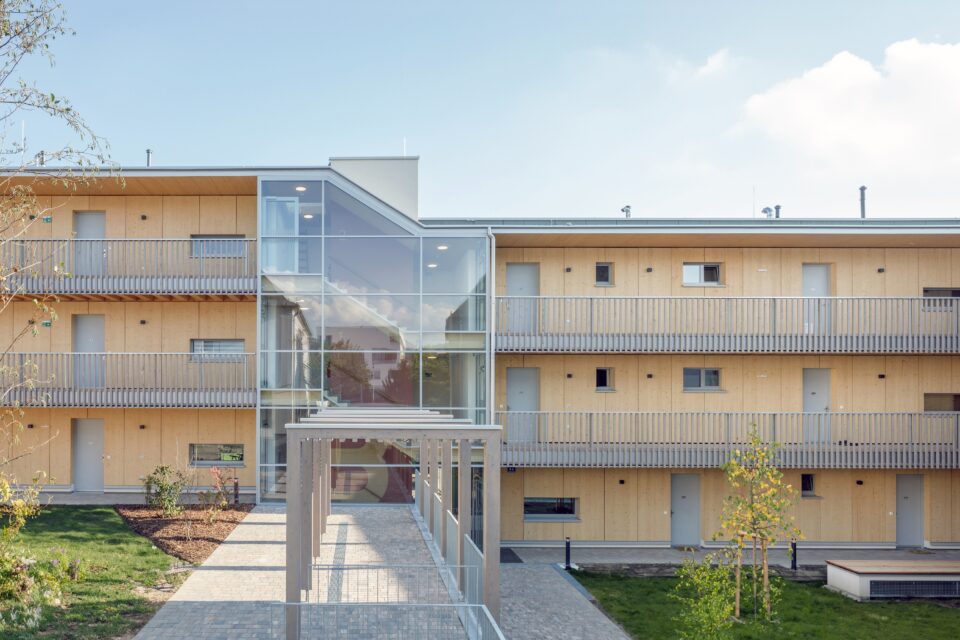
Baumwerk makes use of an already serviced site in the centre of Freistadt. The town centre, bus station, schools and essential local amenities are all within walking distance. At the same time, the previously sealed inner area was planted and redesigned as a shared open space.
During the design process, Tp3 assessed different configurations and developed them further together with the Chamber of Agriculture and the design advisory board. The decision to keep the centre open and concentrate the buildings along the edges created a sheltered courtyard with green areas and pathways.
Henter describes this development as a “game of ping-pong”: proposals were presented, discussed, reviewed and refined. Everyone involved could understand which options were pursued and why. The spatial solution therefore did not emerge as a finished individual design, but was developed step by step through dialogue.
Dividing the complex into several connected structures gives it a manageable scale. “Individual structures that are connected to one another create the impression of a village-like setting,” Henter explains. External access galleries, visual connections and the shared green space create opportunities for people to meet. Balconies, private gardens and clearly defined private areas also provide places to retreat. Today, people from different generations live here.
Climate-Conscious Living at Local Market Rents
From the outset, the project’s ecological objectives were linked to the question of affordability. The 28 apartments are offered at rents in line with local market levels. To make this possible, the Chamber of Agriculture accepted a longer payback period instead of passing the additional investment costs directly on to tenants through higher rents.
“Climate-conscious timber architecture does not have to be reserved for a small elite. It can be accessible to everyone.”
The electricity generated by the photovoltaic system on the green roof also directly benefits the residents. The system comprises 133 modules with a total capacity of 55.25 kWp. It is complemented by a central wood-chip heating system.
The strong demand confirmed the viability of this approach: all apartments had been allocated long before construction was completed. For Henter, this is an important signal. Ecological quality, an attractive living environment and affordable rents can complement one another when they are considered together from an early stage and supported by those responsible for the project.
Impact Through Many Coordinated Decisions
Baumwerk’s climate performance results from the interplay of its location, materials, construction, energy supply and open-space design. Around 480 cubic metres of timber were used in total. This timber stores approximately 480 tonnes of CO₂ over the long term. According to the project calculations, this form of construction produces around 52 per cent fewer greenhouse gas emissions than a comparable mineral-based structure.
The origin of the building material was also considered during planning. With legal support, an assessment system was developed for the tendering process that took short transport distances into account. The timber used comes from the Hausruckviertel and Salzkammergut regions, from a distance of around 100 kilometres. The volume used in the building regrows in Austria’s forests within just a few minutes.
The high degree of prefabrication enabled precise production and efficient assembly. Planted areas, the green roof and reusable building components complete the concept.
The figures make the project’s ecological impact visible. At the same time, they point to specific decisions: short transport distances, a structure made predominantly of timber, renewable energy and the use of a centrally located site that was already connected to existing infrastructure. These measures have an impact because they were coordinated across the planning team, the client, the contractors and the specialist disciplines involved.
A Name Makes the Idea Accessible
The collaboration did not end with the planning and construction stages. Together with Fredmansky, the project team developed the name “Baumwerk”, its visual identity and a brochure that explains the project to audiences beyond specialist circles.
“With the name Baumwerk, it suddenly became something different,” Henter says. “It became tangible and immediately created images in people’s minds.”
The communication translates technical, ecological and architectural content into an accessible narrative. In doing so, it supports the rental process while also sharing knowledge about contemporary timber construction. The brochure is aimed at residents as well as municipalities, political decision-makers, forestry professionals and those responsible for future projects.
The building was thus given an identity that extends beyond its location. The communication design makes it possible to understand how the building works, why certain decisions were made and what benefits they provide. A complex construction project was transformed into an example that can be communicated and carried forward.
From Housing Project to Model
Municipalities and mayors are now interested in learning how Baumwerk was realised. They visit the building, speak with those involved and take away insights for their own projects. Tp3 also uses Baumwerk in discussions as tangible evidence that multi-storey timber construction can work in a town centre while remaining affordable.
“Mayors call us and ask: How did you do it? That is difficult to measure in numbers, but you can see that the project is setting something in motion.”
The 2025 Upper Austrian Timber Construction Award and the nomination for the 2026 Austrian National Award for Timber Construction have further increased the project’s visibility. What matters most, however, is its impact on everyday life and in new discussions: 28 occupied apartments, photovoltaic electricity that residents can use directly, regional value creation and growing interest from other municipalities.
With every visit and every question about its implementation, the experience gained in Freistadt is passed on. Baumwerk is therefore a built example of climate-conscious and affordable housing, as well as a concrete foundation on which other municipalities, planners and project managers can build.
Link: Wohnen im Baumwerk | Tp3 Architekten
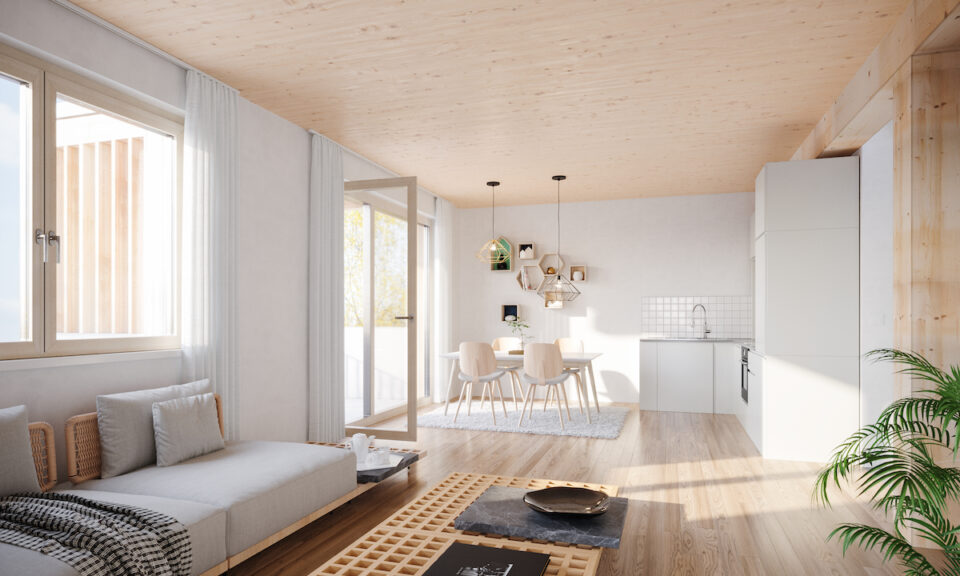
Back in Time Prague – Where history becomes a multisensory experience
8 thematically designed rooms take visitors on a multisensory journey through Prague’s history. Completed in 2025 in a repurposed retail space in the city centre.
LEARN MORE
Where History Becomes a Multisensory Experience
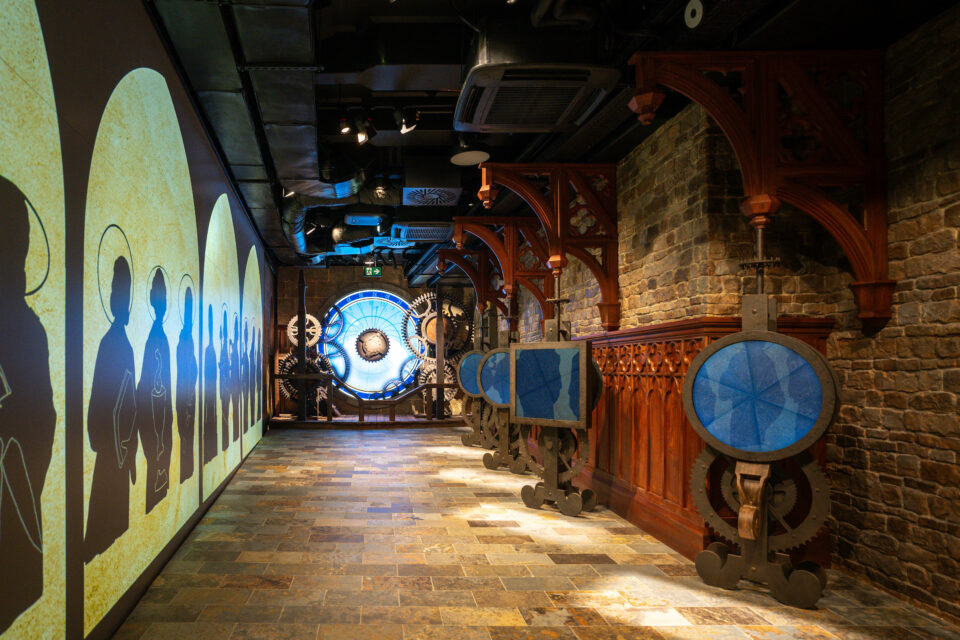
Eight rooms, 1,200 years of Prague and Czech history, around 250 steps: in the former Máj department store, „Back in Time Prague“ was created — a multimedia journey through time that combines historical storytelling, spatial staging, and entertainment.
This was made possible by collaboration among numerous creative and technical disciplines: Responsive Spaces developed the spatial experience design and dramaturgy, while Kraftwerk Living Technologies served as general contractor for the technical implementation. Added to this were the curatorial work of Marek Tajbl, video production by das narrativ, sound design by heimwerk.audio, as well as historical consulting, set construction, and further specialist planning.
We spoke with Markus Pargfrieder of Responsive Spaces about how a former retail space became a complex multimedia experience world — and what the project changed for the creative companies involved.
From Vacant Department Store to Tourist Attraction
The starting point was the former Máj department store in the center of Prague, whose upper floors could no longer be fully used as conventional retail space.
„You can no longer fill more than three or four floors with shops today. The market and the times simply don’t allow for that anymore,“ Pargfrieder describes the initial situation.
AMADEUS Real Estate’s developers therefore decided on a fundamental repositioning of the building. A grocery store remained in the basement; above it, four floors now house an attractive, modern shopping center with a food court. The floors above that include an amusement park, „Back in Time“ as a tourist attraction, „Heroes Park“ as a further exhibition, and, at the very top, a sky restaurant.
For the space that now houses „Back in Time,“ a co-working space was originally also under discussion. In the end, the decision was made in favor of an attraction that would bring additional visitors into the building and establish itself in the long term among the city’s well-known offerings. At the same time, it was meant to create a weather-independent addition away from Prague’s well-known hotspots, helping to distribute tourist flows more evenly.
Historical Accuracy Down to the Last Detail
The exhibition leads visitors from the founding legend of Prague through the era of Charles IV and the legend of the Golem to the Prague Uprising of May 1945.
„This historical accuracy was incredibly important,“ Pargfrieder emphasizes. „Even people who are deeply familiar with Prague’s history should experience the depictions as credible and coherent.“
This accuracy extended down to individual props and costume details. Historical engravings were consulted to determine how a figure’s clothing and jewelry actually looked — down to how many rings Charles IV wore on which hand.
For this expertise, Prague-born illustrator and historical consultant Jakub Prantl was brought on board. Czech curator Marek Tajbl took on an increasingly central role over the course of the project and became creative director for the content development. Filming involved, among others, three Czech actors, including those portraying Charles IV and master builder Peter Parléř.
Historical accuracy did not mean depicting only verified events. Legends such as that of the Golem are also part of Prague’s story. Where no clear historical depictions existed, the team had to develop a visual form that felt credible while still fitting the dramaturgy of the exhibition.
Many Trades, One Shared Dramaturgy
Beyond content and technology, the spatial realization was a discipline of its own. The eight rooms were designed to differ not only visually but also haptically: in the medieval section, visitors walk on cobblestones; later, the floor changes to wood. History becomes tangible in the most literal sense.
International and regional specialists were brought in for set construction — including a German company that normally produces artificial rock formations for luxury resorts in Dubai and Abu Dhabi, as well as a Czech company experienced in theatrical set building. In total, around 15 companies and trades were involved in the realization, ranging from structural engineering and interior fit-out to costume design, film production, sound, and media technology.
One room is dedicated to the Prague Uprising of May 1945. Its walls appear to be damaged, exposed brickwork, but are actually hand-painted concrete surfaces. Details like these show how closely spatial design, craftsmanship, and historical narrative are interwoven.
The building itself posed a particular planning challenge. The heritage-protected façade could only be altered within narrow limits, while a complex media-technology infrastructure had to be built inside. Ceiling heights, structural constraints, and the existing building fabric also placed clear limits on the design.
When Space, Film, Sound, and Technology Come Together
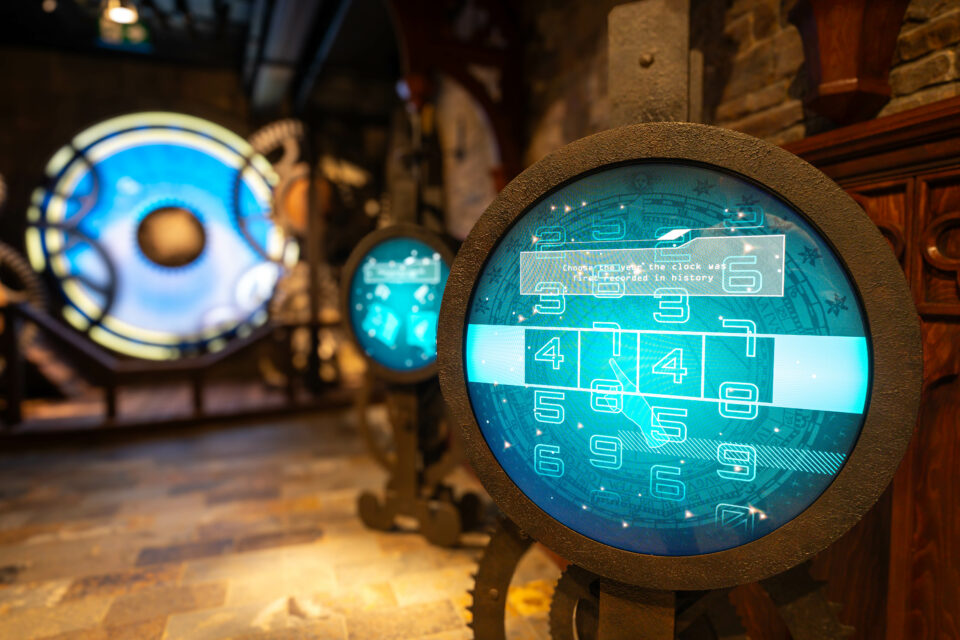
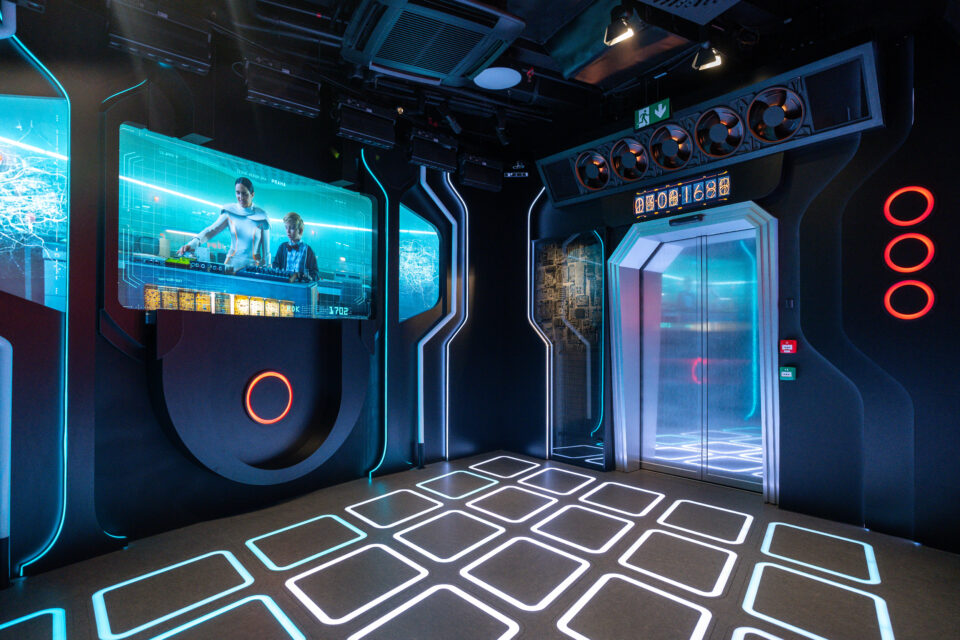
Kraftwerk Living Technologies realized „Back in Time“ as general contractor and was responsible for the technical implementation. This includes projection and LED systems, spatial sound, lighting effects, holographic elements, animatronics, scent and temperature effects, and a 5D cinema with moving seats.
Working closely with this, Responsive Spaces developed the spatial experience design — the interplay of space, media, narrative, and the movement of visitors through the exhibition. The task was to design each room individually and then weave them into a continuous dramaturgical journey.
Reference points included „Time Travel Vienna“ and the „Tirol Experience,“ both also Kraftwerk Living Technologies projects. Experience from these productions fed into the concept but was adapted to Prague’s history, the available spaces, and the expected visitor groups.
Film and sound were also integrated into the concept from the start. das narrativ was responsible for the video productions, heimwerk.audio for the sound design. Both had to be coordinated with the spatial design, the projection surfaces, and the timing of the experience. Here, a film works together with light, set, spatial sound, and movement.
The creative achievement therefore lay not only in the visible appearance. What mattered was the precise interplay of the individual elements. The technical and planning complexity recedes into the background for the audience, making room for emotion, shared wonder, and history brought to life. This takes the ambition well beyond that of a conventional exhibition:
„Back in Time completely redefines the concept of a museum: away from the traditional exhibition, toward a multisensory format that emotionally charges historical content,“ is how Responsive Spaces describes its own approach.
Visitor Flow as Part of the Design
Part of the creative planning also involved the question of how groups move through the eight rooms. The entire customer journey had to be designed so that visitors could intuitively follow the story while day-to-day operations continued to run smoothly.
Transitions, narrative pacing, and technical processes were coordinated so precisely that groups move from room to room without consciously noticing the underlying control system. Projections, sound, light, moving elements, and doors all have to respond at exactly the right moment.
This autonomously running group tour also shaped the possibilities for interaction. Too many individual decisions or varying dwell times would disrupt the fixed rhythm between groups. „Back in Time“ is therefore deliberately linear and narrative: visitors follow a shared story while the staging unfolds around them.
A New Field of Work for Responsive Spaces
For Responsive Spaces, „Back in Time“ meant an expansion of its previous field of work. While earlier projects were strongly geared toward interactive formats, the Prague experience is largely linear and narrative in structure.
„We learned that this, too, is a relevant field of work for us. It broadened our portfolio.“
In the process, Responsive Spaces designed not just individual media elements but their overarching connection to space, story, technology, and ongoing operations.
An important foundation for this was the close collaboration with Marek Tajbl. The direct coordination between spatial design and content dramaturgy enabled short decision paths and a shared development process for each room. From Pargfrieder’s perspective, this also created a model that could be applied again in future projects of this kind.
Working with the other Austrian and Czech partners also expanded the network for large-scale experience projects. Everyone involved gained experience in how different creative contributions can be developed in parallel and in close interdependence with one another.
Response and Outlook
Positive reviews on Google and TripAdvisor show that many visitors perceive the attraction as a coherent, carefully staged experience. What feels seamless to the audience rests on a multitude of technical, spatial, and dramaturgical decisions made behind the scenes.
Beyond the specific project, „Back in Time“ shows the potential that experience spaces, exhibitions, and contemporary museum formats hold for former retail spaces. Where large buildings can no longer be filled with shops alone, they create new reasons to visit and complement retail and dining with weather-independent offerings.
Inner-city department stores in particular offer promising conditions for this: central locations, large contiguous floor areas, and infrastructure designed for high visitor numbers. Multimedia experiences can open up such spaces anew while offering low-threshold access to history, culture, or other local themes.
The rollout potential therefore doesn’t lie in replicating „Back in Time“ identically. What is transferable is the underlying principle: vacant retail spaces become experience destinations whose content grows out of the history and identity of their specific location. The existing infrastructure in Prague could also be used in the future to tell further eras or new stories.
Link: Back in Time Prague: Interactive Museum Experience & Travel
Projects
Diamens – Diagnosis Using Menstrual Blood
“We Are So Free.” – Brewing Culture with Principles
LIT Special Call: Ars Electronica Festival – Making science tangible
Baumwerk Freistadt – A sustainable and affordable housing project
Back in Time Prague – Where history becomes a multisensory experience
České Budějovice – European Capital of Culture 2028
Treffpunkt Atelier – Studios Open Up Borders
lAiKa – Expanding Cultural Opportunities through Local Potential
Art in the City – Site Specific Lab – Art Where Life Happens
About the exhibition
České Budějovice – European Capital of Culture 2028
České Budějovice – European Capital of Culture 2028 uses culture, creativity and international cooperation to strengthen community life and regional identity in South Bohemia.
LEARN MORE
Treffpunkt Atelier – Studios Open Up Borders
Twelve artists from South Bohemia and Upper Austria opened their studios to each other, sparking new works, exhibitions and connections that continue today.
LEARN MORE
Link: Treffpunkt Atelier
lAiKa – Expanding Cultural Opportunities through Local Potential
lAiKa connects cultural practitioners, municipalities and schools across rural South Bohemia, turning scattered local potential into shared resources, plans and new collaborations.
LEARN MORE
Link: KreatIns.cz
Art in the City – Site Specific Lab – Art Where Life Happens
International artists turn public spaces across South Bohemia into site-specific art experiences. Free, accessible 24/7 and created in dialogue with local communities.
LEARN MORE
Link: www.umenivemeste.cz
Scoolpt Experimental Studio – When Concrete Gains a Soul
Scoolpt combines sculpture, architecture and robotic 3D concrete printing to create everything from urban furniture to entire buildings.
LEARN MORE
Link: https://www.scoolpt.com
About the exhibition
„Creativity Matters„
LEARN MORE
Creativity strengthens innovation, regional development and cross-border collaboration.
The exhibition Creativity Matters, part of the Interreg Austria–Czechia project KreATivita&InovaCZe, presents creative industry projects from Upper Austria and South Bohemia whose impact extends far beyond their respective fields.
Creativity opens up new perspectives for rural regions and creates space for new actors. It enables innovative production methods and makes research tangible.
Communication translates regional character into a strong brand identity.
Architecture helps make housing more affordable and climate-friendly.
Design makes medical diagnostics more gender-equitable.
In short: The projects introduce creative methods such as co-creation and prototyping into a wide range of sectors, strengthen regional identity and connect generations, disciplines and countries.
Here, impact means more than measurable figures. It is about lasting change—for people, places and different sectors. Together, the projects demonstrate how the creative industries, as a cross-sectoral field, drive innovation in the economy, society and the region as a whole.
Projects
Diamens – Diagnosis Using Menstrual Blood
“We Are So Free.” – Brewing Culture with Principles
LIT Special Call: Ars Electronica Festival – Making science tangible
Baumwerk Freistadt – A sustainable and affordable housing project
Back in Time Prague – Where history becomes a multisensory experience
České Budějovice – European Capital of Culture 2028
Treffpunkt Atelier – Studios Open Up Borders
lAiKa – Expanding Cultural Opportunities through Local Potential
Art in the City – Site Specific Lab – Art Where Life Happens
About the exhibition
Deutsche Version
Projekte
Diamens – Diagnose Menstruationsblut – Zukunft beginnt mit Zugang
“Wir sind so frei.” – Braukultur mit Haltung
LIT Sonder-Call Ars Electronica Festival – Wissenschaft erfahrbar machen
Baumwerk Freistadt – Nachhaltiges und leistbares Wohnprojekt
Back in Time Prague – Wo Geschichte zum multisensorischen Erlebnis wird
České Budějovice – Europäische Kulturhauptstadt 2028 – Kultur als Ökosystem
Treffpunkt Atelier – Ateliers öffnen Grenzen
lAiKa – Kultur stärken, wo sie übersehen wird
Art in the City – Site-Specific Lab – Kunst, wo das Leben stattfindet
Scoolpt Experimental Studio – Wenn Beton eine Seele bekommt
Über die Ausstellung
Diamens – Diagnose Menstruationsblut – Zukunft beginnt mit Zugang
Diamens entwickelt einen Endometriose-Test auf Basis von Menstruationsblut – mit dem Ziel, Diagnostik schneller, leichter zugänglich und konsequent an den Betroffenen orientiert zu machen.
MEHR ERFAHREN
Wie Diamens die Endometriose-Diagnostik neu denkt
Sieben Jahre. So lange dauert es durchschnittlich, bis bei Betroffenen Endometriose diagnostiziert wird. Sieben Jahre voller Unsicherheit, Schmerzen und oft frustrierender Arztbesuche.
Das Linzer Start-up Diamens möchte diesen Weg verkürzen. Die Gründerinnen entwickeln einen Test, der Endometriose anhand von Menstruationsblut diagnostizieren kann – einfach, niederschwellig und von zu Hause aus anwendbar. Doch hinter der Innovation steckt mehr als medizinische Forschung: Es geht auch um Design, Kommunikation und die Frage, wie man Frauen dort abholt, wo sie Antworten suchen.
Wir haben mit Mitgründerin Angelika Lackner über die Entstehung von Diamens, die Bedeutung nutzer*innenzentrierter Entwicklung und den gesellschaftlichen Impact des Projekts gesprochen.
„Wir haben festgestellt: Für Menstruationsblut gab es praktisch keine Standards.“
Wie ist die Idee zu Diamens entstanden?
Diamens steht für „Diagnose aus Menstruationsblut“. Der Ursprung der Idee lag in der wissenschaftlichen Forschung: Im Rahmen einer bioinformatischen Biomarker-Identifikationspipeline konnten potenzielle Biomarker für Endometriose identifiziert werden. Daraus entstand die Frage, wie diese möglichst patientinnenfreundlich genutzt werden könnten.
Das Gründerinnenteam beschäftigte sich daraufhin intensiv mit Menstruationsblut als diagnostischem Probenmaterial – und stellte fest, dass es hierfür praktisch keine etablierten Verfahren gab. „Für Hautproben, Haarproben oder verschiedenste Gewebearten gibt es standardisierte Laborprotokolle. Für Menstruationsblut gab es praktisch nichts.“
Diese Erkenntnis war der Ausgangspunkt für die Entwicklung einer Diagnostiklösung, die dort ansetzt, wo die Erkrankung ihren Ursprung hat: beim Menstruationszyklus selbst.
Aus der Kombination dieser beiden Erkenntnisse entstand die Idee, Menstruationsblut als bislang kaum genutztes diagnostisches Probenmaterial zu erschließen. Aufgrund seiner engen biologischen Verbindung zum Endometrium und den mit Endometriose verbundenen Prozessen bietet es großes Potenzial für eine nicht-invasive Diagnostik.
Ein Gesundheitsproblem mit langer Leidensgeschichte
Endometriose zählt zu den häufigsten gynäkologischen Erkrankungen. Dennoch dauert es oft Jahre, bis Betroffene Klarheit erhalten.
Symptome werden nicht immer sofort richtig eingeordnet, die Erkrankung kann selbst von erfahrenen Fachpersonen übersehen werden und viele Frauen durchlaufen zahlreiche Arzttermine, bevor überhaupt ein Verdacht geäußert wird. Noch immer gilt die operative Gewebeentnahme als Goldstandard für eine gesicherte Diagnose.
Genau hier setzt Diamens an: Der Test soll den Weg zur Abklärung deutlich verkürzen und Frauen sowie GynäkologInnen früher Antworten ermöglichen.
Wenn (Produkt-)Design Teil der Lösung wird
Das Ziel war von Anfang an, die Probenentnahme so einfach wie möglich zu gestalten. Die Nutzerinnen sollen den Test selbstständig anwenden können, ohne Unsicherheit oder Angst, etwas falsch zu machen. Die Erfahrungen aus der Pandemie haben gezeigt, dass viele Menschen heute bereits mit eigenständiger Probenentnahme vertraut sind.
Besonders wichtig ist dabei die Kommunikation: Anleitungen müssen verständlich sein, Prozesse intuitiv funktionieren und die Verpackung sowohl Vertrauen schaffen als auch regulatorischen Anforderungen entsprechen.
Für das Team bedeutet das, medizinische Komplexität auf das Wesentliche herunterzubrechen. Bildanleitungen spielen dabei eine ebenso wichtige Rolle wie die Gestaltung des Produkts selbst. Denn eine Innovation entfaltet ihren Nutzen erst dann vollständig, wenn Menschen sie im Alltag tatsächlich anwenden können.
Nutzerinnenzentrierte Entwicklung als oberste Prämisse
Im Zuge der Entwicklung des Tests wurden mehr als 350 Betroffene zu ihren Erfahrungen, Bedürfnissen und Erwartungen befragt. Zusätzlich holte das Team Feedback von hunderten weiteren Frauen ein, die selbst noch keine Endometriose-Diagnose erhalten hatten.
Diese Erkenntnisse flossen direkt in die Gestaltung des Produkts und der User Journey ein. Von der Probenentnahme über die Verpackung bis hin zur Kommunikation wurde konsequent aus Sicht der Anwenderinnen gedacht.
Der Bedarf ist dabei deutlich spürbar: Regelmäßig melden sich Frauen direkt beim Unternehmen, fragen nach dem Test oder möchten an Studien teilnehmen. Manche wollen sogar aktiv unterstützen. „Wie kann ich euch helfen?“ ist ein Kommentar, der öfter im entsprechenden Websiteformular hinterlassen wird.
Solche Rückmeldungen zeigen, wie groß der Wunsch nach besseren Diagnosemöglichkeiten ist.
Kommunikation als Brücke zwischen Forschung und Alltag
Genauso wichtig wie die Entwicklung des Tests ist die Frage, wie Betroffene überhaupt davon erfahren.
Deshalb setzt Diamens auf mehrere Kommunikationswege gleichzeitig: von Suchmaschinen und Online-Recherche über gynäkologische Praxen bis hin zu Fachkongressen und medizinischen Netzwerken.
Die Idee dahinter ist einfach: Frauen sollen dort erreicht werden, wo sie beginnen, nach Antworten zu suchen.
Gerade im Gesundheitsbereich zeigt sich, wie eng Innovation und Kommunikation miteinander verbunden sind. Selbst die beste Technologie kann ihren gesellschaftlichen Nutzen nur entfalten, wenn sie sichtbar, verständlich und zugänglich wird.
Eine frühe Diagnose führt zu besserer Lebensqualität
Der potenzielle Impact von Diamens reicht weit über die Diagnostik hinaus.
Eine frühere Diagnose kann dazu beitragen, Behandlungen früher zu beginnen, die Lebensqualität zu verbessern und langfristige Folgen der Erkrankung zu reduzieren. Gleichzeitig eröffnet sie neue Möglichkeiten für Forschung und Therapieentwicklung.
Besonders relevant ist das auch im Bereich Kinderwunsch. Viele Frauen erfahren erst im Rahmen einer Fruchtbarkeitsbehandlung, dass Endometriose die Ursache ihrer Beschwerden ist. Eine frühere Abklärung könnte hier wertvolle Zeit sparen.
Darüber hinaus verändert eine Diagnose auch die Art und Weise, wie über die Erkrankung gesprochen wird. Sie schafft Sichtbarkeit für Beschwerden, die lange als „normal“ abgetan wurden, und macht deutlich, dass starke Schmerzen während der Menstruation nicht selbstverständlich sein müssen.
Wie tief diese Erfahrungen oft reichen, zeigen auch Rückmeldungen von Betroffenen:
„Meine Mama hat es schon gehabt, sie hat sich jeden Monat übergeben vor Schmerz, aber es war halt normal für sie.“ zitiert Angelika Lackner die Aussage einer Betroffenen.
Genau solche Geschichten machen sichtbar, warum Aufklärung, Kommunikation und frühzeitige Diagnostik so eng miteinander verbunden sind.
„Danke, dass ihr das macht, was ihr macht.“
Besonders berührend sind für das Team die Nachrichten, die im Rahmen von Studien oder über die Website eingehen.
Zwischen den vielen Daten und Auswertungen finden sich immer wieder persönliche Kommentare von Frauen, die sich endlich mehr Aufmerksamkeit für das Thema wünschen.
„Danke, dass ihr das macht, was ihr macht.“
Für die Gründerinnen sind solche Rückmeldungen eine Bestätigung dafür, dass es hier auch um die Chance geht, einen lange bestehenden blinden Fleck in der Frauengesundheit sichtbar zu machen.
Der nächste Schritt
Aktuell arbeitet Diamens an der Zertifizierung des Produkts als Medizinprodukt. Das Unternehmen selbst ist bereits als Medizinprodukthersteller zertifiziert. Wenn die weiteren regulatorischen Schritte wie geplant verlaufen, soll der Test 2027 auf den Markt kommen.
Bis dahin bleibt die Vision dieselbe: den Weg zur Endometriose-Diagnose deutlich zu verkürzen und Frauen schneller die Antworten zu geben, die sie brauchen.
Diamens zeigt, dass der eigentliche Impact dort entsteht, wo Forschung, Design und Kommunikation zusammenspielen. Denn erst wenn medizinisches Wissen verständlich, zugänglich und alltagstauglich wird, kann es das Leben von Menschen nachhaltig verändern.
Link: Diamens Website
“Wir sind so frei.” – Braukultur mit Haltung
Gruppe am Park übersetzte die Unabhängigkeit und Mühlviertler Wurzeln von Freistädter Bier in eine starke Markenkampagne.
MEHR ERFAHREN
„Wir sind so frei“: Wie Freistädter Bier seine Marke weiterentwickelt, ohne ihre Wurzeln zu verlieren
Freistädter Bier hat etwas, das sich nicht einfach neu erfinden lässt: 250 Jahre Geschichte, eine starke Verankerung im Mühlviertel und eine Community, die eng mit der Marke verbunden ist. Als Freistädter Bier und die Agentur Gruppe am Park ihre Zusammenarbeit starteten, ging es deshalb nicht um einen radikalen Neustart. Es ging um die Frage: Wie lässt sich eine starke Marke weiterentwickeln, ohne das zu verlieren, was sie besonders macht?
Die Antwort darauf wurde „Wir sind so frei“. Ein Claim, der Unabhängigkeit, Regionalität und die Herstellungsprinzipien der Brauerei zu einer klaren Haltung verbindet und Freistädter damit bewusst von einem österreichischen Biermarkt abgrenzt, der stark von großen Konzernmarken geprägt ist. Frei von Gentechnik, frei von Zusätzen und ohne multinationalen Konzern im Rücken: Der Claim bringt auf den Punkt, was bereits Teil der Marke war, und schafft gleichzeitig Raum für ihre Weiterentwicklung.
Mit reduzierten Plakaten, pointierten Botschaften und einem Auftritt mit Ecken und Kanten wird diese Haltung konsequent in Kommunikation übersetzt. Vor allem aber rückt „Wir sind so frei“ jene Menschen stärker ins Zentrum, die Freistädter Bier seit jeher prägen.
Wir haben mit Paul Steininger von Freistädter Bier und Bernhard Buchegger von Gruppe am Park über behutsame Markenarbeit, gegenseitiges Vertrauen, mutige Entscheidungen und die Frage gesprochen, warum eine starke Community für eine regionale Brauerei weit mehr ist als ein Marketinginstrument.
Weiterentwickeln statt neu erfinden
Die Ausgangslage bedeutete für die Gruppe am Park: genau hinzusehen. Was funktioniert bereits? Was darf keinesfalls verloren gehen? Und wo kann man die Marke einen Schritt weiterführen?
„Die Ausgangssituation war insofern spannend, weil ein tolles Fundament schon da war. […] Wie können wir zum einen vorhandenes Potenzial nutzen und trotzdem einen Schritt draufsetzen, ohne dieses Fundament zu verlieren?“ so Bernhard Buchegger, Geschäftsführer Gruppe am Park, über die Kernfrage der Ausgangssituation.
Die Antwort lag nicht in einem radikalen Relaunch, sondern in vielen kleinen Entscheidungen. Von Typografie bis hin zur Art, wie die Produkte in Kampagnen inszeniert werden.
Von „Frisch, frei, Freistädter“ zu „Wir sind so frei“
Mit „Frisch, frei, Freistädter“ gab es bereits eine starke Positionierung. Sie blieb bestehen. Gruppe am Park erkannte darin aber noch ein weiteres Potenzial: das „frei“ stärker mit einem „wir“ zu verbinden.
„Für uns war das Community-Potenzial ein bisschen wie ein noch nicht gehobener Goldschatz.“
Daraus entstand „Wir sind so frei“. Der neue Claim setzt auf der bestehenden Markenpositionierung auf, öffnet sie aber gleichzeitig: für die Menschen im Unternehmen, für Fans der Marke, für die Region und ihren eigenen Charakter, ihre Ecken und Kanten.
Dass gerade Freistädter dafür besondere Voraussetzungen mitbringt, liegt auch in der Geschichte der Brauerei. Die Braucommune Freistadt ist aus einer Gemeinschaft heraus entstanden. Community, lange bevor jemand diesen Begriff im Marketing verwendet hätte.
„Es gibt kaum eine andere Biermarke, die das Thema Community so in der DNA verankert hat wie Freistädter. Wenn man so will, eine Community seit 250 Jahren.”
Wie weit darf man gehen?
Eine etablierte Marke weiterzuentwickeln bedeutet immer auch, Grenzen auszuloten. Wie viel Veränderung verträgt sie? Wann ist ein Schritt zu klein, um überhaupt wahrgenommen zu werden und wann so groß, dass Menschen ihre Marke plötzlich nicht mehr wiedererkennen?
Genau darüber wurde intensiv diskutiert. Selbst scheinbar kleine Fragen wurden relevant: Wie stark verändert man die Typografie? Muss auf einem Sujet immer das komplette Produkt zu sehen sein? Und könnte man sogar das charakteristische Grün zurücknehmen?
Bei Letzterem war die Antwort schnell klar.
„Bei der Frage, ob wir das Grün zurücknehmen, haben wir sofort gesehen: das wäre absoluter Wahnsinn, wenn man so etwas machen würde.“
Stattdessen begann die Linzer Agentur, innerhalb des bestehenden Markensystems freier zu spielen. Wo früher häufig der klassische Packshot im Zentrum stand, werden heute unterschiedliche Ausschnitte und Produkte inszeniert. Bei einem digitalen Citylight ging man noch einen Schritt weiter: zunächst kein Produkt, nur eine Headline auf Grün.
„Wir sind schon so eine starke Marke, wir trauen uns zu, dass die Leute uns identifizieren, auch wenn wir nicht einmal das Produkt darstellen.“
Vertrauen als Voraussetzung
Das Wort “Vertrauen” zieht sich durch das gesamte Gespräch. Denn gerade eine evolutionäre Markenentwicklung verlangt von beiden Seiten Sensibilität.
Für Freistädter bedeutet das, die eigene Marke ein Stück weit in die Hände externer Kreativer zu legen. Für Gruppe am Park wiederum bedeutet es, das vorhandene Wissen und die Verbundenheit des Unternehmens mit seiner Marke ernst zu nehmen.
„Das ist auch für uns natürlich ganz wichtig, dass wir hier Profis an der Seite haben, denen wir im Prozess voll vertrauen können.“, so Paul Steininger, Geschäftsführer von Freistädter Bier.
Dabei half es, Veränderungen früh sichtbar zu machen. Gruppe am Park arbeitet bewusst mit Visualisierungen verschiedener Varianten, vom vorsichtigen bis zum mutigeren Schritt. So lässt sich gemeinsam diskutieren, welche Chancen eine Veränderung eröffnet und an welcher Stelle etwas verloren gehen könnte.
Bernhard Buchegger sieht den Erfolg deshalb ausdrücklich als gemeinsame Leistung: „Es braucht beide Seiten, sonst kann es nicht funktionieren.“
Denn Werbung ist ein Feld, zu dem fast jede*r eine Meinung hat. Umso wichtiger ist eine gemeinsame strategische Linie, von der man sich auch durch unterschiedliche Rückmeldungen nicht vorschnell abbringen lässt.
Ein Mural als erster großer Vertrauensbeweis
Wie gut dieses Zusammenspiel funktionieren kann, wurde schon früh in der Zusammenarbeit sichtbar. An einer großflächigen Hauswand an einer Linzer Einfahrtsstraße entstand ein Mural, bei dem eine Freistädter-Flasche scheinbar aus der Ziegelwand bricht.
Die Idee wurde zu einem frühen „Match“ zwischen Brauerei und Agentur. Gleichzeitig war die Umsetzung ein großes Investment und eine für die Region noch ungewöhnliche Werbeform. Intern wurde das Mural zu einem wichtigen Signal für den neuen Weg. Manche Mitarbeiter*innen fuhren sogar eigens hin, um sich das fertige Werk anzusehen.
Wenn Menschen von selbst über Werbung sprechen
Die Reaktionen auf die Weiterentwicklung erlebt Steininger vor allem unmittelbar. Er beobachtet neben der positiven Geschäftsentwicklung vor allem, wie Menschen auf die Kommunikation reagieren. Und dabei sei besonders auffällig, dass Rückmeldungen häufig ungefragt kommen. „Das kommt nicht auf die Frage: ‚Ja, und wie gefällt dir das Plakat?‘, sondern von den Menschen selber, die sagen: ‚Eure Werbung ist super, das gefällt mir.’”
Die Wiedererkennbarkeit zieht sich dabei über unterschiedliche Kanäle, von Plakat und Social Media bis zu den LKWs der Brauerei. Gerade das Freistädter Grün sorgt dafür, dass die Marke oft schon aus großer Entfernung erkennbar ist.
Auch digital zeigt sich Bewegung: 60,3% mehr Follower auf Instagram (Vergleich 2024-25), eine fast 50% höhere Interaktionsrate und eine Steigerung der Reichweite um mehr als 170%. Dazu kommen Auszeichnungen aus der Kommunikationsbranche, unter anderem ein German Brand Award in Gold für die Markenarbeit (Kategorie Brand Strategy – B2C).
Doch der vielleicht nachhaltigste, nicht unmittelbar messbare Impact liegt tiefer: in der emotionalen Bindung an die Marke.
Von der Biermarke zur Community
Diese Bindung war von Beginn an Teil der Strategie. Im zweiten Jahr der Zusammenarbeit wurde der Community-Gedanke deshalb noch konsequenter weitergeführt.
Eine bereits vorhandene App, die bislang vor allem für Informationen wie das Mittagsmenü des Brauhauses genutzt worden war, wurde zu einem Community-Tool weiterentwickelt. Unter dem Namen VIB 1777 (VIB steht hier für Very Important Biertrinker 😉 bekommen Fans der Marke eine eigene Plattform mit Events, Gewinnspielen, Gamification und weiteren Angeboten.
Dabei geht es nicht darum, künstlich eine Community zu erfinden. Sie ist längst da.
„Wenn es uns gelingt, dieser Community, die ja eigentlich schon vorhanden ist, noch eine Plattform und eine Bühne zu bieten, so dass sie sich noch intensiver verbunden fühlen, […] dann wären wir ungeschickt, das nicht zu machen.“
Community lässt sich nicht beliebig über jede Marke stülpen. Sie funktioniert dort, wo Menschen ohnehin eine Haltung, Geschichte und Identität mit einer Marke verbinden. Und diese Verbindung ist bei Freistädter durchaus handfest: Fans tragen Shirts und Radtrikots der Brauerei, kleben Sticker auf ihre Autos und suchen Kontakt, wenn sie umziehen und ihr Freistädter Bier am neuen Wohnort plötzlich nicht mehr bekommen.
Markenbindung als wirtschaftlicher Faktor
Für eine regionale Privatbrauerei ist diese Loyalität mehr als ein schöner Nebeneffekt. Sie ist Teil der wirtschaftlichen Grundlage.
Mit den Preisen und der Marktmacht großer Brauereikonzerne kann und will Freistädter nicht auf dieselbe Weise konkurrieren. Entscheidend ist deshalb, dass Menschen nicht bei jedem Einkauf neu vergleichen, welches Bier gerade in Aktion ist.
„Wir leben davon, dass Leute beim Einkauf sagen: ‚Ja, wir kaufen eine grüne Freistädter Bierkiste und wir schauen jetzt gar nicht, was in Aktion ist.‘“
Die Community-Arbeit wird damit zu langfristiger Markenarbeit. Ihr Effekt zeigt sich nicht zwangsläufig unmittelbar nach einer einzelnen Kampagne oder Maßnahme.
„Das sind alles Entscheidungen, die keine sofort messbaren Impact auslösen, sondern ein stetiges Steigen vom Markenwert oder der emotionalen Aufladung einer Marke.“
Eine starke Marke mit Raum für Humor
„Wir sind so frei“ funktioniert dabei als Klammer für diese Entwicklung. Der Satz lässt Raum für den Mühlviertler Charakter, für Humor und kurze Botschaften mit Augenzwinkern, für unterschiedliche Menschen und Produkte. Gleichzeitig bleibt das Fundament bestehen: das Grün, die Geschichte, die regionale Verankerung, die Unabhängigkeit und „Frisch, frei, Freistädter“.
Vielleicht liegt genau darin die Stärke der Zusammenarbeit zwischen Freistädter Bier und Gruppe am Park: gemeinsam herauszufinden, an welchen feinen Hebeln man drehen kann, damit sich eine starke Marke weiterentwickelt und trotzdem unverkennbar sie selbst bleibt. Dafür braucht es ein Gespür für das Bestehende, den Mut, Neues auszuprobieren und vor allem das Vertrauen, diesen Weg gemeinsam zu gehen.
Link: Gruppe am Park Werbeagentur | Braucommune Freistadt Kampagne
LIT Sonder-Call Ars Electronica Festival – Wissenschaft erfahrbar machen
Der LIT Sonder-Call bringt Forscher*innen, Studierende und Künstler*innen zusammen, um komplexe Forschung für das Ars Electronica Festival interaktiv erlebbar zu machen.
MEHR ERFAHREN
Wenn Wissenschaft auf Kunst trifft: Wie der LIT Sonder-Call Forschung erlebbar macht
Was passiert, wenn Wissenschaft die Labor- und Konferenzwelt verlässt und auf Künstler*innen, Festivalpublikum und völlig neue Perspektiven trifft? Seit 2020 bringt der LIT Sonder-Call der Johannes Kepler Universität Linz genau diese Welten zusammen. Forschende und Studierende entwickeln gemeinsam mit Künstler*innen Projekte für das Ars Electronica Festival. Mit einem Anspruch, der über klassische Wissenschaftskommunikation hinausgeht.
Denn hier geht es nicht darum, Forschung nachträglich hübsch zu verpacken. Es geht darum, etwas entstehen zu lassen, das keine der beteiligten Disziplinen alleine hätte entwickeln können.
Wir haben mit Gregor Pechmann und Denise Atteneder, dem Team hinter dem LIT Sonder-Call darüber gesprochen, warum Wissenschaft den Elfenbeinturm verlassen muss, was Kunst dabei verändern kann und warum ein Festival mit einer unverrückbaren Deadline manchmal genau der richtige Ort für Experimente ist.
Wissenschaft raus aus dem Labor
Als der JKU Campus 2020 erstmals zu einem Hauptschauplatz des Ars Electronica Festivals wurde, sollte die Universität nicht nur Raum zur Verfügung stellen, sondern sich auch inhaltlich einbringen. Der LIT Sonder-Call entstand vor dem Hintergrund der sogenannten „Third Mission“ von Universitäten: Neben Forschung und Lehre gehört auch der Transfer von Wissen in die Gesellschaft zu ihren Aufgaben.
Der Call sollte dafür eine neue Plattform schaffen.
„Wissenschaft soll nicht einfach nur zum Selbstzweck da sein. Es geht sehr viel um die dritte Mission einer Universität. Die erste ist forschen, die zweite ist lehren, und die dritte: eben diesen Wissenstransfer an die Öffentlichkeit zu ermöglichen.“, so Gregor Pechmann.
Dafür werden Wissenschaftler*innen und Studierende der JKU eingeladen, Projekte einzureichen, die beim Ars Electronica Festival präsentiert werden. Der Call ist bewusst für alle Disziplinen offen, denn auch wenn man bei Ars Electronica schnell an AI, Computer oder Robotik denkt, soll in diesem Rahmen gerade die Vielfalt wissenschaftlicher Themen sichtbar werden.
Mehr als „Kunst, mach etwas schön!“
Entscheidend dabei ist die Zusammenarbeit zwischen Wissenschaft und Kunst. Denn der kreative Anteil soll nicht erst am Ende eines Forschungsprozesses dazukommen, um Daten schöner zu visualisieren oder einer fertigen Idee eine attraktive Form zu geben.
„Es geht nicht nur darum, etwas aufzuhübschen, z.B. Daten schön zu visualisieren, sondern dass sich Künstler*innen und Wissenschaftler*innen gegeneinander so befruchten, dass etwas ganz Neues entsteht.“
Genau diese Verschränkung ist inzwischen auch ein wesentliches Auswahlkriterium. Während beim ersten Call noch eine große Zahl an Projekten unterstützt wurde, hat sich der Fokus über die Jahre stärker von Quantität zu Qualität verschoben. 2026 werden sechs Projekte über den LIT Sonder-Call umgesetzt.
Was Kunst dabei einbringen kann, zeigt sich für das Team vor allem dort, wo wissenschaftliche Fragestellungen um gesellschaftliche und emotionale Dimensionen erweitert werden.
„Kunst ist viel mehr direkt ‘am Menschen’ bzw. kann auch andere Emotionen herausbringen, als die Wissenschaft alleine.“
Wenn aus einer Idee etwas völlig Neues wird
Wie sehr sich Projekte durch diesen Austausch im Laufe der Frist bis zum Festival verändern können, zeigt ein aktuelles Projekt aus der Humangenetik. Ausgangspunkt war die Frage, wie stark sich aus unserer DNA rekonstruieren lässt, wie ein Mensch aussieht. Bereits 2025 beschäftigte sich das Projekt damit, dass unser Erscheinungsbild eben nicht nur durch Gene geprägt wird, sondern auch durch Umwelt, Verhalten und Erfahrungen.
In der Weiterentwicklung für 2026 kam durch die Zusammenarbeit mit einer Künstlerin eine neue gesellschaftliche Fragestellung hinzu: Ist Gewalt etwas, das in unseren Genen liegt oder etwas, das durch Erfahrungen und unser soziales Umfeld entsteht?
Die Installation übersetzt diese Frage unter anderem in veränderte Gesichter. Besucher*innen können Erfahrungen eingeben – positive ebenso wie negative –, die anschließend visuell auf Gesichter von Projektbeteiligten mittels Videoinstallation übertragen werden. Parallel dazu wird DNA musikalisch übersetzt.
Das Projekt zeigt damit exemplarisch, was der LIT Sonder-Call erreichen möchte: Eine wissenschaftliche Ausgangsfrage wird durch die künstlerische Perspektive erweitert und neu verhandelt.
Elf Monate zwischen Antrag und Festival
Von der Einreichung bis zur Präsentation am Ars Electronica Festival liegen rund elf Monate. Nach der Ausschreibung haben Interessierte zunächst mehrere Monate Zeit, ihre Ideen einzureichen. Das Organisationsteam unterstützt bei Anträgen, vermittelt Kontakte zu Künstler*innen und anderen Institutionen und begleitet die Projekte anschließend durch das Auswahlverfahren. Bei einem Hearing präsentieren die Teams ihre Vorhaben einer hochkarätigen Jury.
Doch der Antrag ist selten das fertige Projekt.
„Dieser Weg zwischen der Stellung des Antrags, der vielleicht auch noch eher flapsig formuliert ist oder noch sehr viele offene Fragen beinhaltet, bis zur tatsächlichen Umsetzung, ist ein ganz spannender Prozess, den wir da verfolgen dürfen.“
Manche Projekte verändern sich sogar noch in den letzten Wochen vor dem Festival. Räume stehen erst später fest, technische Voraussetzungen ändern sich, Kooperationen entwickeln sich anders als geplant.
Eine Sache ist allerdings nicht verhandelbar: Zum Festival muss etwas stehen.
Mehr als 55 Projekte wurden seit 2020 bereits umgesetzt. Und trotz aller Unwägbarkeiten konnten bislang alle etwas präsentieren.
Wissenschaftler*innen als Menschen zeigen
Wie Wissenschaftskommunikation aussehen kann, hat das Team auch selbst erprobt. 2025 entstand mit „Into the JKUniverse – Science starts with you“ eine Begegnungszone am Festival, die Wissenschaft näher an das Publikum bringen sollte.
Mit Formaten wie „Meet the Scientist” ging es bewusst darum, sichtbar zu machen, wer die Menschen hinter der Wissenschaft eigentlich sind. Das Publikum blickte dabei hinter die akademischen Titeln und Institutsbezeichnungen der Professor*innen. Hinter der wissenschaftlichen Fassade kamen plötzlich Menschen mit Hobbys, Lieblingsfarben, Hoffnungen und Träumen zum Vorschein. Oder jemand, der zu Hause Ziegen hält und selbst Apfelsaft macht.
„Wenn man diese menschliche Ebene für sich realisiert, hat man gleich mehr Vertrauen zu dem, was diese Menschen sagen.“
Gerade in Zeiten zunehmender Wissenschaftsskepsis ist diese persönliche Ebene entscheidend.
Quantenphysik für alle
Dass selbst hochkomplexe Themen zugänglich werden können, zeigt ein Projekt aus dem Jahr 2024. Durch Quantenverschränkung erzeugte Daten wurden in Noten übersetzt und von zwei Organisten im Linzer Mariendom gespielt. Ein Thema also, das auf den ersten Blick kaum nach niedrigschwelliger Wissenschaftskommunikation klingt.
Doch genau darin liegt eine besondere Qualität der Projekte: Beim Ars Electronica Festival treffen internationale Expert*innen auf Familien, Kinder, Kunstinteressierte und zufällige Besucher*innen. Die Zielgruppe ist, wie es im Gespräch heißt, schlicht „alle“.
Und trotzdem, oder gerade deshalb, gelingt es den Projektteams immer wieder, ihre Arbeit auf ganz unterschiedlichen Ebenen zu vermitteln.
„Die Teams können innerhalb von 30 Sekunden umswitchen und die gleiche Installation […] in ein ganz anderes Erlebnis je nach Zielgruppe verwandeln.“
Die Forschenden selbst sind deshalb während des Festivals vor Ort. Nicht nur, um ihre Installation zu erklären, sondern um über ihre Forschung zu sprechen, Fragen zu beantworten und in direkten Austausch mit den Besucher*innen zu kommen.
Ein bisschen Culture Clash gehört dazu
Dabei treffen nicht nur Wissenschaft und Kunst aufeinander. Auch JKU und Ars Electronica funktionieren nach unterschiedlichen Logiken. Das Team des LIT Sonder-Calls sitzt genau dazwischen. Es koordiniert, übersetzt, vermittelt, löst technische und organisatorische Probleme und begleitet die Projekte von den ersten Informationsgesprächen bis zur fertigen Installation.
Dass das manchmal an Troubleshooting oder Feuerwehrarbeit erinnert, gehört dazu. Gleichzeitig ist über die Jahre eine eigene LIT-Community entstanden. Projektteams tauschen sich aus, helfen einander beim Aufbau oder leihen sich gegenseitig Material.
„Sie wissen auch, dass sie sich auf uns verlassen können und dass sie bei Fragen nicht alleine sind. Ich glaube, das macht auch diesen Call sehr einzigartig.“ meint Denise Atteneder.
Wirkung, die sich nicht immer in Zahlen messen lässt
Wie misst man aber, ob Menschen nach einem Festivalbesuch weniger wissenschaftsskeptisch sind? Oder ob eine Installation tatsächlich langfristig verändert, wie jemand über Forschung denkt?
Einfach ist das nicht.
„Es gibt keine Messung, ob die Menschen jetzt mehr oder weniger Wissenschaftsskepsis haben, nachdem sie das Ars Electronica Festival besuchen.“
Ein Teil der Wirkung zeigt sich deshalb an anderer Stelle: innerhalb der Universität selbst. Die Zahl und Qualität der Einreichungen hat sich über die Jahre entwickelt, Forschende warten inzwischen auf den nächsten Call und Wissenschaftskommunikation gewinnt neben klassischen wissenschaftlichen Kennzahlen zunehmend an Bedeutung.
Der LIT Sonder-Call schafft somit auch einen Anlass, Forschung anders zu denken: Was bedeutet die eigene Arbeit außerhalb des wissenschaftlichen Systems? Wie lässt sie sich mit Menschen diskutieren, die keine Expert*innen sind? Und was passiert, wenn eine andere Disziplin plötzlich Fragen stellt, die man selbst nicht gestellt hätte?
Besonders für Studierende eröffnet der Call die Möglichkeit, eigene Forschungsinteressen in einem außergewöhnlichen Kontext weiterzuentwickeln und bei einem der international bekanntesten Festivals für Medienkunst zu präsentieren.
„Es geht tatsächlich um den Austausch mit der Bevölkerung und nicht nur: ‚Ich mache etwas, um zitiert zu werden.‘“
Wenn nach fünf Tagen plötzlich alles vorbei ist
Nach elf Monaten Entwicklung, unzähligen Abstimmungen und einer intensiven Aufbauphase dauert das eigentliche Festival fünf Tage. Danach wird innerhalb weniger Tage wieder abgebaut.
Was bleibt, ist trotzdem mehr als eine Installation.
Projekte werden weiterentwickelt oder andernorts gezeigt, aus gewonnenen Daten entstehen wissenschaftliche Arbeiten, Kontakte bleiben bestehen und manche Teams reichen beim nächsten Call erneut ein.
Vor allem aber bleibt der Moment, wenn aus einer Idee tatsächlich etwas geworden ist.
Vielleicht erklärt das auch die im Gespräch augenzwinkernd erwähnte „Post-Ars Electronica-Depression“: Nach Monaten voller Deadlines, Culture Clashes, Lösungen in letzter Sekunde und gemeinsamer Arbeit ist plötzlich alles vorbei.
Bis zum nächsten Call.
Link: LIT Sonder-Call: Ars Electronica Festival 2025 | LIFT_C, LIT – Linz Institute of Technology
Baumwerk Freistadt – Nachhaltiges und leistbares Wohnprojekt
28 leistbare Mietwohnungen, fast vollständig aus Holz gebaut, zeigen, wie klimafreundliches Bauen und urbanes Wohnen zusammenpassen.
MEHR ERFAHREN
Wie das Baumwerk nachhaltiges Wohnen leistbar macht
480 Kubikmeter Holz wurden für das Baumwerk in Freistadt verbaut. Entstanden sind 28 Mietwohnungen, die klimabewusste Bauweise, hohe Wohnqualität und ortsübliche Mietpreise miteinander verbinden.
Das Projekt entwickelte sich im Zusammenspiel der Landwirtschaftskammer Oberösterreich mit Tp3 Architekten, regionalen Holzbauunternehmen, Fachplaner*innen und Kommunikationsdesigner*innen. Wir haben mit Andreas Henter von Tp3 darüber gesprochen, wie die unterschiedlichen Kompetenzen zusammenfanden und warum das Baumwerk inzwischen auch für andere Gemeinden interessant ist.
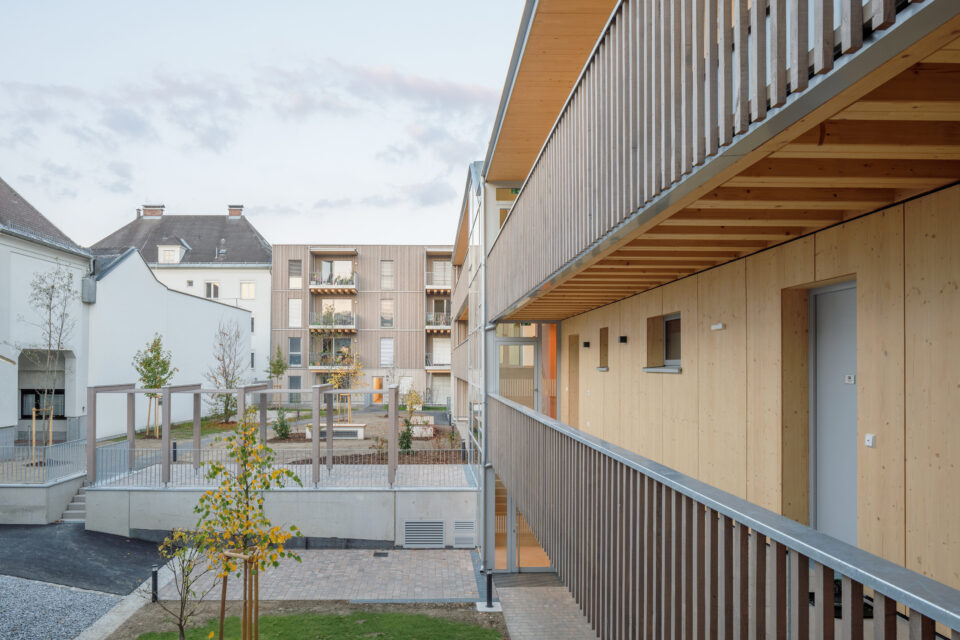
Eine gemeinsame Haltung als Ausgangspunkt
Auf dem Gelände der ehemaligen Landwirtschaftskammer in Freistadt, das zuletzt vor allem als Parkplatz genutzt wurde, sollte neuer Wohnraum entstehen. Im Rahmen eines Planungsverfahrens entwickelte Tp3 Architekten die Idee für einen mehrgeschossigen Holzbau. Die Landwirtschaftskammer Oberösterreich griff diesen Ansatz auf und verband ihn mit einem klaren Anspruch: Nachhaltigkeit sollte das gesamte Projekt prägen: ökologisch, wirtschaftlich und sozial.
„Die Herausforderung beginnt, wenn die Auftraggeberin sagt: Wir wollen wirklich einen nachhaltigen Wohnbau bauen“, erzählt Andreas Henter. „Wenn sie das ernst nimmt, müssen wir es auch konsequent umsetzen. Und genau das ist das Schöne daran.“
Damit war eine gemeinsame Grundlage geschaffen. Tp3 entwickelte und prüfte unterschiedliche räumliche Lösungen. Holzbauunternehmen, Statik, Bauphysik, Brandschutz und Projektmanagement überführten den Entwurf in umsetzbare Konstruktionen. Der Gestaltungsbeirat brachte eine weitere Perspektive in die Anordnung der Gebäude ein. Für die regionale Beschaffung des Holzes entstand gemeinsam mit juristischer Unterstützung ein passendes Vergabemodell. Die Agentur Fredmansky übersetzte die Besonderheiten des Projekts schließlich in einen Namen, ein Erscheinungsbild und eine verständliche Erzählung.
Holz als konsequente Entscheidung
Die neuen Gebäude wurden weitgehend in Holzriegelbauweise errichtet. Holz prägt die Tragstruktur, die Innenräume und die Fassade; lediglich die Tiefgarage und die Stiegenhauskerne bestehen aus Stahlbeton. Sichtbare Stützen, Träger und Oberflächen machen den Baustoff auch für die Bewohner*innen unmittelbar erlebbar.
Der mehrgeschossige Holzbau erforderte eine enge Zusammenarbeit der beteiligten Unternehmen. Fragen zu Statik, Schallschutz, Brandschutz und Bauphysik wurden gemeinsam mit den beteiligten Fachleuten und Obermayr Holzkonstruktionen gelöst. Dabei traf architektonischer Anspruch auf handwerkliche Erfahrung und regionales Produktionswissen.
„Man beginnt gemeinsam zu überlegen: Wie kann man das als Holzbau umsetzen? Dann wird der Vorschlag geprüft und mit Statik, Brandschutz und Bauphysik abgestimmt“, beschreibt Henter den Prozess. „Die Betriebe und das Know-how sind in der Region vorhanden. Man muss sie nur zusammenbringen.“
Dabei entstand Erfahrungswissen, das auch für weitere Vorhaben nutzbar ist.
Verdichtung schafft neuen Freiraum
Das Baumwerk nutzt eine bereits erschlossene Fläche im Zentrum von Freistadt. Stadtzentrum, Busbahnhof, Schulen und Nahversorgung sind zu Fuß erreichbar. Gleichzeitig wurde der zuvor versiegelte Innenbereich begrünt und als gemeinsamer Freiraum neu gestaltet.
Im Entwurfsprozess prüfte Tp3 unterschiedliche Anordnungen und entwickelte sie gemeinsam mit der Landwirtschaftskammer und dem Gestaltungsbeirat weiter. Die Entscheidung, die Mitte freizuhalten und die Gebäude an den Rändern zu konzentrieren, schuf einen geschützten Hof mit Grünflächen und Wegen.
Henter beschreibt diese Entwicklung als „Pingpong-Spiel“: Vorschläge wurden präsentiert, diskutiert, überprüft und verdichtet. Die Beteiligten konnten nachvollziehen, welche Möglichkeiten weiterverfolgt wurden und warum. So entstand die räumliche Lösung nicht als fertiger Einzelentwurf, sondern Schritt für Schritt im Austausch.
Die Gliederung in mehrere verbundene Baukörper gibt der Anlage einen überschaubaren Maßstab. „Einzelne, untereinander in Verbindung stehende Baukörper vermitteln das Gefühl einer dörflichen Struktur“, erklärt Henter. Laubengänge, Sichtbeziehungen und der gemeinsame Grünraum schaffen Gelegenheiten für Begegnung. Balkone, Eigengärten und klar definierte private Bereiche bieten zugleich Rückzugsmöglichkeiten. Heute wohnen hier Menschen unterschiedlicher Generationen.
Klimabewusst wohnen zu ortsüblichen Preisen
Der ökologische Anspruch wurde von Beginn an mit der Frage der Leistbarkeit verbunden. Die 28 Wohnungen werden zu ortsüblichen Mietpreisen angeboten. Dafür nahm die Landwirtschaftskammer eine längere Amortisationszeit in Kauf, anstatt die zusätzlichen Investitionen unmittelbar über höhere Mieten weiterzugeben.
„Klimabewusste Architektur in Holzbauweise muss nicht einer kleinen Elite vorbehalten sein, sondern ist für alle möglich.“
Auch der Strom der Photovoltaikanlage auf dem Gründach kommt den Bewohner*innen direkt zugute. Die Anlage umfasst 133 Module mit einer Leistung von 55,25 kWp. Ergänzt wird sie durch eine zentrale Hackschnitzelheizung.
Die große Nachfrage bestätigte den Ansatz: Alle Wohnungen waren lange vor der Fertigstellung vergeben. Für Henter ist das ein wichtiges Signal. Ökologische Qualität, ein attraktives Wohnumfeld und leistbare Mieten können einander ergänzen, wenn sie früh gemeinsam gedacht und von den Verantwortlichen mitgetragen werden.
Wirkung durch viele abgestimmte Entscheidungen
Die Klimabilanz des Baumwerks entsteht aus dem Zusammenspiel von Standort, Material, Konstruktion, Energieversorgung und Freiraumgestaltung. Insgesamt wurden rund 480 Kubikmeter Holz verbaut. Darin bleiben etwa 480 Tonnen CO₂ langfristig gespeichert. Laut Projektberechnung verursacht die Ausführung rund 52 Prozent weniger Treibhausgase als eine vergleichbare mineralische Bauweise.
Auch die Herkunft des Baustoffs war Teil der Planung. Für die Ausschreibung wurde gemeinsam mit juristischer Unterstützung ein Bewertungssystem entwickelt, das kurze Transportwege berücksichtigt. Das eingesetzte Holz stammt aus dem Hausruckviertel und dem Salzkammergut, aus einer Entfernung von rund 100 Kilometern. Die verbaute Menge wächst in Österreichs Wäldern innerhalb weniger Minuten nach.
Der hohe Vorfertigungsgrad ermöglichte eine präzise Herstellung und effiziente Montage. Begrünte Flächen, das Gründach und wiederverwertbare Bauteile ergänzen das Konzept.
Die Zahlen machen den ökologischen Impact sichtbar. Zugleich verweisen sie auf konkrete Entscheidungen: kurze Transportwege, eine weitgehend hölzerne Konstruktion, erneuerbare Energie und die Nutzung einer zentral gelegenen, bereits erschlossenen Fläche. Ihre Wirkung entsteht, weil diese Maßnahmen von Planung, Auftraggeberin, ausführenden Unternehmen und Fachdisziplinen aufeinander abgestimmt wurden.
Ein Name macht die Idee zugänglich
Die Zusammenarbeit endete nicht mit Planung und Bau. Gemeinsam mit Fredmansky entstanden der Name „Baumwerk“, das Erscheinungsbild und eine Broschüre, die das Projekt über Fachkreise hinaus verständlich macht.
„Mit dem Namen Baumwerk war es auf einmal etwas anderes“, sagt Henter. „Es wurde greifbar und hat sofort Bilder im Kopf ausgelöst.“
Die Kommunikation übersetzt technische, ökologische und architektonische Inhalte in eine zugängliche Erzählung. Damit unterstützt sie die Vermietung und vermittelt zugleich Wissen über zeitgemäßen Holzbau. Die Broschüre richtet sich an Bewohner*innen ebenso wie an Gemeinden, politische Entscheidungsträger*innen, Forstwirt*innen und künftige Projektverantwortliche.
So erhielt das Gebäude eine Identität, die über den Standort hinauswirkt. Das Kommunikationsdesign macht nachvollziehbar, wie das Gebäude funktioniert, warum bestimmte Entscheidungen getroffen wurden und welchen Nutzen sie bringen. Aus einem komplexen Bauprojekt wurde damit ein Beispiel, das sich vermitteln und weitertragen lässt.
Vom Wohnprojekt zum Vorbild
Heute interessieren sich Gemeinden und Bürgermeister*innen dafür, wie das Baumwerk realisiert wurde. Sie besuchen das Gebäude, sprechen mit den Beteiligten und nehmen Erfahrungen für eigene Vorhaben mit. Auch Tp3 nutzt das Projekt in Gesprächen als anschaulichen Beleg dafür, dass mehrgeschossiger Holzbau im Ortszentrum funktionieren und leistbar bleiben kann.
„Es rufen Bürgermeister*innen bei uns an und fragen: Wie habt ihr das gemacht? Das ist schwer in Zahlen zu messen, aber man merkt, dass das Projekt etwas auslöst.“
Der OÖ Holzbaupreis 2025 und die Nominierung für den Österreichischen Staatspreis Holzbau 2026 erhöhen diese Sichtbarkeit zusätzlich. Entscheidend ist die Wirkung im Alltag und in neuen Gesprächen: 28 bewohnte Wohnungen, direkt nutzbarer PV-Strom, regionale Wertschöpfung und das wachsende Interesse weiterer Gemeinden.
Mit jeder Besichtigung und jeder Frage nach der Umsetzung werden die Erfahrungen aus Freistadt weitergegeben. Das Baumwerk ist damit ein gebautes Beispiel für klimabewusstes und leistbares Wohnen und eine konkrete Grundlage, auf der andere Gemeinden, Planer*innen und Projektverantwortliche aufbauen können.
Link: Wohnen im Baumwerk | Tp3 Architekten
Back in Time Prague – Wo Geschichte zum multisensorischen Erlebnis wird
8 thematisch gestaltete Räume, eine multisensorische Zeitreise durch die Geschichte Prags. Fertiggestellt 2025 in einer umgenutzten Handelsfläche im Stadtzentrum.
MEHR ERFAHREN
Link: Back in Time Prague: Interactive Museum Experience & Travel
Wo Geschichte zum multisensorischen Erlebnis wird
Acht Räume, 1.200 Jahre Prager und tschechischer Geschichte, rund 250 Schritte: Mitten im ehemaligen Kaufhaus Máj entstand mit „Back in Time Prague“ eine multimediale Zeitreise, die historische Vermittlung, räumliche Inszenierung und Entertainment miteinander verbindet.
Möglich wurde das durch die Zusammenarbeit zahlreicher kreativer und technischer Disziplinen: Responsive Spaces entwickelte das Spatial Experience Design und die Dramaturgie, Kraftwerk Living Technologies realisierte als Generalunternehmer die technische Umsetzung. Hinzu kamen die kuratorische Arbeit von Marek Tajbl, die Videoproduktion von das narrativ, das Sounddesign von heimwerk.audio sowie historische Beratung, Kulissenbau und weitere Fachplanungen.
Wir haben mit Markus Pargfrieder von Responsive Spaces darüber gesprochen, wie aus einer ehemaligen Handelsfläche eine komplexe multimediale Erlebniswelt entstand und was das Projekt für die beteiligten Kreativunternehmen verändert hat.
Vom leerstehenden Kaufhaus zur Tourist*innenattraktion
Ausgangspunkt war das ehemalige Kaufhaus Máj im Zentrum Prags, dessen obere Etagen nicht mehr vollständig durch klassische Handelsflächen genutzt werden konnten.
„Mehr als drei oder vier Stockwerke bekommt man heute nicht mehr mit Geschäften gefüllt. Der Markt und die Zeit geben das nicht mehr her“, beschreibt Pargfrieder die Ausgangslage.
Die Immobilienentwickler*innen von AMADEUS Real Estate entschieden sich deshalb für eine grundlegende Neuausrichtung des Gebäudes. Ein Nahversorger blieb im Untergeschoss, darüber entstand auf vier Etagen ein attraktives, modernes Shoppingcenter mit Foodcourt. In den darüberliegenden Stockwerken folgen ein Amusement Park, mit „Back in Time“ eine Tourist*innenattraktion, mit dem „Heroes Park“ eine weitere Ausstellung sowie ganz oben ein Sky-Restaurant.
Für die Fläche, die heute „Back in Time“ beherbergt, stand ursprünglich auch ein Coworking-Space zur Debatte. Die Entscheidung fiel schließlich zugunsten einer Attraktion, die zusätzliches Publikum ins Haus bringen und sich langfristig unter den bekannten Angeboten der Stadt etablieren sollte. Zugleich sollte sie ein wetterunabhängiges Zusatzangebot abseits der bekannten Prager Hotspots schaffen und damit zu einer breiteren Verteilung der Tourist*innen beitragen.
Historische Genauigkeit bis ins Detail
Die Ausstellung führt von der Gründungslegende Prags über die Zeit Karls IV. und die Legende des Golems bis zum Prager Aufstand im Mai 1945.
„Diese historische Genauigkeit war irrsinnig wichtig“, betont Pargfrieder. “Auch Menschen, die sich intensiv mit der Geschichte Prags beschäftigen, sollten die Darstellungen als glaubwürdig und stimmig erleben.”
Diese Genauigkeit reichte bis zu einzelnen Requisiten und Kostümdetails. Historische Kupferstiche wurden herangezogen, um zu klären, wie Kleidung und Schmuck einer Figur tatsächlich ausgesehen haben, etwa wie viele Ringe Karl IV. an welcher Hand trug.
Für diese Fachkompetenz wurde der aus Prag stammende Illustrator und Historical Consultant Jakub Prantl hinzugezogen. Der tschechische Kurator Marek Tajbl übernahm im Projektverlauf eine zunehmend zentrale Rolle und wurde zum Creative Director der inhaltlichen Ausarbeitung. Gedreht wurde unter anderem mit drei tschechischen Schauspielern, darunter die Darsteller von Karl IV. und dem Baumeister Peter Parléř.
Historische Genauigkeit bedeutete dabei nicht, ausschließlich gesicherte Ereignisse abzubilden. Auch Legenden wie jene vom Golem gehören zur Erzählung Prags. Wo keine eindeutigen historischen Darstellungen existierten, mussten die Beteiligten eine visuelle Form entwickeln, die glaubwürdig wirkt und sich zugleich in die Dramaturgie der Ausstellung einfügt.
Viele Gewerke, eine gemeinsame Dramaturgie
Neben Inhalt und Technik war die räumliche Umsetzung eine eigene Disziplin. Die acht Räume sollten sich nicht nur optisch, sondern auch haptisch voneinander unterscheiden: Im mittelalterlichen Teil gehen Besucher*innen über Kopfsteinpflaster, später verändert sich der Untergrund zu einem Holzboden. Geschichte wird damit im wörtlichen Sinn spürbar.
Für den Kulissenbau wurden internationale und regionale Spezialist*innen hinzugezogen. Darunter war ein deutsches Unternehmen, das normalerweise Kunstfelsen für Luxusresorts in Dubai und Abu Dhabi fertigt, ebenso wie ein tschechischer Betrieb mit Erfahrung im Theater- und Kulissenbau. Insgesamt waren rund 15 Firmen und Gewerke an der Umsetzung beteiligt, von Statik und Innenausbau über Kostümdesign und Filmproduktion bis zu Sound und Medientechnik.
Ein Raum widmet sich dem Prager Aufstand im Mai 1945. Seine Wände wirken wie beschädigtes, freigelegtes Ziegelmauerwerk, bestehen tatsächlich aber aus händisch bemalten Betonflächen. Solche Details zeigen, wie eng räumliche Gestaltung, handwerkliche Umsetzung und historische Erzählung miteinander verbunden sind.
Eine besondere planerische Herausforderung stellte das Gebäude selbst dar. Die denkmalgeschützte Fassade durfte nur in engen Grenzen verändert werden, während im Inneren eine komplexe medientechnische Infrastruktur entstehen musste. Auch Raumhöhen, Statik und die vorhandene Gebäudestruktur setzten der Gestaltung klare Grenzen.
Wenn Raum, Film, Sound und Technik zusammenwirken
Kraftwerk Living Technologies realisierte „Back in Time“ als Generalunternehmer und verantwortete die technische Umsetzung. Dazu gehören unter anderem Projektions- und LED-Systeme, räumlicher Klang, Lichteffekte, holografische Elemente, Animatronics, Duft- und Temperatureffekte sowie ein 5D-Kino mit beweglichen Sitzen.
Responsive Spaces entwickelte in enger Zusammenarbeit damit das Spatial Experience Design. Gemeint ist die Gestaltung des Zusammenspiels von Raum, Medien, Erzählung und der Bewegung der Besucher*innen durch die Ausstellung. Die Aufgabe bestand darin, einzelne Räume unabhängig voneinander zu gestalten und daraus eine durchgehende dramaturgische Reise zu entwickeln.
Als Referenzpunkte dienten unter anderem „Time Travel Vienna“ und die „Tirol Experience“, ebenfalls Projekte von Kraftwerk Living Technologies. Erfahrungen aus diesen Produktionen flossen in die Konzeption ein, wurden aber an die Geschichte Prags, die vorhandenen Räume und die erwarteten Besucher*innengruppen angepasst.
Auch Film und Sound wurden von Anfang an in das Konzept integriert. das narrativ verantwortete die Videoproduktionen, heimwerk.audio das Sounddesign. Beide Ebenen mussten auf die Raumgestaltung, die Projektionsflächen und den zeitlichen Ablauf abgestimmt werden. Ein Film funktioniert hier gemeinsam mit Licht, Kulisse, räumlichem Klang und Bewegung.
Die kreative Leistung lag deshalb nicht nur im sichtbaren Erscheinungsbild. Entscheidend war das präzise Zusammenspiel der einzelnen Elemente. Die technische und planerische Komplexität tritt für das Publikum in den Hintergrund und schafft Raum für Emotion, gemeinsames Staunen und lebendige Geschichte. Damit geht der Anspruch über eine klassische Ausstellung hinaus:
„Back in Time definiert den Begriff Museum komplett neu: weg von der traditionellen Ausstellung, hin zu einem multisensorischen Format, das historische Inhalte emotional auflädt“, beschreibt Responsive Spaces den eigenen Ansatz.
Besucher*innenführung als Teil der Gestaltung
Zur kreativen Planung gehörte auch die Frage, wie Gruppen durch die acht Räume geführt werden. Die gesamte Customer Journey musste so gestaltet werden, dass Besucher*innen der Geschichte intuitiv folgen können und zugleich der laufende Betrieb funktioniert.
Übergänge, Erzähltempo und technische Abläufe wurden so aufeinander abgestimmt, dass sich die Gruppen von Raum zu Raum bewegen, ohne die dahinterliegende Steuerung bewusst wahrzunehmen. Projektionen, Ton, Licht, bewegliche Elemente und Türen müssen dafür exakt zum richtigen Zeitpunkt reagieren.
Diese autonom ablaufende Gruppenführung beeinflusste auch die Möglichkeiten der Interaktion. Zu viele individuelle Entscheidungen oder unterschiedliche Verweildauern würden den festgelegten Rhythmus zwischen den Gruppen unterbrechen. „Back in Time“ ist daher bewusst linear und narrativ aufgebaut: Die Besucher*innen folgen einer gemeinsamen Geschichte, während die Inszenierung um sie herum abläuft.
Ein neues Arbeitsfeld für Responsive Spaces
Für Responsive Spaces bedeutete „Back in Time“ eine Erweiterung des bisherigen Tätigkeitsfelds. Während frühere Projekte stark auf interaktive Formate ausgerichtet waren, ist die Prager Experience weitgehend linear und narrativ aufgebaut.
„Wir haben gelernt, dass auch das für uns ein relevantes Arbeitsfeld ist. Unser Portfolio ist dadurch breiter geworden.“
Responsive Spaces gestaltete dabei nicht nur einzelne mediale Elemente, sondern deren übergeordnete Verbindung mit Raum, Geschichte, Technik und laufendem Betrieb.
Eine wichtige Grundlage dafür war die enge Zusammenarbeit mit Marek Tajbl. Die direkte Abstimmung zwischen räumlicher Gestaltung und inhaltlicher Dramaturgie ermöglichte kurze Entscheidungswege und eine gemeinsame Entwicklung der einzelnen Räume. Aus Sicht Pargfrieders entstand damit auch ein Modell, das bei künftigen Projekten dieser Art wieder eingesetzt werden kann.
Auch die Zusammenarbeit mit den weiteren österreichischen und tschechischen Partner*innen erweiterte das Netzwerk für großformatige Experience-Projekte. Die Beteiligten sammelten Erfahrungen damit, wie unterschiedliche kreative Leistungen parallel und in enger Abhängigkeit voneinander entwickelt werden können.
Resonanz und Ausblick
Positive Bewertungen auf Google und TripAdvisor zeigen, dass viele Besucher*innen die Attraktion als zusammenhängendes, sorgfältig inszeniertes Erlebnis wahrnehmen. Was für das Publikum nahtlos erscheint, beruht auf einer Vielzahl technischer, räumlicher und dramaturgischer Entscheidungen im Hintergrund.
Über das konkrete Projekt hinaus zeigt „Back in Time“, welches Potenzial Erlebnisräume, Ausstellungen und zeitgemäße Museumsformate für ehemalige Handelsflächen haben können. Wo sich große Gebäude nicht mehr ausschließlich mit Geschäften füllen lassen, schaffen sie neue Anlässe für einen Besuch und ergänzen Handel und Gastronomie um wetterunabhängige Angebote.
Gerade innerstädtische Kaufhäuser bieten dafür interessante Voraussetzungen: zentrale Lagen, große zusammenhängende Flächen und eine Infrastruktur, die auf hohe Besucher*innenzahlen ausgelegt ist. Multimediale Experiences können solche Räume neu erschließen und gleichzeitig einen niederschwelligen Zugang zu Geschichte, Kultur oder anderen lokalen Themen ermöglichen.
Das Rollout-Potenzial liegt daher nicht in der identischen Wiederholung von „Back in Time“. Übertragbar ist vielmehr das Grundprinzip: Leerstehende Handelsflächen werden zu Erlebnisorten, deren Inhalte aus der Geschichte und Identität des jeweiligen Standorts entstehen. Auch die bestehende Infrastruktur in Prag könnte künftig genutzt werden, um weitere Epochen oder neue Themen zu erzählen.
Projekte
Diamens – Diagnose Menstruationsblut – Zukunft beginnt mit Zugang
“Wir sind so frei.” – Braukultur mit Haltung
LIT Sonder-Call Ars Electronica Festival – Wissenschaft erfahrbar machen
Baumwerk Freistadt – Nachhaltiges und leistbares Wohnprojekt
Back in Time Prague – Wo Geschichte zum multisensorischen Erlebnis wird
České Budějovice – Europäische Kulturhauptstadt 2028 – Kultur als Ökosystem
Treffpunkt Atelier – Ateliers öffnen Grenzen
lAiKa – Kultur stärken, wo sie übersehen wird
Art in the City – Site-Specific Lab – Kunst, wo das Leben stattfindet
Scoolpt Experimental Studio – Wenn Beton eine Seele bekommt
Über die Ausstellung
České Budějovice – Europäische Kulturhauptstadt 2028 – Kultur als Ökosystem
České Budějovice – Europäische Kulturhauptstadt 2028 nutzt Kultur, Kreativität und internationale Zusammenarbeit, um das Gemeinschaftsleben und die regionale Identität in Südböhmen zu stärken.
MEHR ERFAHREN
Link: České Budějovice – Europäische Kulturhauptstadt 2028
Treffpunkt Atelier – Ateliers öffnen Grenzen
Zwölf Künstler*innen aus Südböhmen und Oberösterreich öffneten einander ihre Ateliers – daraus entstanden neue Werke, Ausstellungen und Verbindungen, die bis heute bestehen.
MEHR ERFAHREN
Link: Treffpunkt Atelier
lAiKa – Kultur stärken, wo sie übersehen wird
lAiKa vernetzt Kulturakteur*innen, Gemeinden und Schulen im ländlichen Südböhmen und macht aus verstreutem lokalem Potenzial gemeinsame Ressourcen, Pläne und neue Kooperationen.
MEHR ERFAHREN
Link: KreatIns.cz
Art in the City – Site-Specific Lab – Kunst, wo das Leben stattfindet
Art in the City – Site-Specific Lab – Kunst, wo das Leben stattfindet: Internationale Künstler*innen verwandeln öffentliche Räume in Südböhmen in ortsspezifische Kunsterlebnisse. Kostenlos, rund um die Uhr zugänglich und im Dialog mit lokalen Communities entwickelt.
MEHR ERFAHREN
Link: www.umenivemeste.cz
Scoolpt Experimental Studio – Wenn Beton eine Seele bekommt: Scoolpt verbindet Skulptur, Architektur und robotergestützten 3D-Betondruck – von Stadtmöbeln bis hin zu ganzen Gebäuden.
MEHR ERFAHREN
Link: https://www.scoolpt.com
Über die Ausstellung
„Creativity Matters“
MEHR ERFAHREN
Kreativität stärkt Innovation, regionale Entwicklung und die Zusammenarbeit über Grenzen hinweg.
Die Ausstellung Creativity Matters, Teil des Interreg-AT-CZ-Projekts KreATivita&InovaCZe, präsentiert Projekte aus der Kreativwirtschaft in Oberösterreich und Südböhmen, deren Wirkung weit über ihren eigenen Bereich hinausreicht.
Kreativität eröffnet ländlichen Regionen neue Perspektiven und schafft Raum für neue Akteur*innen. Sie ermöglicht innovative Produktionsmethoden und macht Forschung greifbar.
Kommunikation übersetzt den regionalen Charakter in eine starke Markenidentität.
Architektur trägt dazu bei, Wohnen leistbarer und klimafreundlicher zu gestalten.
Design macht die medizinische Diagnostik geschlechtergerechter.
Kurz gesagt: Die vorgestellten Projekte bringen kreative Methoden wie Co-Creation und Prototyping in unterschiedlichste Branchen ein, stärken die regionale Identität und verbinden Generationen, Disziplinen und Länder.
Wirkung bedeutet dabei mehr als messbare Zahlen. Es geht um nachhaltige Veränderungen – bei den Menschen, an den Orten und in den verschiedenen Branchen. Gemeinsam zeigen die Projekte, wie die Kreativwirtschaft als Querschnittsbranche Innovationen in Wirtschaft, Gesellschaft und der gesamten Region anstößt.
Projekte
Diamens – Diagnose Menstruationsblut – Zukunft beginnt mit Zugang
“Wir sind so frei.” – Braukultur mit Haltung
LIT Sonder-Call Ars Electronica Festival – Wissenschaft erfahrbar machen
Baumwerk Freistadt – Nachhaltiges und leistbares Wohnprojekt
Back in Time Prague – Wo Geschichte zum multisensorischen Erlebnis wird
České Budějovice – Europäische Kulturhauptstadt 2028 – Kultur als Ökosystem
Treffpunkt Atelier – Ateliers öffnen Grenzen
lAiKa – Kultur stärken, wo sie übersehen wird
Art in the City – Site-Specific Lab – Kunst, wo das Leben stattfindet
Scoolpt Experimental Studio – Wenn Beton eine Seele bekommt
Über die Ausstellung
Česká verze
Projekty
Diamens – Diagnosis Using Menstrual Blood
„Máme svobodu.“ – Pivní kultura s přesvědčením
Speciální výzva LIT: Ars Electronica Festival
Baumwerk Freistadt – Udržitelné a cenově dostupné bydlení
Back in Time Prague – Kde se historie stává multisenzorickým zážitkem
České Budějovice – Evropské hlavní město kultury – Kultura jako ekosystém
Místo setkání – Ateliér – Ateliéry otevírají hranice
lAiKa – Posilování kultury tam, kde je přehlížena
Art in the City – Site-Specific Lab – Umění tam, kde se odehrává život
O výstavě
Diamens – Diagnostika z menstruační krve – Budoucnost začíná dostupností
Diamens vyvíjí test na endometriózu založený na menstruační krvi s cílem urychlit diagnostiku, usnadnit k ní přístup a zaměřit ji na potřeby dotčených žen.
ZJISTIT VÍCE
Jak Diamens mění přístup k diagnostice endometriózy
Sedm let. Tak dlouho v průměru trvá, než je lidem s endometriózou stanovena diagnóza. Sedm let plných nejistoty, bolesti a často také frustrujících návštěv lékaře.
Linecký start-up Diamens chce tuto cestu zkrátit. Jeho zakladatelky vyvíjejí test, který dokáže diagnostikovat endometriózu z menstruační krve – jednoduše, dostupně a v domácím prostředí. Za touto inovací se však skrývá víc než jen medicínský výzkum. Jde také o design, komunikaci a otázku, jak oslovit ženy právě tam, kde hledají odpovědi.
S Angelikou Lackner, jednou ze zakladatelek společnosti, jsme hovořili o vzniku Diamens, významu vývoje zaměřeného na uživatelky a společenském dopadu projektu.
„Zjistily jsme, že pro menstruační krev prakticky neexistují žádné standardy.“
Jak vznikla myšlenka založit Diamens?
Název Diamens znamená „diagnostika z menstruační krve“. Myšlenka má svůj původ ve vědeckém výzkumu: pomocí bioinformatického procesu identifikace biomarkerů se podařilo nalézt potenciální biomarkery endometriózy. To vedlo k otázce, jak je využít způsobem, který by byl pro pacientky co nejpřívětivější.
Tým zakladatelek se proto začal intenzivně zabývat menstruační krví jako diagnostickým vzorkem – a zjistil, že pro ni prakticky neexistují žádné zavedené postupy. „Pro vzorky kůže, vlasů nebo nejrůznějších typů tkání existují standardizované laboratorní protokoly. Pro menstruační krev prakticky nic takového neexistovalo.“
Toto zjištění se stalo východiskem pro vývoj diagnostického řešení, které se zaměřuje na samotný proces, s nímž je onemocnění spojeno: na menstruační cyklus.
Spojením těchto dvou poznatků vznikla myšlenka využít menstruační krev jako dosud téměř opomíjený diagnostický materiál. Díky své úzké biologické souvislosti s endometriem a procesy spojenými s endometriózou nabízí značný potenciál pro neinvazivní diagnostiku.
Zdravotní problém spojený s dlouholetým utrpením
Endometrióza patří k nejčastějším gynekologickým onemocněním. Přesto často trvá celé roky, než postižené ženy získají jasnou diagnózu.
Příznaky nejsou vždy hned správně vyhodnoceny, onemocnění mohou přehlédnout i zkušení odborníci a mnoho žen absolvuje řadu lékařských vyšetření, než vůbec vznikne podezření na endometriózu. Za zlatý standard potvrzení diagnózy je stále považován chirurgický odběr tkáně.
Právě zde přichází Diamens se svým řešením: test má výrazně zkrátit cestu k objasnění obtíží a poskytnout ženám i gynekologům odpovědi včas.
Když se (produktový) design stává součástí řešení
Cílem od samého začátku bylo maximálně zjednodušit odběr vzorku. Uživatelky by měly být schopny provést test samostatně, bez nejistoty či obav, že udělají něco špatně. Zkušenosti z pandemie ukázaly, že mnoho lidí je dnes již na samostatný odběr vzorků zvyklých.
Mimořádně důležitou roli přitom hraje komunikace: pokyny musí být srozumitelné, jednotlivé kroky intuitivní a obal musí vzbuzovat důvěru a současně splňovat regulatorní požadavky.
Pro tým to znamená zjednodušit medicínskou problematiku na to nejpodstatnější. Obrazové návody jsou přitom stejně důležité jako design samotného produktu. Inovace totiž může plně naplnit svůj potenciál teprve tehdy, když ji lidé dokážou skutečně používat v každodenním životě.
Vývoj zaměřený na uživatelky jako nejvyšší priorita
Během vývoje testu se do průzkumu zaměřeného na zkušenosti, potřeby a očekávání zapojilo více než 350 žen s endometriózou. Tým navíc získal zpětnou vazbu od dalších stovek žen, kterým endometrióza dosud diagnostikována nebyla.
Tyto poznatky se přímo promítly do podoby produktu i celé uživatelské cesty. Každý krok – od odběru vzorku přes obal až po komunikaci – byl důsledně promýšlen z pohledu uživatelek.
Zájem je jasně patrný: společnosti se pravidelně ozývají ženy, které se ptají na test nebo se chtějí zapojit do studií. Některé chtějí projektu dokonce aktivně pomoci. „Jak vám mohu pomoci?“ patří ke komentářům, které se opakovaně objevují v příslušném formuláři na webových stránkách.
Takové reakce ukazují, jak velká je poptávka po lepších možnostech diagnostiky.
Komunikace jako most mezi výzkumem a každodenním životem
Stejně důležitá jako samotný vývoj testu je otázka, jak se o něm postižené ženy vůbec dozvědí.
Diamens proto využívá několik komunikačních kanálů současně: od vyhledávačů a online rešerší přes gynekologické ordinace až po odborné kongresy a medicínské sítě.
Princip je jednoduchý: oslovit ženy tam, kde začínají hledat odpovědi.
Právě v oblasti zdravotnictví je zřejmé, jak úzce spolu souvisejí inovace a komunikace. Ani ta nejlepší technologie nemůže naplnit svůj společenský přínos, pokud není viditelná, srozumitelná a dostupná.
Včasná diagnóza vede k lepší kvalitě života
Potenciální dopad Diamens sahá daleko za hranice samotné diagnostiky.
Včasnější diagnóza může přispět k dřívějšímu zahájení léčby, zlepšit kvalitu života a omezit dlouhodobé následky onemocnění. Zároveň otevírá nové možnosti pro výzkum a vývoj léčebných postupů.
Obzvlášť důležité je to pro ženy, které chtějí otěhotnět. Mnohé z nich se teprve během léčby neplodnosti dozvědí, že příčinou jejich potíží je endometrióza. Dřívější vyšetření by jim mohlo ušetřit drahocenný čas.
Diagnóza navíc mění také způsob, jakým se o onemocnění hovoří. Zviditelňuje potíže, které byly dlouho považovány za „normální“, a ukazuje, že silná bolest během menstruace není něčím, co by se mělo brát jako samozřejmost.
Jak hluboko mohou tyto zkušenosti sahat, ukazují také reakce žen s endometriózou:
„Moje maminka ji měla také. Každý měsíc zvracela bolestí, ale pro ni to bylo zkrátka normální,“ cituje Angelika Lackner výpověď jedné z žen.
Právě takové příběhy ukazují, proč spolu osvěta, komunikace a včasná diagnostika tak úzce souvisejí.
„Děkujeme, že děláte to, co děláte.“
Pro tým jsou obzvlášť dojemné zprávy, které dostává v rámci studií nebo prostřednictvím webových stránek.
Mezi množstvím dat a analýz se opakovaně objevují osobní komentáře žen, které si přejí, aby se tomuto tématu konečně věnovalo více pozornosti.
„Děkujeme, že děláte to, co děláte.“
Pro zakladatelky jsou takové reakce potvrzením, že jejich práce představuje také příležitost zviditelnit dlouhodobě přehlížené téma v oblasti ženského zdraví.
Další krok
Diamens v současnosti pracuje na certifikaci produktu jako zdravotnického prostředku. Samotná společnost již certifikaci výrobce zdravotnických prostředků získala. Pokud budou další regulatorní kroky probíhat podle plánu, měl by být test uveden na trh v roce 2027.
Do té doby zůstává vize stejná: výrazně zkrátit cestu k diagnóze endometriózy a poskytnout ženám potřebné odpovědi rychleji.
Diamens ukazuje, že skutečný dopad vzniká tam, kde se propojují výzkum, design a komunikace. Medicínské poznatky totiž mohou dlouhodobě měnit životy lidí teprve tehdy, když jsou srozumitelné, dostupné a využitelné v každodenním životě.
Link: Diamens Website
„Máme svobodu.“ – Pivní kultura s přesvědčením
Gruppe am Park proměnila nezávislost a mühlviertelské kořeny piva Freistädter v výraznou značkovou kampaň.
ZJISTIT VÍCE
„Jsme tak svobodní“: Jak Freistädter Bier rozvíjí svou značku, aniž by ztratila své kořeny
Freistädter Bier má něco, co nelze jednoduše vytvořit znovu: 250letou historii, silné zakotvení v regionu Mühlviertel a komunitu, která je se značkou úzce spjata. Když pivovar Freistädter Bier a agentura Gruppe am Park zahájily spolupráci, nešlo proto o radikální nový začátek. Šlo o otázku: Jak lze silnou značku dále rozvíjet, aniž by ztratila to, co ji činí výjimečnou?
Odpovědí se stal slogan „Jsme tak svobodní“. Spojuje nezávislost, regionální ukotvení a výrobní principy pivovaru v jeden jasný postoj. Freistädter se tak vědomě vymezuje na rakouském pivním trhu, kterému dominují značky velkých koncernů. Bez geneticky modifikovaných surovin, bez přísad a bez nadnárodního koncernu v zádech: slogan vystihuje to, co již bylo součástí značky, a zároveň vytváří prostor pro její další rozvoj.
Tento postoj se důsledně promítá do komunikace prostřednictvím minimalistických plakátů, výstižných sdělení a výrazného projevu s osobitým charakterem. Především však slogan „Jsme tak svobodní“ více staví do centra pozornosti lidi, kteří značku Freistädter Bier odjakživa utvářejí.
S Paulem Steiningerem z Freistädter Bier a Bernhardem Bucheggerem z Gruppe am Park jsme hovořili o citlivém rozvoji značky, vzájemné důvěře, odvážných rozhodnutích a o tom, proč je silná komunita pro regionální pivovar mnohem víc než jen marketingový nástroj.
Rozvíjet, nikoli vytvářet znovu
Výchozí situace pro Gruppe am Park znamenala nutnost podívat se na značku opravdu pozorně. Co již funguje? Co se v žádném případě nesmí ztratit? A kde lze značku posunout o krok dál?
„Výchozí situace byla zajímavá tím, že už existoval skvělý základ. […] Jak můžeme na jedné straně využít stávající potenciál a zároveň přidat něco navíc, aniž bychom o tento základ přišli?“ popisuje Bernhard Buchegger, jednatel Gruppe am Park, klíčovou otázku na začátku procesu.
Odpovědí nebyl radikální relaunch, ale řada drobných rozhodnutí – od typografie až po způsob, jakým jsou produkty prezentovány v kampaních.
Od „Svěží, svobodný, Freistädter“ k „Jsme tak svobodní“
Slogan „Svěží, svobodný, Freistädter“ již značce zajišťoval silnou pozici a zůstal zachován. Gruppe am Park v něm ale rozpoznala další potenciál: propojit motiv svobody výrazněji s pocitem sounáležitosti.
„Potenciál komunity pro nás byl tak trochu jako dosud neobjevený poklad.“
Tak vzniklo „Jsme tak svobodní“. Nový slogan navazuje na dosavadní pozici značky, ale zároveň ji otevírá lidem ve firmě, fanouškům značky i regionu a jeho osobitému charakteru, svéráznosti a nedokonalostem.
To, že má právě Freistädter pro tento přístup mimořádně dobré předpoklady, souvisí také s historií pivovaru. Braucommune Freistadt vznikla z komunitního společenství – dávno předtím, než se pojem komunita začal používat v marketingu.
„Sotva najdete jinou pivní značku, která by měla komunitu tak hluboce zakořeněnou ve své DNA jako Freistädter. Dalo by se říct, že jde o komunitu s 250letou historií.“
Kam až lze zajít?
Rozvíjet zavedenou značku vždy znamená také zkoumat její hranice. Kolik změn snese? Kdy je krok příliš malý na to, aby si ho vůbec někdo všiml, a kdy naopak tak velký, že lidé svou značku najednou přestanou poznávat?
Právě o tom se intenzivně diskutovalo. Důležité byly i zdánlivé drobnosti: Jak výrazně změnit typografii? Musí být na každém vizuálu vždy vidět celý produkt? A bylo by možné potlačit i charakteristickou zelenou barvu?
U poslední otázky byla odpověď rychle jasná.
„Když jsme uvažovali o potlačení zelené, okamžitě jsme si uvědomili, že něco takového by bylo naprosté šílenství.“
Linecká agentura proto začala volněji pracovat v rámci stávajícího systému značky. Zatímco dříve stál v centru pozornosti často klasický produktový záběr, dnes kampaně pracují s různými výřezy a produkty. U digitálního citylightu zašla agentura ještě o krok dál: zpočátku na něm nebyl žádný produkt, pouze titulek na zeleném pozadí.
„Jsme už natolik silná značka, že věříme, že nás lidé poznají, i když produkt vůbec nezobrazíme.“
Důvěra jako základní předpoklad
Slovo „důvěra“ se prolíná celým rozhovorem. Právě evoluční rozvoj značky totiž vyžaduje citlivost na obou stranách.
Pro Freistädter to znamená svěřit vlastní značku do určité míry externím kreativcům. Pro Gruppe am Park zase brát vážně stávající znalosti firmy a její pevné sepětí s vlastní značkou.
„Pro nás je samozřejmě velmi důležité mít po svém boku profesionály, kterým můžeme během celého procesu plně důvěřovat,“ říká Paul Steininger, jednatel Freistädter Bier.
Pomohlo také představit navrhované změny v názorné podobě již v rané fázi. Gruppe am Park cíleně pracuje s vizualizacemi různých variant, od opatrného až po odvážnější krok. Společně tak lze diskutovat o tom, jaké příležitosti změna přináší a kde by se naopak mohlo něco ztratit.
Bernhard Buchegger proto úspěch výslovně považuje za společný výsledek: „Jsou zapotřebí obě strany, jinak to nemůže fungovat.“
Reklama je totiž oblast, na kterou má názor téměř každý. O to důležitější je společná strategická linie, od níž se tým nenechá ukvapeně odradit rozdílnými reakcemi.
Nástěnná malba jako první velký projev důvěry
Jak dobře může tato souhra fungovat, se ukázalo již na počátku spolupráce. Na rozměrné stěně domu u jedné z příjezdových komunikací do Lince vznikla nástěnná malba, na níž láhev piva Freistädter zdánlivě proráží cihlovou zeď.
Tento nápad se stal jedním z prvních momentů, kdy si pivovar a agentura skutečně porozuměly. Realizace zároveň představovala velkou investici a v regionu dosud neobvyklou formu reklamy. Uvnitř firmy se nástěnná malba stala důležitým symbolem nového směru. Někteří zaměstnanci se na hotové dílo dokonce přijeli osobně podívat.
Když lidé mluví o reklamě sami od sebe
Steininger se s reakcemi na rozvoj značky setkává především bezprostředně. Vedle pozitivního obchodního vývoje sleduje zejména to, jak lidé reagují na komunikaci. Zvlášť nápadné podle něj je, že zpětná vazba často přichází spontánně. „Není to odpověď na otázku: ‚Tak co, jak se ti líbí ten plakát?‘ Lidé sami přicházejí a říkají: ‚Vaše reklama je skvělá, líbí se mi.‘“
Rozpoznatelnost značky se přitom promítá do různých kanálů, od plakátů a sociálních sítí až po nákladní vozidla pivovaru. Především typická zelená barva značky Freistädter zajišťuje, že ji lze často poznat už z velké dálky.
Posun je patrný také v digitálním prostředí: počet sledujících na Instagramu vzrostl o 60,3 % (srovnání let 2024 a 2025), míra interakce téměř o 50 % a dosah o více než 170 %. K tomu se přidávají ocenění z komunikačního odvětví, mimo jiné zlatá cena German Brand Award za práci se značkou v kategorii Brand Strategy – B2C.
Možná nejtrvalejší dopad, který nelze přímo změřit, však sahá hlouběji: spočívá v emocionálním vztahu ke značce.
Od pivní značky ke komunitě
Tento vztah byl součástí strategie od samého počátku. Ve druhém roce spolupráce proto agentura s pivovarem myšlenku komunity rozvíjely ještě důsledněji.
Stávající aplikace, která se do té doby používala především ke sdílení informací, například poledního menu pivovarské restaurace, se proměnila v komunitní nástroj. Pod názvem VIB 1777 – zkratka VIB zde znamená „Very Important Biertrinker“, tedy velmi důležitý pivař 😉 – získali fanoušci značky vlastní platformu s akcemi, soutěžemi, herními prvky a dalšími nabídkami.
Nejde přitom o to uměle vytvářet komunitu. Ta už dávno existuje.
„Pokud se nám podaří nabídnout této komunitě, která už vlastně existuje, platformu a prostor, díky nimž se její členové budou cítit ještě pevněji propojeni, […] byli bychom nerozumní, kdybychom toho nevyužili.“
Komunitu nelze libovolně navázat na jakoukoli značku. Funguje tam, kde si lidé se značkou už spojují určitý postoj, historii a identitu. U Freistädteru má toto spojení velmi konkrétní podobu: fanoušci nosí trička a cyklistické dresy pivovaru, lepí si samolepky na auta a ozvou se, když se přestěhují a v novém bydlišti najednou nemohou pivo Freistädter sehnat.
Věrnost značce jako ekonomický faktor
Pro regionální soukromý pivovar je tato loajalita víc než jen příjemný vedlejší efekt. Je součástí jeho ekonomických základů.
Freistädter nemůže ani nechce soupeřit s cenami a tržní silou velkých pivovarnických koncernů stejným způsobem. Rozhodující proto je, aby lidé při každém nákupu znovu neporovnávali, které pivo je právě v akci.
„Žijeme z toho, že si lidé při nákupu řeknou: ‚Ano, koupíme zelenou přepravku piva Freistädter a ani se nebudeme dívat, co je právě v akci.‘“
Práce s komunitou se tak stává dlouhodobou prací se značkou. Její účinek se nemusí projevit bezprostředně po jediné kampani nebo opatření.
„Jsou to rozhodnutí, která nevyvolají okamžitě měřitelný dopad, ale vedou k postupnému růstu hodnoty značky nebo jejího emocionálního náboje.“
Silná značka s prostorem pro humor
Slogan „Jsme tak svobodní“ tuto proměnu zastřešuje. Nabízí prostor pro osobitý charakter regionu Mühlviertel, pro humor a krátká sdělení s nadsázkou, pro různé lidi i produkty. Zároveň zůstávají zachovány základy značky: zelená barva, historie, regionální zakotvení, nezávislost a slogan „Svěží, svobodný, Freistädter“.
Možná právě v tom spočívá síla spolupráce mezi Freistädter Bier a Gruppe am Park: společně hledají drobné prvky, které lze citlivě měnit, aby se silná značka mohla dále rozvíjet, a přitom zůstala nezaměnitelně sama sebou. K tomu je zapotřebí cit pro to, co již existuje, odvaha zkoušet nové věci a především důvěra, že se touto cestou lze vydat společně.
Link: Gruppe am Park Werbeagentur | Braucommune Freistadt Kampagne
Speciální výzva LIT: Ars Electronica Festival
Speciální výzva LIT propojuje výzkumníky a výzkumnice, studující a umělce a umělkyně, aby společně proměnili komplexní výzkum v interaktivní zážitky pro festival Ars Electronica.
ZJISTIT VÍCE
Když se věda setkává s uměním: Jak speciální výzva LIT proměňuje výzkum v zážitek
Co se stane, když věda opustí svět laboratoří a konferencí a setká se s umělkyněmi a umělci, festivalovým publikem a zcela novými pohledy? Speciální výzva LIT Univerzity Johannese Keplera v Linci propojuje tyto světy již od roku 2020. Vědkyně, vědci a studující společně s umělkyněmi a umělci vytvářejí projekty pro festival Ars Electronica – s ambicí přesahující rámec běžné komunikace vědy.
Nejde totiž o to výzkum dodatečně zabalit do líbivé podoby. Cílem je vytvořit něco, co by žádná ze zapojených disciplín nedokázala rozvinout sama.
S Gregorem Pechmannem a Denise Atteneder z týmu stojícího za speciální výzvou LIT jsme hovořili o tom, proč musí věda opustit svou věž ze slonoviny, co v tomto procesu může změnit umění a proč je festival s pevně daným termínem někdy přesně tím správným místem pro experimenty.
Věda ven z laboratoře
Když se kampus JKU v roce 2020 poprvé stal jedním z hlavních míst konání festivalu Ars Electronica, univerzita nechtěla poskytnout pouze prostory, ale také aktivně přispět k jeho programu. Speciální výzva LIT vznikla v kontextu takzvané „třetí role“ univerzit. Vedle výzkumu a výuky patří k jejich úkolům také předávání znalostí společnosti.
Výzva měla pro tento účel vytvořit novou platformu.
„Věda by neměla existovat pouze sama pro sebe. Velkou roli zde hraje třetí poslání univerzity. Prvním je výzkum, druhým výuka a třetím právě zprostředkovávání znalostí veřejnosti,“ vysvětluje Gregor Pechmann.
Vědkyně, vědci a studující z JKU jsou proto vyzýváni, aby přihlašovali projekty, které budou představeny na festivalu Ars Electronica. Výzva je záměrně otevřena všem oborům. Přestože si lidé při názvu Ars Electronica často okamžitě vybaví umělou inteligenci, počítače nebo robotiku, cílem je zviditelnit rozmanitost vědeckých témat.
Víc než jen „Umění, udělej to hezké!“
Rozhodující je spolupráce mezi vědou a uměním. Kreativní složka nemá být přidána až na konci výzkumného procesu, aby data vypadala lépe nebo aby hotová myšlenka dostala atraktivní podobu.
„Nejde jen o to něco přikrášlit, například hezky vizualizovat data. Umělkyně, umělci a lidé z vědeckého prostředí se mají vzájemně inspirovat tak, aby vzniklo něco zcela nového.“
Právě toto propojení se mezitím stalo také důležitým kritériem výběru. Zatímco v rámci první výzvy získalo podporu velké množství projektů, v průběhu let se důraz přesunul od kvantity ke kvalitě. V roce 2026 bude prostřednictvím speciální výzvy LIT realizováno šest projektů.
Podle týmu se přínos umění projevuje především tam, kde vědecké otázky doplňuje o společenský a emocionální rozměr.
„Umění je mnohem blíže lidem a dokáže vyvolat jiné emoce než samotná věda.“
Když se z nápadu stane něco zcela nového
Aktuální projekt z oblasti humánní genetiky ukazuje, jak výrazně se mohou projekty díky této výměně během příprav na festival proměnit. Výchozí otázkou bylo, do jaké míry lze z DNA rekonstruovat vzhled člověka. Již v roce 2025 se projekt zabýval skutečností, že náš vzhled neurčují pouze geny, ale také prostředí, chování a zkušenosti.
Při dalším rozvíjení projektu pro rok 2026 přinesla spolupráce s umělkyní novou společenskou otázku: Je násilí něčím, co je zakódováno v našich genech, nebo vzniká v důsledku našich zkušeností a sociálního prostředí?
Instalace tuto otázku převádí mimo jiné do proměněných tváří. Návštěvnice a návštěvníci mohou zadávat pozitivní i negativní zkušenosti, které jsou následně prostřednictvím videoinstalace vizuálně přeneseny na tváře lidí zapojených do projektu. Souběžně je DNA převáděna do hudební podoby.
Projekt tak názorně ukazuje, čeho chce speciální výzva LIT dosáhnout: výchozí vědeckou otázku rozšiřuje umělecký pohled a umožňuje ji znovu promyslet.
Jedenáct měsíců od přihlášky k festivalu
Od podání přihlášky po prezentaci na festivalu Ars Electronica uplyne přibližně jedenáct měsíců. Po vyhlášení výzvy mají zájemci několik měsíců na předložení svých nápadů. Organizační tým pomáhá s přihláškami, zprostředkovává kontakty na umělkyně, umělce a další instituce a následně projekty provází výběrovým řízením. Během slyšení týmy představují své záměry odborné porotě.
Přihláška však jen zřídka odpovídá konečné podobě projektu.
„Cesta od podání přihlášky, která může být zpočátku formulována poměrně volně nebo obsahovat mnoho otevřených otázek, až po samotnou realizaci je nesmírně zajímavým procesem, který můžeme sledovat.“
Některé projekty se mění ještě během posledních týdnů před festivalem. Konkrétní prostory jsou potvrzeny až později, technické podmínky se mění a spolupráce se vyvíjejí jinak, než se původně plánovalo.
O jedné věci se však nediskutuje: do začátku festivalu musí být výsledek hotový.
Od roku 2020 již bylo realizováno více než 55 projektů. Navzdory všem nejistotám se zatím každému týmu podařilo něco představit.
Ukázat lidskou stránku vědy
Tým sám vyzkoušel, jak může komunikace vědy vypadat. V roce 2025 vznikla na festivalu zóna pro setkávání s názvem „Into the JKUniverse – Science Starts with You“, jejímž cílem bylo přiblížit vědu publiku.
Formáty jako „Meet the Scientist“ měly záměrně ukázat, kdo jsou lidé stojící za vědou. Publikum dostalo možnost podívat se za akademické tituly a názvy pracovišť. Za vědeckou fasádou se náhle objevili lidé se zálibami, oblíbenými barvami, nadějemi a sny – nebo někdo, kdo doma chová kozy a vyrábí si vlastní jablečný mošt.
„Jakmile si člověk uvědomí tuto lidskou rovinu, začne tomu, co tito lidé říkají, mnohem více důvěřovat.“
Právě v době rostoucí skepse vůči vědě je tato osobní rovina zásadní.
Kvantová fyzika pro všechny
Projekt z roku 2024 ukázal, že lze zpřístupnit i velmi složitá témata. Data vytvořená prostřednictvím kvantového provázání byla převedena do not a dva varhaníci je zahráli v lineckém Mariendomu. Na první pohled tedy šlo o téma, které se pro přístupnou komunikaci vědy příliš nehodí.
Právě v tom však spočívá mimořádná kvalita těchto projektů. Na festivalu Ars Electronica se mezinárodní odbornice a odborníci setkávají s rodinami, dětmi, lidmi se zájmem o umění i náhodnými návštěvníky. Cílovou skupinou jsou, jak zaznělo v rozhovoru, jednoduše „všichni“.
Přesto – nebo možná právě proto – se projektovým týmům opakovaně daří zprostředkovat svou práci na velmi rozdílných úrovních.
„Týmy dokážou během 30 sekund přepnout a proměnit stejnou instalaci […] ve zcela odlišný zážitek podle toho, koho právě oslovují.“
Samotné výzkumné týmy jsou proto během festivalu přímo na místě. Nejen aby vysvětlovaly své instalace, ale také aby hovořily o svém výzkumu, odpovídaly na otázky a vstupovaly do přímého dialogu s návštěvnicemi a návštěvníky.
Trocha kulturního střetu k tomu patří
Nestřetává se zde pouze věda s uměním. Také JKU a Ars Electronica fungují podle odlišných principů. Tým speciální výzvy LIT stojí přímo mezi nimi. Koordinuje, překládá, zprostředkovává, řeší technické i organizační problémy a provází projekty od prvních informačních schůzek až po hotovou instalaci.
Někdy to připomíná řešení problémů nebo práci hasičského týmu. V průběhu let však zároveň vznikla svébytná komunita LIT. Projektové týmy si vyměňují zkušenosti, pomáhají si při instalaci nebo si navzájem půjčují materiál.
„Vědí také, že se na nás mohou spolehnout a že se svými otázkami nezůstanou sami. Myslím, že i díky tomu je tato výzva tak jedinečná,“ říká Denise Atteneder.
Dopad, který nelze vždy vyjádřit čísly
Jak ale změřit, zda jsou lidé po návštěvě festivalu méně skeptičtí vůči vědě? Nebo zda instalace skutečně dlouhodobě změnila něčí pohled na výzkum?
Není to jednoduché.
„Neměříme, zda jsou lidé po návštěvě festivalu Ars Electronica více, nebo méně skeptičtí vůči vědě.“
Část dopadu se proto projevuje jinde: uvnitř samotné univerzity. Počet i kvalita přihlášených projektů se v průběhu let rozvíjely, vědecké týmy dnes očekávají další výzvu a komunikace vědy získává vedle tradičních akademických ukazatelů stále větší význam.
Speciální výzva LIT tak vytváří také příležitost přemýšlet o výzkumu jinak: Co znamená vlastní práce mimo vědecký systém? Jak o ní diskutovat s lidmi, kteří nejsou odborníky? A co se stane, když jiný obor náhle položí otázky, které by si člověk sám nikdy nepoložil?
Zejména studujícím výzva nabízí možnost dále rozvíjet vlastní výzkumné zájmy v neobvyklém kontextu a představit je na jednom z mezinárodně nejznámějších festivalů mediálního umění.
„Skutečně jde o dialog s veřejností, a ne pouze o přístup: ‚Dělám něco proto, aby mě ostatní citovali.‘“
Když je po pěti dnech náhle všechno pryč
Po jedenácti měsících vývoje, nespočtu koordinačních schůzek a intenzivní fázi instalace trvá samotný festival pět dní. Během několika dalších dnů je vše opět demontováno.
Přesto zůstává víc než jen instalace.
Projekty se dále rozvíjejí nebo představují na jiných místech, získaná data se stávají základem vědeckých prací, navázané kontakty přetrvávají a některé týmy se přihlásí také do další výzvy.
Především však zůstává okamžik, kdy se z nápadu skutečně něco stalo.
Možná to vysvětluje i „post-Ars-Electronica depresi“, která byla během rozhovoru zmíněna s nadsázkou: po měsících plných termínů, kulturních střetů, řešení na poslední chvíli a společné práce je náhle po všem.
Až do další výzvy.
Link: LIT Sonder-Call: Ars Electronica Festival 2025 | LIFT_C, LIT – Linz Institute of Technology
Baumwerk Freistadt – Udržitelné a cenově dostupné bydlení
28 cenově dostupných nájemních bytů postavených téměř výhradně ze dřeva ukazuje, jak lze spojit klimaticky šetrnou výstavbu s městským bydlením – při zachování místních běžných cen nájemného.
ZJISTIT VÍCE
Jak Baumwerk zpřístupňuje udržitelné bydlení
Na výstavbu projektu Baumwerk ve Freistadtu bylo použito 480 metrů krychlových dřeva. Vzniklo zde 28 nájemních bytů, které spojují klimaticky šetrnou výstavbu, vysokou kvalitu bydlení a nájemné odpovídající místním poměrům.
Projekt vznikl ve spolupráci Zemědělské komory Horního Rakouska, studia Tp3 Architekten, regionálních dřevařských stavebních firem, odborných projektantů a projektantek a komunikačních designérů a designérek. S Andreasem Henterem ze studia Tp3 jsme hovořili o tom, jak se podařilo propojit různé odbornosti a proč se o Baumwerk zajímají i další obce.
Společný postoj jako výchozí bod
Na pozemku bývalé Zemědělské komory ve Freistadtu, který v posledních letech sloužil především jako parkoviště, mělo vzniknout nové bydlení. V rámci plánovacího řízení přišlo studio Tp3 Architekten s myšlenkou vícepodlažní dřevostavby. Zemědělská komora Horního Rakouska tento přístup převzala a spojila jej s jasným požadavkem: udržitelnost měla prostupovat celým projektem – z ekologického, ekonomického i sociálního hlediska.
„Výzva začíná ve chvíli, kdy zadavatelka řekne: Opravdu chceme postavit udržitelný obytný dům,“ vypráví Andreas Henter. „Pokud to myslí vážně, musíme tento přístup také důsledně naplnit. A právě to je na tom krásné.“
Tím vznikl společný základ. Tp3 navrhlo a prověřilo různé prostorové varianty. Dřevařské stavební firmy a odborníci a odbornice na statiku, stavební fyziku, požární ochranu a projektové řízení převedli návrh do realizovatelných konstrukcí. Poradní sbor pro architekturu přinesl další pohled na rozmístění budov. Pro regionální nákup dřeva vznikl za právní podpory vhodný model zadávání zakázek. Agentura Fredmansky nakonec převedla výjimečné vlastnosti projektu do jeho názvu, vizuální identity a srozumitelného příběhu.
Dřevo jako důsledné rozhodnutí
Nové budovy byly z velké části postaveny jako lehké rámové dřevostavby. Dřevo určuje nosnou konstrukci, interiéry i fasádu; pouze podzemní garáž a jádra schodišť jsou ze železobetonu. Viditelné sloupy, nosníky a povrchy umožňují obyvatelům a obyvatelkám bezprostředně vnímat použitý stavební materiál.
Vícepodlažní dřevostavba vyžadovala úzkou spolupráci zapojených firem. Otázky statiky, zvukové izolace, požární ochrany a stavební fyziky řešili společně příslušní odborníci a odbornice a společnost Obermayr Holzkonstruktionen. Architektonické ambice se zde propojily s řemeslnou zkušeností a regionálními výrobními znalostmi.
„Začneme společně přemýšlet o tom, jak lze návrh realizovat jako dřevostavbu. Potom se řešení prověří a sladí z hlediska statiky, požární ochrany a stavební fyziky,“ popisuje Henter celý proces. „Firmy i potřebné know-how v regionu máme. Stačí je propojit.“
Vznikly tak zkušenosti využitelné i při dalších projektech.
Zahuštění zástavby vytváří nový volný prostor
Baumwerk využívá již napojený pozemek v centru Freistadtu. Centrum města, autobusové nádraží, školy i základní občanská vybavenost jsou dostupné pěšky. Zároveň byla dříve zpevněná vnitřní plocha zazeleněna a nově upravena jako společný venkovní prostor.
Během navrhování Tp3 prověřovalo různé varianty uspořádání a dále je rozvíjelo společně se Zemědělskou komorou a poradním sborem pro architekturu. Rozhodnutí ponechat střed pozemku volný a soustředit budovy po jeho okrajích vytvořilo chráněný dvůr se zelenými plochami a cestami.
Henter tento vývoj popisuje jako „ping-pong“: návrhy se prezentovaly, diskutovaly, prověřovaly a postupně zpřesňovaly. Všichni zúčastnění mohli sledovat, které možnosti byly dále rozpracovány a proč. Prostorové řešení tak nevzniklo jako hotový návrh jednotlivce, ale postupně ve vzájemném dialogu.
Rozdělení do několika vzájemně propojených stavebních celků dává areálu přehledné měřítko. „Jednotlivé, navzájem propojené stavební objekty vytvářejí dojem vesnické struktury,“ vysvětluje Henter. Otevřené přístupové chodby, průhledy a společná zeleň vytvářejí příležitosti k setkávání. Balkony, soukromé zahrádky a jasně vymezené soukromé prostory zároveň nabízejí dostatek soukromí. Dnes zde žijí lidé různých generací.
Klimaticky šetrné bydlení za místní nájemné
Ekologické ambice byly od začátku spojeny s otázkou cenové dostupnosti. Všech 28 bytů je pronajímáno za ceny odpovídající místním poměrům. Zemědělská komora proto přijala delší dobu návratnosti investice, místo aby dodatečné náklady bezprostředně promítla do vyššího nájemného.
„Klimaticky šetrná architektura v podobě dřevostavby nemusí být vyhrazena malé elitě. Může být dostupná všem.“
Také elektřina z fotovoltaické elektrárny na zelené střeše slouží přímo obyvatelům a obyvatelkám domu. Zařízení tvoří 133 panelů s celkovým výkonem 55,25 kWp. Doplňuje je centrální vytápění na dřevní štěpku.
Velká poptávka tento přístup potvrdila: všechny byty byly pronajaty dlouho před dokončením projektu. Pro Hentera je to důležitý signál. Ekologická kvalita, atraktivní obytné prostředí a dostupné nájemné se mohou vzájemně doplňovat, pokud se od počátku plánují společně a odpovědní aktéři se za ně postaví.
Výsledek mnoha koordinovaných rozhodnutí
Klimatická bilance projektu Baumwerk vychází ze souhry lokality, materiálu, konstrukce, zásobování energií a úpravy venkovních prostor. Celkem bylo použito přibližně 480 metrů krychlových dřeva. V něm zůstává dlouhodobě uloženo přibližně 480 tun CO₂. Podle výpočtů projektu tato realizace způsobuje přibližně o 52 procent méně emisí skleníkových plynů než srovnatelná stavba z minerálních materiálů.
Součástí plánování byl také původ stavebního materiálu. Pro výběrové řízení vznikl za právní podpory hodnoticí systém, který zohledňoval krátké přepravní vzdálenosti. Použité dřevo pochází z regionů Hausruckviertel a Salzkammergut, ze vzdálenosti přibližně 100 kilometrů. Objem dřeva použitý na stavbu v rakouských lesích znovu vyroste během několika minut.
Vysoký stupeň prefabrikace umožnil přesnou výrobu a efektivní montáž. Koncept doplňují zelené plochy, zelená střecha a opětovně použitelné stavební prvky.
Čísla zviditelňují ekologický dopad. Zároveň odkazují na konkrétní rozhodnutí: krátké přepravní trasy, konstrukci tvořenou převážně dřevem, obnovitelné zdroje energie a využití centrálně umístěného, již napojeného pozemku. Tato opatření jsou účinná, protože je navzájem sladili projektanti, zadavatelka, realizační firmy a jednotlivé odborné profese.
Název zpřístupňuje myšlenku projektu
Spolupráce neskončila plánováním a výstavbou. Společně s agenturou Fredmansky vznikl název „Baumwerk“, vizuální identita a brožura, která projekt srozumitelně představuje i mimo odborné kruhy.
„S názvem Baumwerk to najednou bylo něco jiného,“ říká Henter. „Projekt se stal uchopitelným a okamžitě vyvolával konkrétní představy.“
Komunikace převádí technická, ekologická a architektonická témata do přístupného příběhu. Podporuje tak pronájem bytů a zároveň zprostředkovává znalosti o současných dřevostavbách. Brožura je určena jak obyvatelům a obyvatelkám, tak obcím, politickým představitelům a představitelkám, lidem působícím v lesním hospodářství a budoucím vedoucím podobných projektů.
Budova tak získala identitu, jejíž působení přesahuje konkrétní místo. Komunikační design srozumitelně ukazuje, jak budova funguje, proč byla přijata určitá rozhodnutí a jaký přinášejí užitek. Z komplexního stavebního projektu se tak stal příklad, který lze vysvětlovat a dále předávat.
Od rezidenčního projektu ke vzoru
O realizaci projektu Baumwerk se dnes zajímají obce i starostové a starostky. Navštěvují budovu, hovoří se zapojenými lidmi a odnášejí si zkušenosti pro vlastní projekty. Také Tp3 využívá Baumwerk při jednáních jako názorný důkaz, že vícepodlažní dřevostavba může fungovat v centru obce a zároveň zůstat cenově dostupná.
„Volají nám starostové a starostky a ptají se: Jak jste to udělali? Těžko se to vyjadřuje čísly, ale je vidět, že projekt něco uvádí do pohybu.“
Hornorakouská cena za dřevostavbu 2025 a nominace na Rakouskou státní cenu za dřevostavby 2026 tuto viditelnost dále posilují. Rozhodující je však dopad v každodenním životě a při nových jednáních: 28 obydlených bytů, přímo využitelná elektřina z fotovoltaiky, regionální tvorba hodnot a rostoucí zájem dalších obcí.
S každou návštěvou a každou otázkou týkající se realizace se zkušenosti z Freistadtu předávají dál. Baumwerk je tak realizovaným příkladem klimaticky šetrného a cenově dostupného bydlení a konkrétním základem, z něhož mohou vycházet další obce, projektanti a projektantky i lidé odpovědní za budoucí projekty.
Link: Wohnen im Baumwerk | Tp3 Architekten
Back in Time Prague – Kde se historie stává multisenzorickým zážitkem
8 tematicky koncipovaných místností nabízí multisenzorickou cestu historií Prahy. Projekt byl dokončen v roce 2025 v nově využitém obchodním prostoru v centru města.
ZJISTIT VÍCE
Kde se historie mění v multismyslový zážitek
Osm místností, 1 200 let pražské a české historie, kolem 250 kroků: v bývalém obchodním domě Máj vznikl projekt „Back in Time Prague“ – multimediální cesta časem, která spojuje historické zprostředkování, prostorovou inscenaci a zábavu.
Umožnila to spolupráce řady kreativních a technických oborů: společnost Responsive Spaces vytvořila prostorový experience design a dramaturgii, generálním dodavatelem technické realizace byla společnost Kraftwerk Living Technologies. K tomu přibyla kurátorská práce Marka Tajbla, videoprodukce das narrativ, sound design heimwerk.audio a také historické poradenství, výroba kulis a další odborné plánování.
Mluvili jsme s Markusem Pargfriederem ze společnosti Responsive Spaces o tom, jak se z bývalé obchodní plochy stal komplexní multimediální svět zážitků – a co projekt změnil pro zúčastněné kreativní firmy.
Z prázdného obchodního domu turistickou atrakcí
Výchozím bodem byl bývalý obchodní dům Máj v centru Prahy, jehož horní patra už nebylo možné plně využít jako klasické obchodní plochy.
„Dnes už se víc než třemi nebo čtyřmi patry obchody nezaplní. Trh ani doba to už nedovolují,“ popisuje Pargfrieder výchozí situaci.
Developeři ze společnosti AMADEUS Real Estate se proto rozhodli pro zásadní přeorientování budovy. V suterénu zůstala prodejna potravin, nad ní vzniklo na čtyřech podlažích atraktivní, moderní nákupní centrum s foodcourtem. V patrech nad ním následují zábavní park, projekt „Back in Time“ jako turistická atrakce, „Heroes Park“ jako další výstava a úplně nahoře restaurace s výhledem (Sky-Restaurant).
O ploše, kde dnes sídlí „Back in Time“, se původně uvažovalo i jako o coworkingovém prostoru. Nakonec padlo rozhodnutí ve prospěch atrakce, která má do budovy přivést další návštěvníky a dlouhodobě se zařadit mezi známé nabídky města. Zároveň měla vytvořit na počasí nezávislou doplňkovou nabídku mimo známá pražská turistická centra, a přispět tak k rovnoměrnějšímu rozložení návštěvnických proudů.
Historická přesnost do posledního detailu
Výstava provází návštěvníky od zakladatelské legendy Prahy přes dobu Karla IV. a legendu o Golemovi až po Pražské povstání v květnu 1945.
„Tato historická přesnost byla neuvěřitelně důležitá,“ zdůrazňuje Pargfrieder. „I lidé, kteří se do hloubky zabývají historií Prahy, měli zobrazení vnímat jako věrohodné a konzistentní.“
Tato přesnost sahala až k jednotlivým rekvizitám a detailům kostýmů. K objasnění toho, jak skutečně vypadalo oblečení a šperky určité postavy – například kolik prstenů nosil Karel IV. na které ruce – byly použity historické rytiny.
Pro tuto odbornost byl přizván pražský rodák, ilustrátor a historický konzultant Jakub Prantl. Český kurátor Marek Tajbl v průběhu projektu převzal stále významnější roli a stal se kreativním ředitelem obsahové stránky projektu. Natáčelo se mimo jiné se třemi českými herci, mezi nimi představiteli Karla IV. a stavitele Petra Parléře.
Historická přesnost přitom neznamenala zobrazovat pouze ověřené události. Součástí pražského příběhu jsou i legendy, jako je legenda o Golemovi. Tam, kde neexistovala jednoznačná historická zobrazení, museli zúčastnění vytvořit vizuální podobu, která působí věrohodně a zároveň zapadá do dramaturgie výstavy.
Mnoho řemesel, jedna společná dramaturgie
Vedle obsahu a techniky byla prostorová realizace samostatnou disciplínou. Osm místností se mělo lišit nejen opticky, ale i hmatově. Ve středověké části procházejí návštěvníci po dlažebních kostkách, později se podlaha mění na dřevěnou. Historie se tak stává hmatatelnou v doslovném smyslu slova.
Pro výrobu kulis byli přizváni mezinárodní i regionální specialisté. Patřila mezi ně německá firma, která běžně vyrábí umělé skály pro luxusní resorty v Dubaji a Abú Zabí, a rovněž český podnik se zkušenostmi s divadelní kulisářskou tvorbou. Na realizaci se celkově podílelo přibližně 15 firem a řemesel – od statiky a interiérových prací přes kostýmní výtvarnictví a filmovou produkci až po zvuk a mediální techniku.
Jedna místnost je věnována Pražskému povstání z května 1945. Její stěny působí jako poškozené, obnažené cihlové zdivo, ve skutečnosti jde ale o ručně malované betonové plochy. Takové detaily ukazují, jak úzce jsou prostorový design, řemeslné zpracování a historické vyprávění propojeny.
Zvláštní plánovací výzvu představovala samotná budova. Památkově chráněnou fasádu bylo možné upravovat jen v úzkých mezích, zatímco uvnitř musela vzniknout komplexní mediálně-technická infrastruktura. Jasné hranice designu určovaly i světlé výšky, statika a stávající struktura budovy.
Když spolupůsobí prostor, film, zvuk a technika
Společnost Kraftwerk Living Technologies realizovala „Back in Time“ jako generální dodavatel a odpovídala za technickou realizaci. Patří sem mimo jiné projekční a LED systémy, prostorový zvuk, světelné efekty, holografické prvky, animatronika, pachové a teplotní efekty a 5D kino s pohyblivými sedadly.
V úzké spolupráci s tím vyvinula společnost Responsive Spaces prostorový experience design – tedy propojení prostoru, médií, vyprávění a pohybu návštěvníků výstavou. Úkolem bylo navrhnout jednotlivé místnosti nezávisle na sobě a z nich vytvořit souvislou dramaturgickou cestu.
Jako referenční body posloužily mimo jiné projekty „Time Travel Vienna“ a „Tirol Experience“, rovněž realizované společností Kraftwerk Living Technologies. Zkušenosti z těchto produkcí byly zapracovány do konceptu, přizpůsobeny ale pražské historii, dostupným prostorům a očekávaným skupinám návštěvníků.
Od začátku byly do konceptu integrovány také film a zvuk. Videoprodukci měla na starosti das narrativ, sound design heimwerk.audio. Obě roviny bylo nutné sladit s prostorovým řešením, projekčními plochami a časovým průběhem. Film zde funguje společně se světlem, kulisami, prostorovým zvukem a pohybem.
Kreativní výkon proto nespočíval jen ve viditelné podobě. Rozhodující byla precizní souhra jednotlivých prvků. Technická a plánovací složitost ustupuje pro publikum do pozadí a vytváří prostor pro emoce, společný úžas a živou historii. Tím ambice projektu přesahuje rámec klasické výstavy:
„Back in Time zcela nově definuje pojem muzeum: pryč od tradiční výstavy směrem k multismyslovému formátu, který emocionálně nabíjí historický obsah,“ popisuje Responsive Spaces vlastní přístup.
Vedení návštěvníků jako součást designu
Součástí kreativního plánování byla i otázka, jak vést skupiny osmi místnostmi. Celá cesta návštěvníka musela být navržena tak, aby mohli intuitivně sledovat příběh a zároveň fungoval plynulý provoz.
Přechody, tempo vyprávění a technické procesy byly sladěny tak přesně, že se skupiny pohybují z místnosti do místnosti, aniž by vědomě vnímaly řízení v pozadí. Projekce, zvuk, světlo, pohyblivé prvky a dveře musí v přesně daný okamžik zareagovat.
Tento autonomně probíhající způsob provázení skupin ovlivnil i možnosti interakce. Příliš mnoho individuálních rozhodnutí nebo rozdílná délka pobytu v jednotlivých místnostech by narušily pevně daný rytmus mezi skupinami. „Back in Time“ je proto záměrně koncipován lineárně a narativně: návštěvníci sledují společný příběh, zatímco kolem nich probíhá inscenace.
Nová oblast práce pro Responsive Spaces
Pro Responsive Spaces znamenal „Back in Time“ rozšíření dosavadní oblasti působení. Zatímco dřívější projekty byly silně zaměřené na interaktivní formáty, pražská experience je z velké části lineární a narativní.
„Naučili jsme se, že i tohle je pro nás relevantní oblast práce. Naše portfolio se díky tomu rozšířilo.“
Responsive Spaces přitom nenavrhovala jen jednotlivé mediální prvky, ale i jejich nadřazené propojení s prostorem, příběhem, technikou a běžným provozem.
Důležitým základem pro to byla úzká spolupráce s Markem Tajblem. Přímá koordinace mezi prostorovým designem a obsahovou dramaturgií umožnila krátké rozhodovací cesty a společný vývoj jednotlivých místností. Podle Pargfriedera tak vznikl i model, který lze znovu využít při budoucích projektech tohoto typu.
Spolupráce s dalšími rakouskými a českými partnery zároveň rozšířila síť kontaktů pro velkoformátové experience projekty. Zúčastnění získali zkušenosti s tím, jak lze různé kreativní výkony vyvíjet paralelně a ve vzájemné úzké provázanosti.
Ohlasy a výhled
Pozitivní hodnocení na Google a TripAdvisoru ukazují, že mnozí návštěvníci vnímají atrakci jako soudržný, pečlivě inscenovaný zážitek. To, co publiku připadá jako plynulé, stojí na množství technických, prostorových a dramaturgických rozhodnutí v zákulisí.
Nad rámec konkrétního projektu ukazuje „Back in Time“, jaký potenciál mají zážitkové prostory, výstavy a současné podoby muzeí pro bývalé obchodní plochy. Tam, kde už velké budovy nelze zaplnit pouze obchody, vytvářejí nový důvod k návštěvě a doplňují obchod a gastronomii o nabídku nezávislou na počasí.
Zejména vnitroměstské obchodní domy k tomu nabízejí zajímavé předpoklady: centrální polohu, velké souvislé plochy a infrastrukturu dimenzovanou na vysoký počet návštěvníků. Multimediální zážitky mohou takové prostory nově zpřístupnit a zároveň nabídnout nenáročný přístup k historii, kultuře nebo dalším místním tématům.
Potenciál pro další využití proto nespočívá v identickém opakování „Back in Time“. Přenositelný je spíše základní princip: prázdné obchodní plochy se mění v místa zážitků, jejichž obsah vychází z historie a identity daného místa. I stávající infrastrukturu v Praze by bylo možné v budoucnu využít k vyprávění dalších epoch či nových témat.
Link: Back in Time Prague: Interactive Museum Experience & Travel
Projekty
Diamens – Diagnosis Using Menstrual Blood
„Máme svobodu.“ – Pivní kultura s přesvědčením
Speciální výzva LIT: Ars Electronica Festival
Baumwerk Freistadt – Udržitelné a cenově dostupné bydlení
Back in Time Prague – Kde se historie stává multisenzorickým zážitkem
České Budějovice – Evropské hlavní město kultury – Kultura jako ekosystém
Místo setkání – Ateliér – Ateliéry otevírají hranice
lAiKa – Posilování kultury tam, kde je přehlížena
Art in the City – Site-Specific Lab – Umění tam, kde se odehrává život
O výstavě
České Budějovice – Evropské hlavní město kultury – Kultura jako ekosystém
České Budějovice – Evropské hlavní město kultury 2028 využívá kulturu, kreativitu a mezinárodní spolupráci k posílení komunitního života a regionální identity v jižních Čechách.
ZJISTIT VÍCE
Místo setkání – Ateliér – Ateliéry otevírají hranice
Dvanáct umělců a umělkyň z jižních Čech a Horního Rakouska si navzájem otevřelo své ateliéry – vznikla tak nová díla, výstavy a kontakty, které trvají dodnes.
ZJISTIT VÍCE
Link: Treffpunkt Atelier
lAiKa – Posilování kultury tam, kde je přehlížena
lAiKa propojuje kulturní aktéry a aktérky, obce a školy na jihočeském venkově a proměňuje roztříštěný místní potenciál ve sdílené zdroje, společné plány a nové spolupráce.
ZJISTIT VÍCE
Link: KreatIns.cz
Art in the City – Site-Specific Lab – Umění tam, kde se odehrává život
Mezinárodní umělci a umělkyně proměňují veřejná místa v jižních Čechách v umělecké zážitky spjaté s konkrétním místem. Zdarma, přístupné 24/7 a vznikající v dialogu s místními komunitami.
ZJISTIT VÍCE
Link: www.umenivemeste.cz
Scoolpt Experimental Studio – Když beton získá duši
Scoolpt propojuje sochařství, architekturu a robotický 3D tisk betonu – od městského mobiliáře až po celé stavby, včetně prvního 3D tištěného domu v České republice.
ZJISTIT VÍCE
Link: https://www.scoolpt.com
O výstavě
„Creativity Matters“
Kreativita posiluje inovace, regionální rozvoj a přeshraniční spolupráci.
Výstava Creativity Matters, která je součástí projektu Interreg Rakousko–Česko KreATivita&InovaCZe, představuje projekty z oblasti kreativních odvětví v Horním Rakousku a jižních Čechách, jejichž dopad sahá daleko za hranice jejich vlastního oboru.
Kreativita otevírá venkovským regionům nové perspektivy a vytváří prostor pro nové aktéry. Umožňuje inovativní výrobní postupy a přibližuje výzkum veřejnosti.
Komunikace převádí regionální charakter do silné identity značky.
Architektura přispívá k dostupnějšímu bydlení šetrnému ke klimatu.
Design pomáhá vytvářet genderově spravedlivější lékařskou diagnostiku.
Stručně řečeno: Představené projekty přinášejí kreativní metody, jako jsou spolutvorba a prototypování, do nejrůznějších odvětví, posilují regionální identitu a propojují generace, obory a země.
Dopad zde znamená víc než měřitelná čísla. Jde o trvalé změny, které se projevují u lidí, na konkrétních místech a v různých odvětvích. Projekty společně ukazují, jak kreativní odvětví coby mezioborová oblast podněcují inovace v ekonomice, společnosti i celém regionu.
Projekty
Diamens – Diagnosis Using Menstrual Blood
„Máme svobodu.“ – Pivní kultura s přesvědčením
Speciální výzva LIT: Ars Electronica Festival
Baumwerk Freistadt – Udržitelné a cenově dostupné bydlení
Back in Time Prague – Kde se historie stává multisenzorickým zážitkem
České Budějovice – Evropské hlavní město kultury – Kultura jako ekosystém
Místo setkání – Ateliér – Ateliéry otevírají hranice
lAiKa – Posilování kultury tam, kde je přehlížena
Art in the City – Site-Specific Lab – Umění tam, kde se odehrává život
O výstavě