What happens when a forgotten place regains meaning?
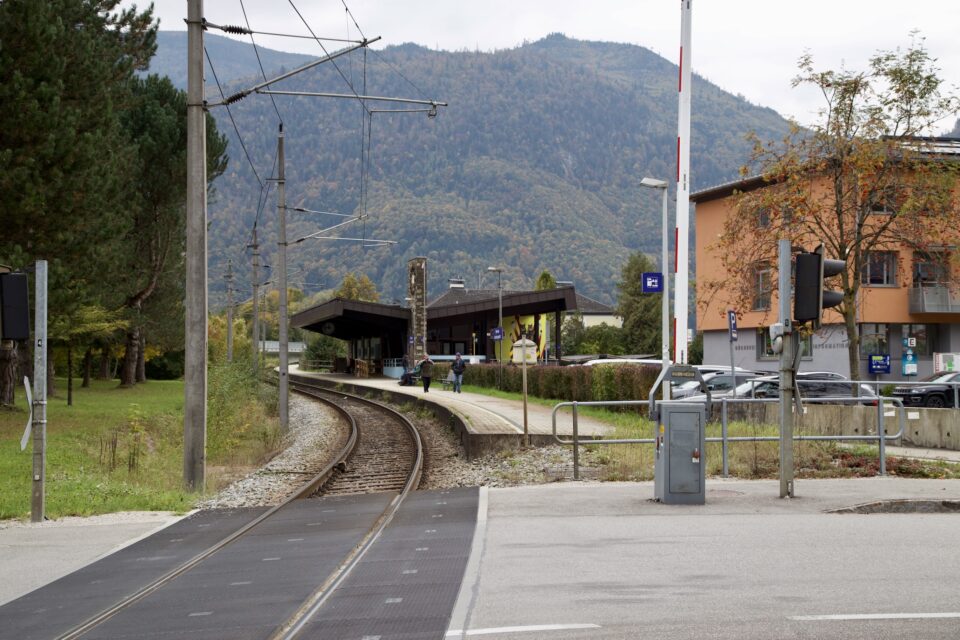
The former ÖBB railway station at Landungsplatz in Ebensee is one of many buildings across Europe – rich in history, yet left behind by time. Once a place of arrival and departure, it now stands still – quiet, unused, but full of potential.
As part of the EU project DECORATOR, it became the starting point for a co-creative journey. Students, citizens, designers, and local authorities came together to rethink the space – sustainably, collaboratively, and with a deep sense of atmosphere and place.
This page documents that process in a compact and self-explanatory way. It also presents five design ideas showing how the station could once again become a meaningful place in the daily life of the town and its people.
Rethinking How We Build – DECORATOR & the New European Bauhaus

DECORATOR is an EU-funded cooperation project in the Danube Region with an ambitious goal: to make the construction sector more circular.
This does not only apply to materials – but also to planning processes, digital innovation, and regulatory frameworks.
At the heart of DECORATOR is the belief that circular transformation must connect the technical, social and cultural dimensions of building.
The project therefore brings together partners from design, policy, technology, and education across multiple countries.
The work is guided by the New European Bauhaus values:
- Sustainability – reuse of resources, lifecycle thinking, and energy efficiency
- Participation – co-creation with local actors and diverse stakeholders
- Beauty – human-centered design that creates identity, quality, and atmosphere
These principles are not only reflected in the project’s activities, but also form the foundation of the DECORATOR Model – a guiding framework that translates the New European Bauhaus values into practical approaches for circular construction.
It offers a structured and holistic approach to implementing circularity on the ground – through local demonstrators, pilot projects, and forward-thinking policy recommendations.
Find out more:
A Town in Transition – Ebensee’s Search for Identity
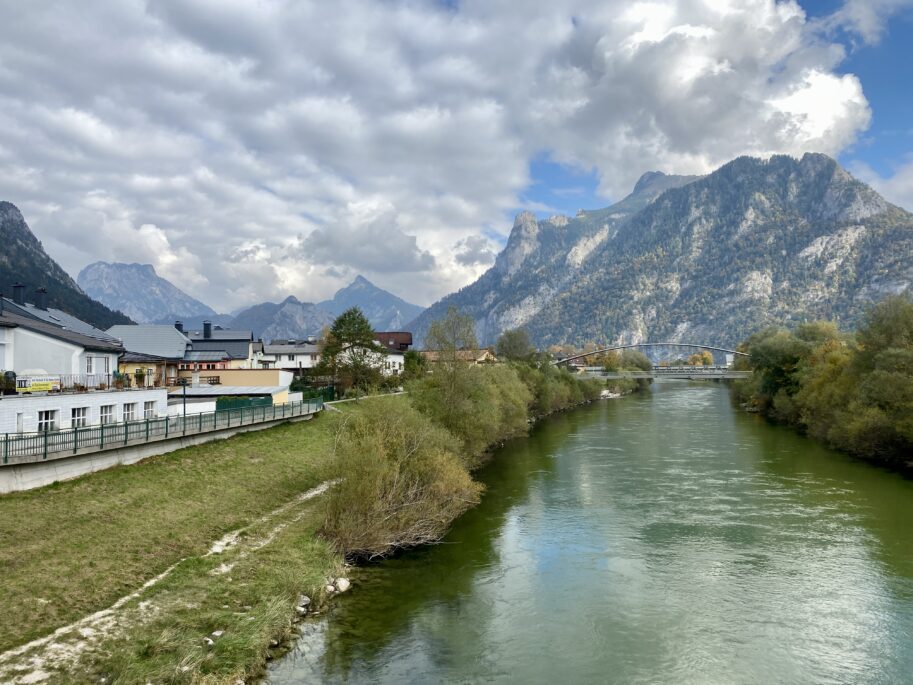
Ebensee is a town in Upper Austria’s Salzkammergut region – known for its lake, industrial heritage, and strong community.
It has long been shaped by industry – salt production, chemical plants, and heavy labour formed the backbone of its economy for over a century. As an industrial town nestled between lake and mountain, Ebensee was closely linked to extraction, production, and working-class culture.
In the last two decades, the town has undergone deep structural changes. With the decline of traditional industries, population loss, a shrinking public life, and a search for new identity became central challenges. Young people moved away, many buildings fell out of use, and spaces once filled with labour became silent.
But change is underway. In 2024, Ebensee participated in the European Capital of Culture “Bad Ischl – Salzkammergut”, hosting art interventions, performances, and collective experiments. These opened up new narratives around care, community, and spatial imagination.
Against this backdrop, DECORATOR explores how circular building and participatory design can become tools for local regeneration – not only physically, but culturally and socially.
The Railway Station at Landungsplatz – A Space Between Transit and Potential
Just 50 meters from the town center, nestled between the Traunsee and the foot of the Feuerkogel, stands the ÖBB railway station “Ebensee Landungsplatz”.
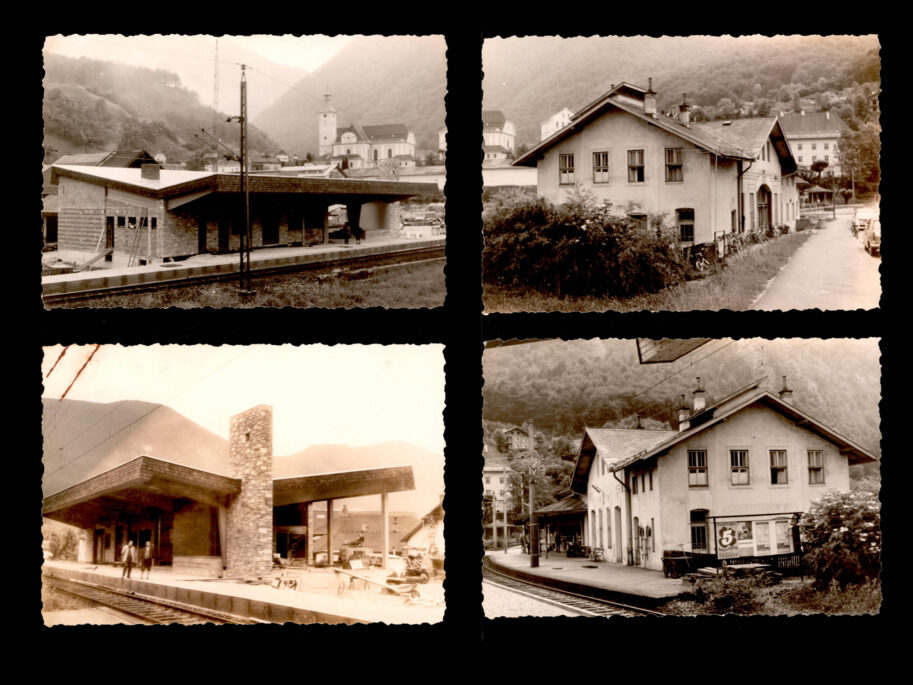
While the station continues to serve daily trains, the station building itself has stood empty for years. Built in 1971, it replaced an older structure from the opposite side of the tracks. For decades, it played a central role in local life – connecting people, industry, and tourism. Today, it still features bus stops, parking, and a public WC, but the building itself is unused.
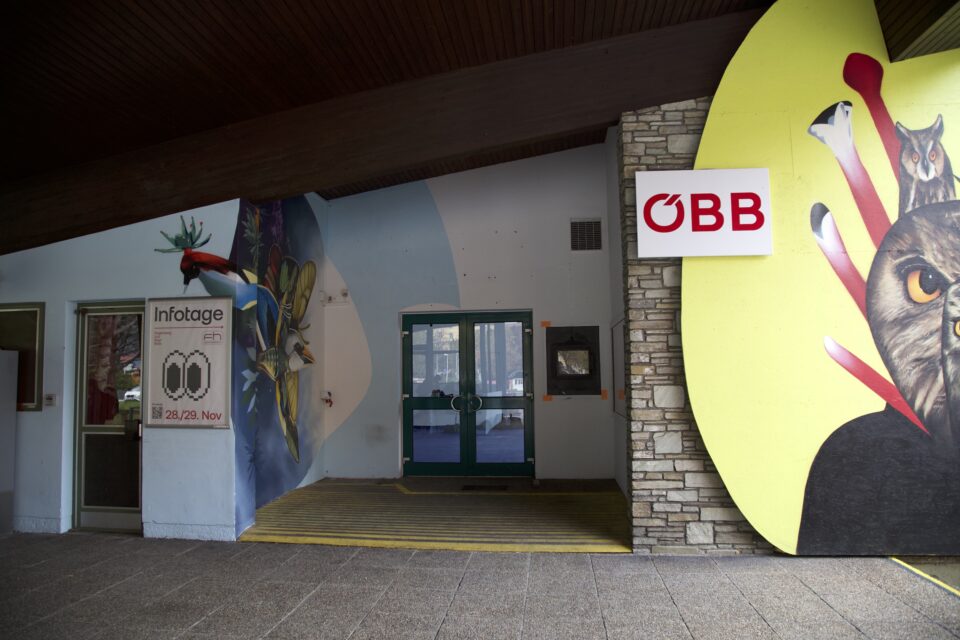
In 2024, during the Salzkammergut 2024, the station was temporarily revived. Art installations, performances and workshops transformed the rooms into an interdisciplinary cultural space – with projects by international and local artists.
These moments revealed the building’s potential – not just as transit infrastructure, but as a space for public life. The municipality now supports its interim use as a social and civic space – creating room for participation, experimentation and dialogue.
Find out more:
The Process: From Serendipity to Structured Co-Creation
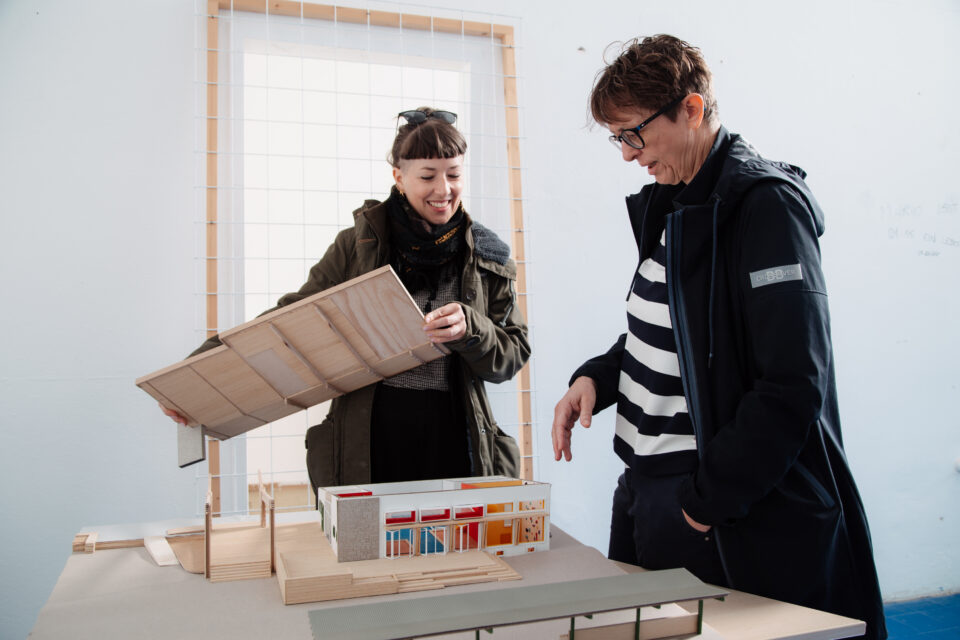
„It was a very interesting experience, and I’m glad that we went through this process. I’m also always happy when we have the opportunity to work with students from outside the region — I really value that. When knowledge comes in from the outside on an equal footing, it is very important for us. We don’t like being told what to do from the outside, but we are very interested in working together to gradually develop our town further.“ – Sabine Promberger, Mayor of Ebensee.
From Idea to Prototype – The Participatory Design Process
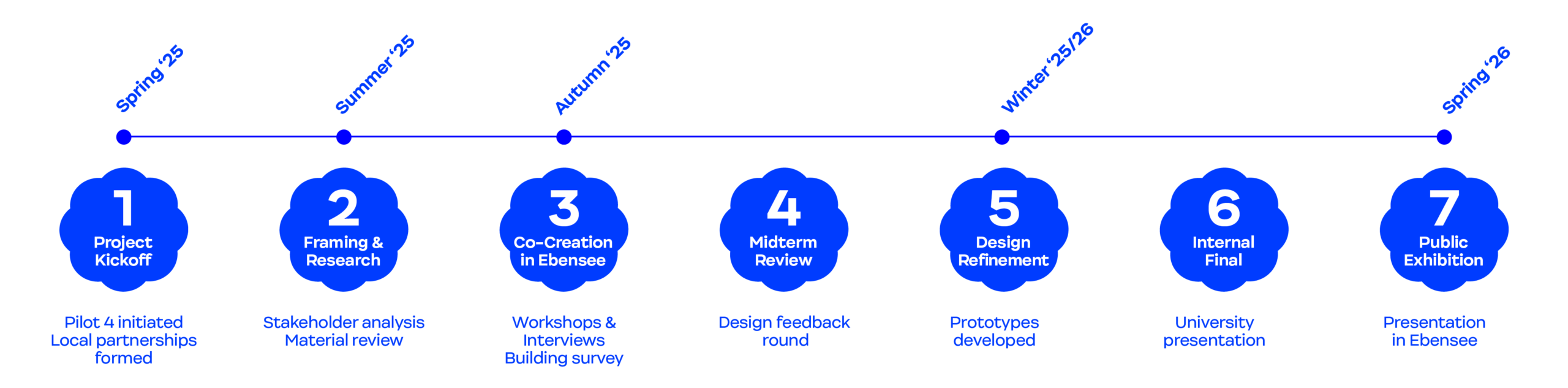
1) Spring 2025 – Project Kickoff
Sometimes it takes the right constellation of people to unlock the potential of a place. In Ebensee, it was a combination of local openness, regional momentum, and shared curiosity that made the pilot possible.
The Creative Region Linz & Upper Austria brought the location into the EU project DECORATOR as Pilot 4, and began shaping a process that would connect circular building, local knowledge and civic imagination.
In collaboration with the Kunstuniversität Linz and its platform for sustainable and socially responsible architecture basehabitat, the project was integrated into the architecture curriculum as a semester project (Fall/Winter 2025/26).
2) Summer 2025 – Framing & Research
From the start, the municipality of Ebensee, the ÖBB-Immobilienmanagement GmbH, and local cultural actors from “Aufbruch Salzkammergut” were involved. Together, they helped define the scope and framework for temporary reuse.
Before the design process began, the team conducted a stakeholder analysis and reviewed existing material and history, including an architectural walk of Ebensee.
Resources:
- ARCHITEKTUR SPAZIERGANG EBENSEE (german)
- Simple Smart Buildings during Salzkammergut 2024 (german)
3) Autumn 2025 – Fieldwork in Ebensee
In October, the participatory process started, accompanied by nonconform, an architecture office with a focus on participatory planning processes, who facilitated citizen and stakeholder involvement.
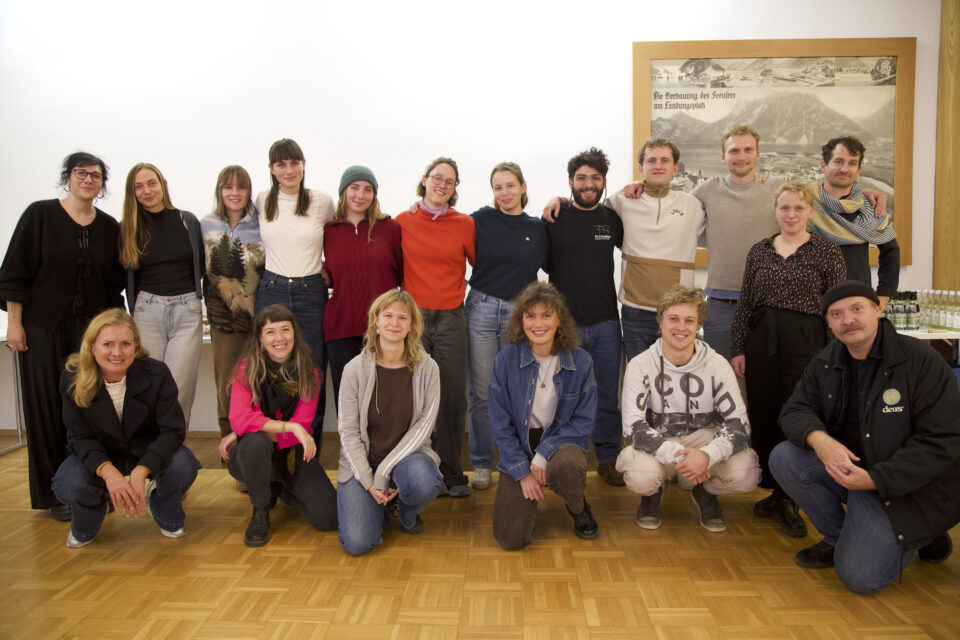
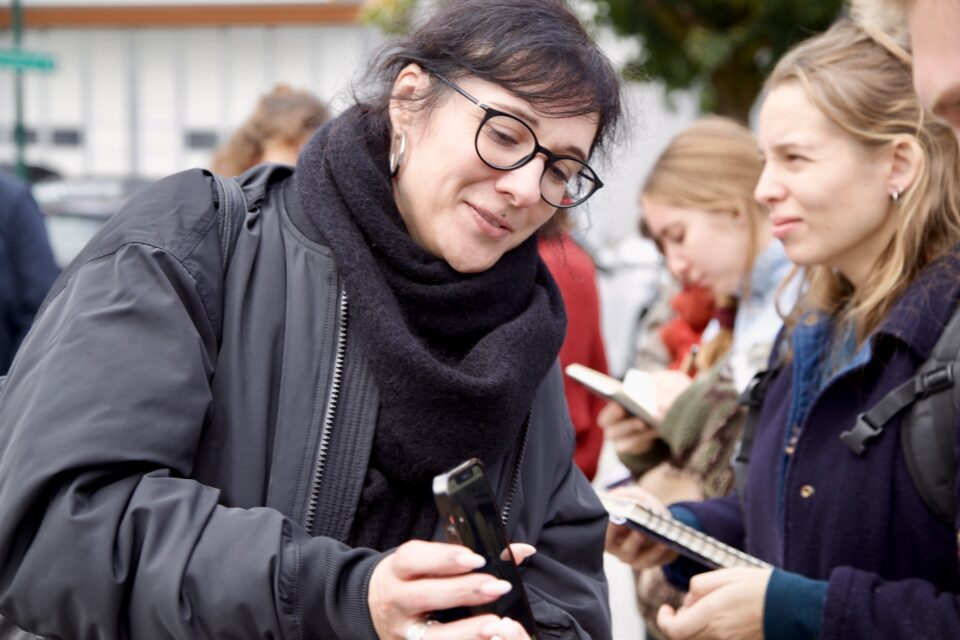
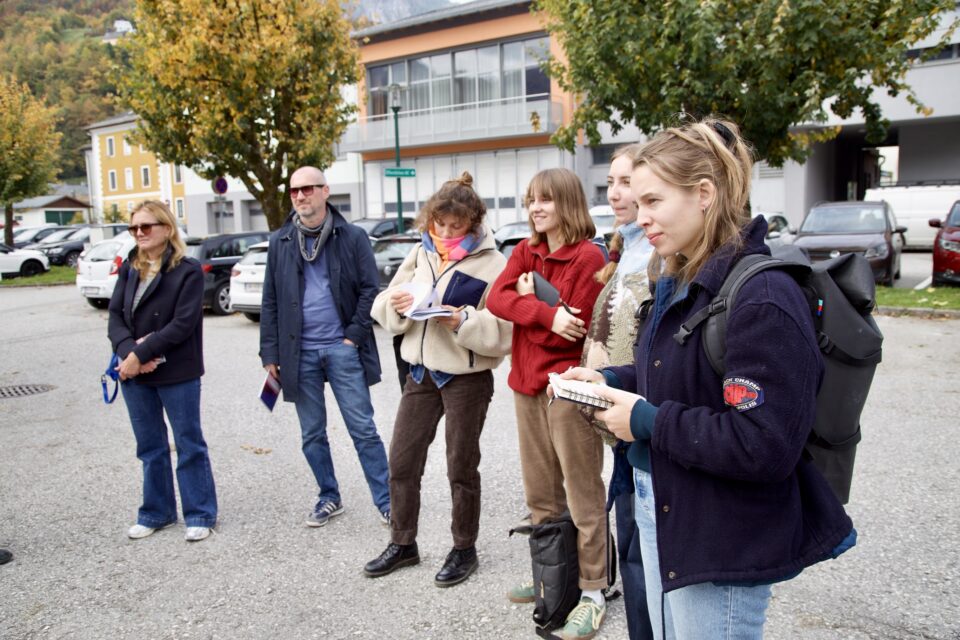
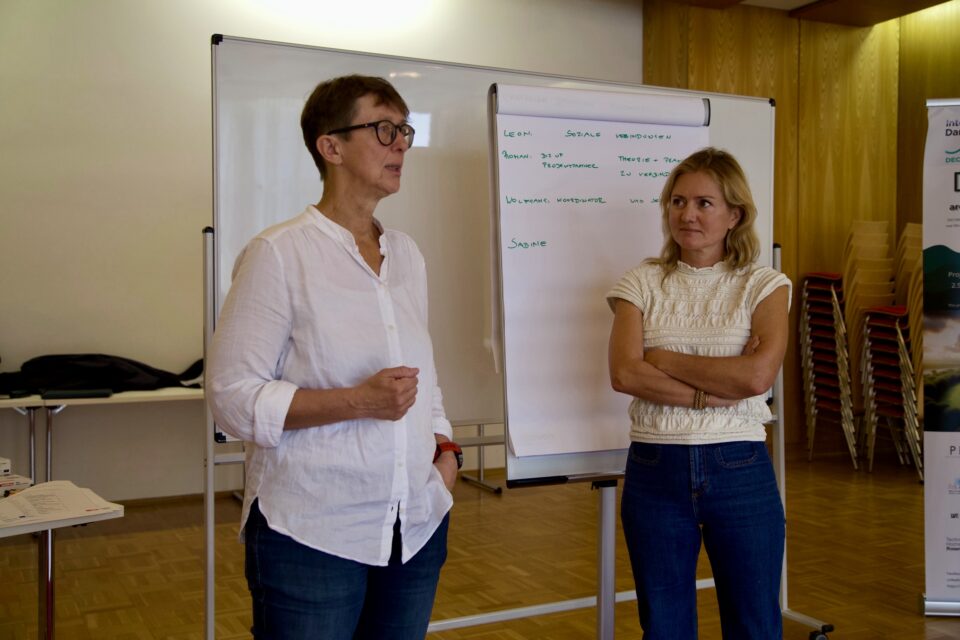
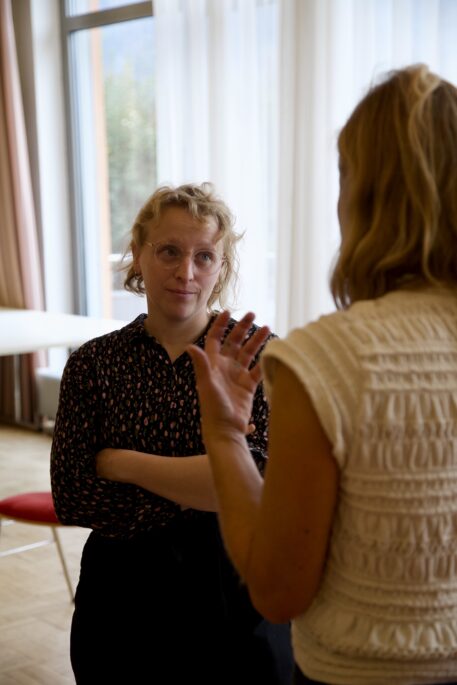
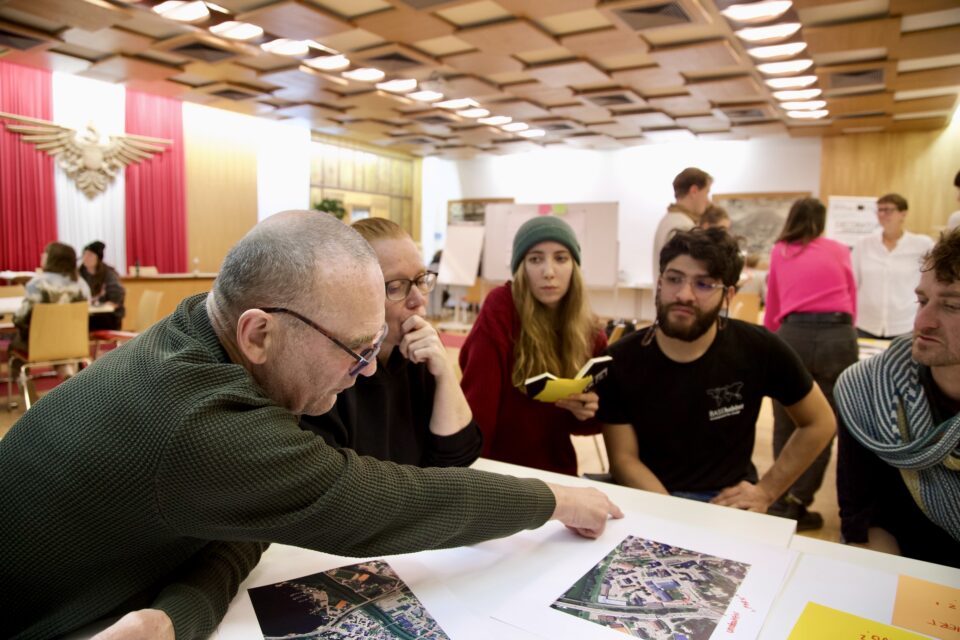
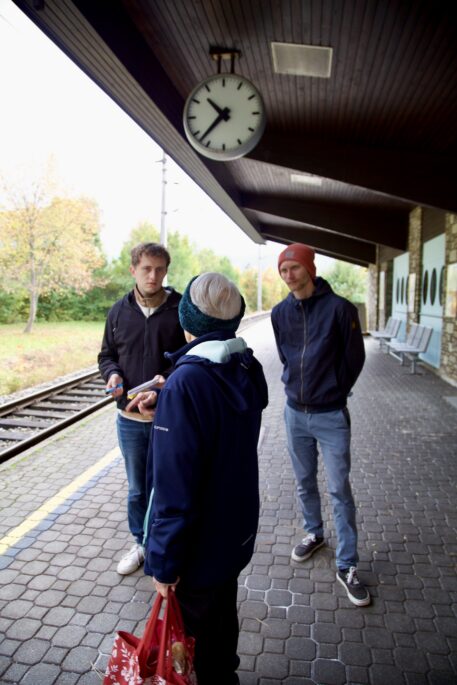
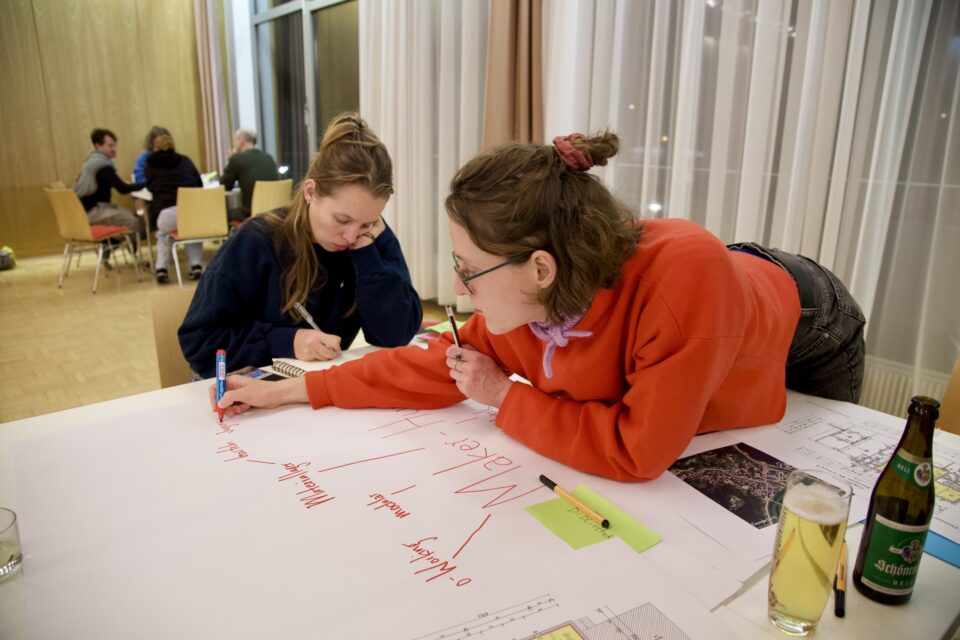
During a field trip to Ebensee, workshops, interviews and co-creative sessions brought together citizens, stakeholders, and local experts to share needs, ideas and experiences.
The students also conducted an in-depth building survey, created floor plans, and documented the site through photography and video.
They visited the municipal office, the town museum, and went on a guided walk through Ebensee with a local expert from Aufbruch Salzkammergut.
Additional site visits to nearby companies in the fields of construction and industry helped contextualize their ideas within the regional economy. These visits were planned and moderated by DECORATOR project partner Business Upper Austria.
Find out more:
- Poster about the Field Research Week in Ebensee (german)
- Summary of the participatory process by nonconform (german)
- Bauteilkatalog Landungsplatz (german)
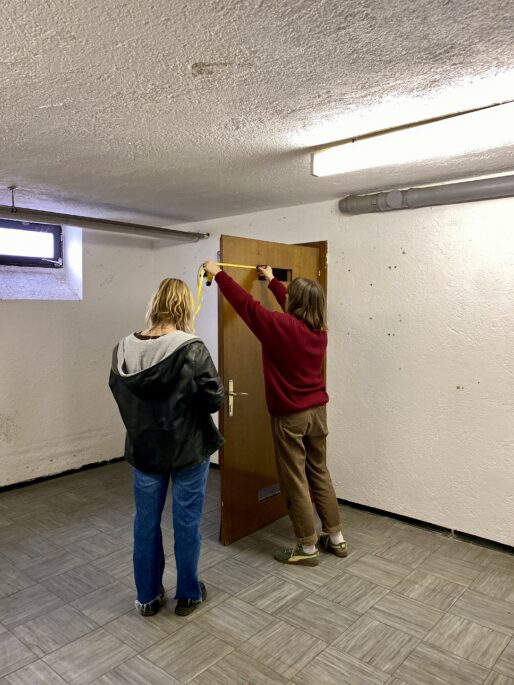
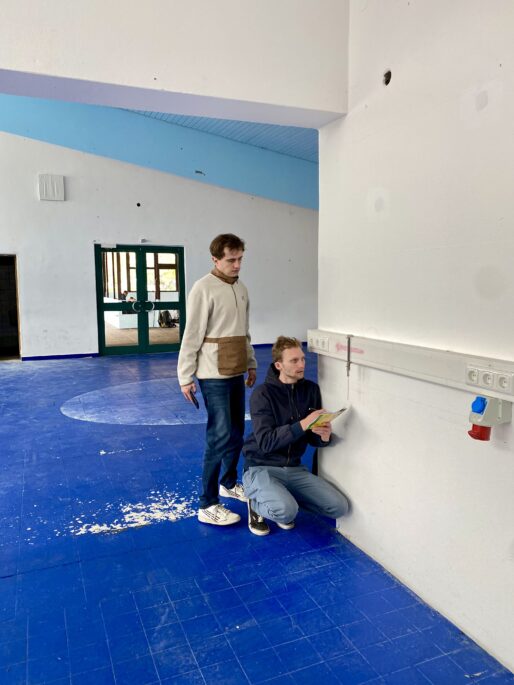
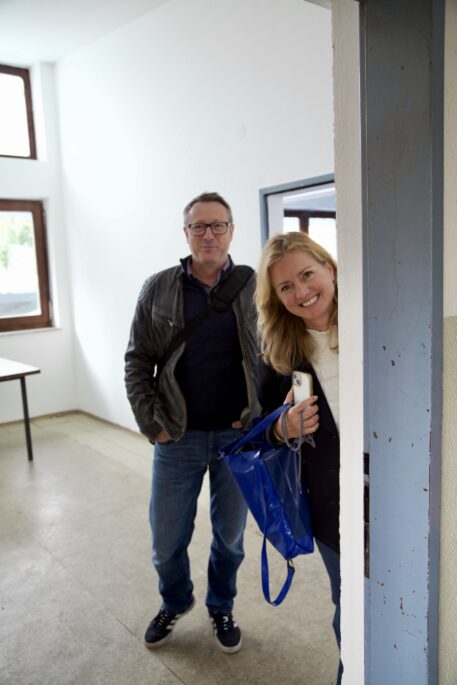
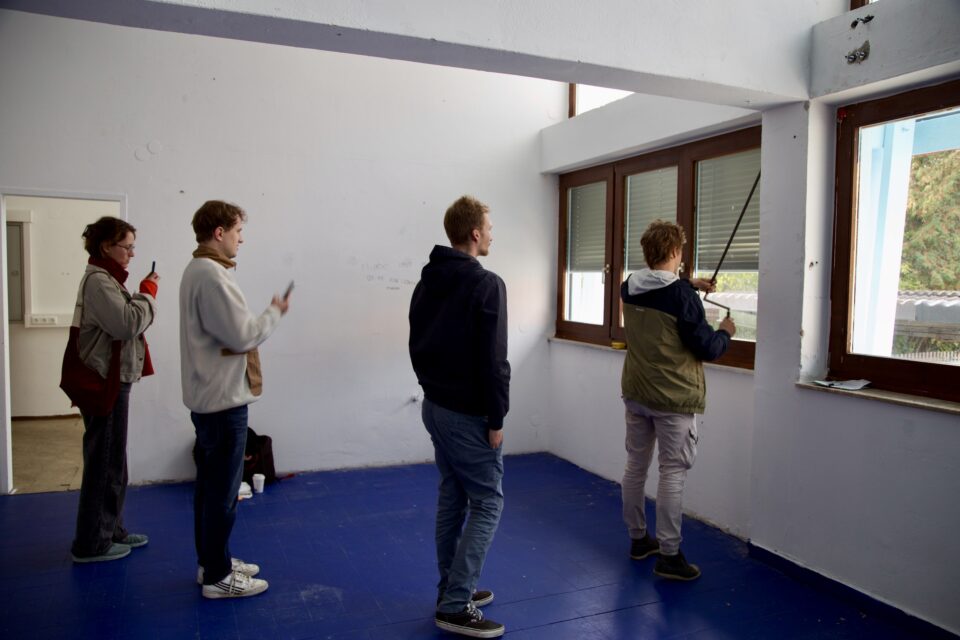

4) December 2025 – Midterm Review
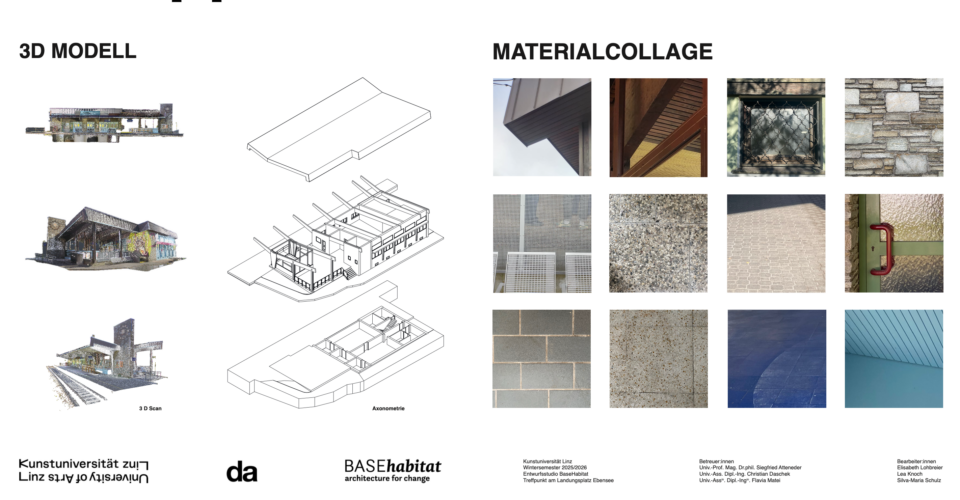
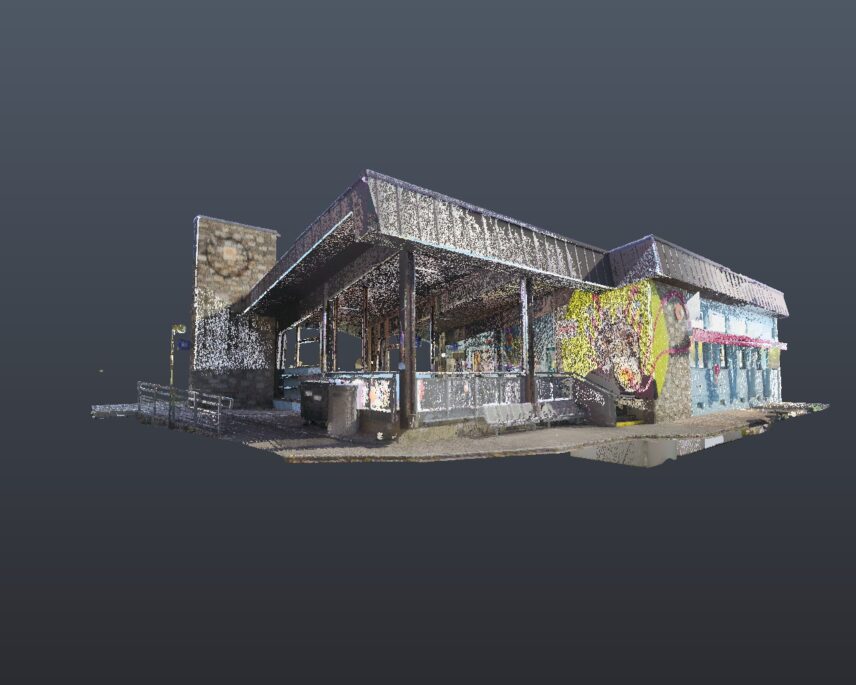
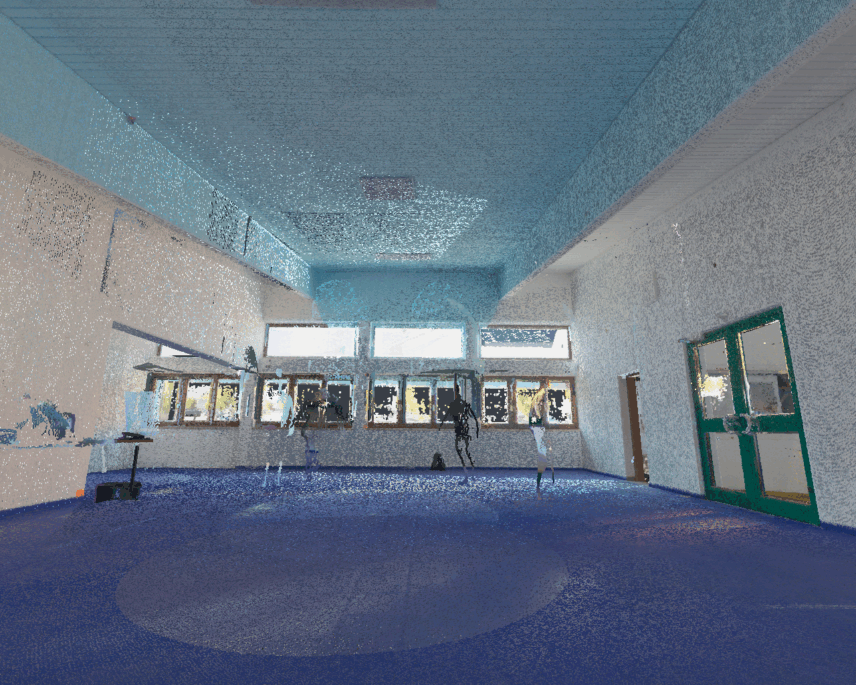
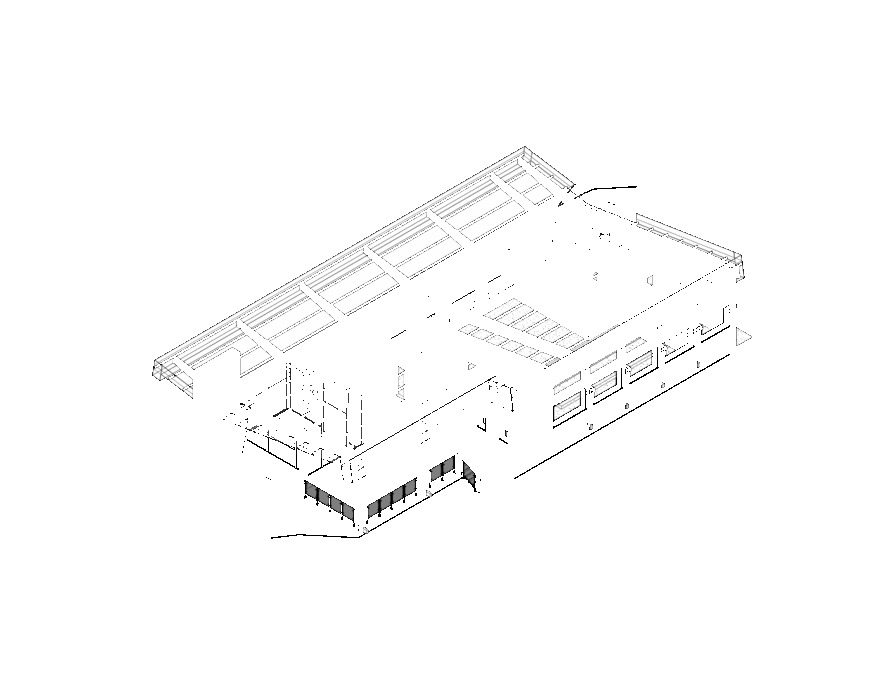
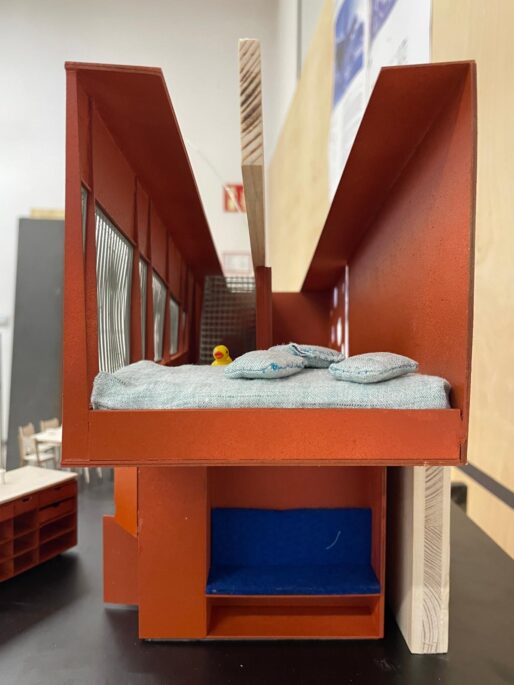
After coming back to Linz, the students developed a model for the Landungsplatz based on the point cloud, as well as a schematic of the resulting reconstruction.
Throughout the winter semester, five student teams developed prototypical reuse scenarios for the station – envisioned for a period of five years.
These first ideas and design concepts, which were presented in Linz to a group of advisors from Creative Region, nonconform, Aufbruch Salzkammergut, architects and professors.
5) Winter 2025/26 – Design Refinement
Based on the feedback, the five prototypes were further refined and finalized during the winter months.
6) January 2026 – Internal Final
The results were internally presented at the end of January at the Architekturforum Linz.
After this presentation, the students together with the team of Creative Region, nonconform and Aufbruch Salzkammergut prepared the public exhibition and presentation in Ebensee.
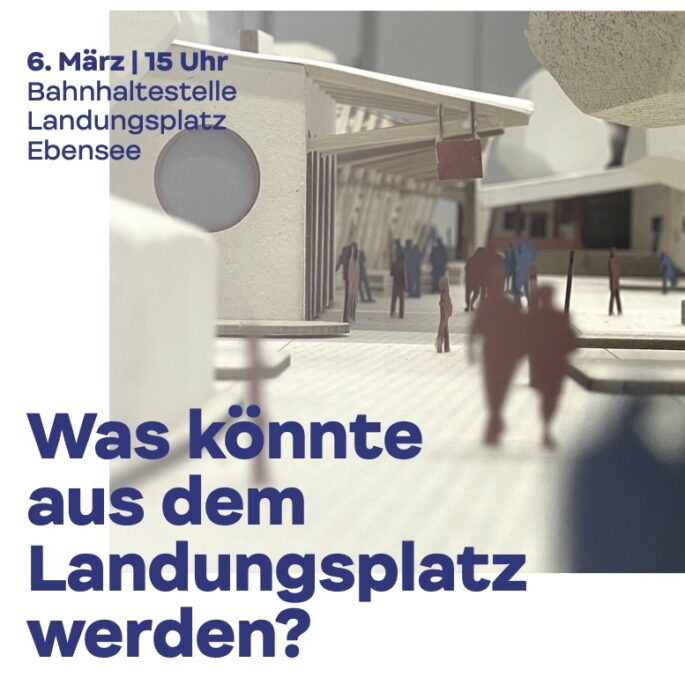
Find the invitation here:
7) March 2026 – Public Exhibition
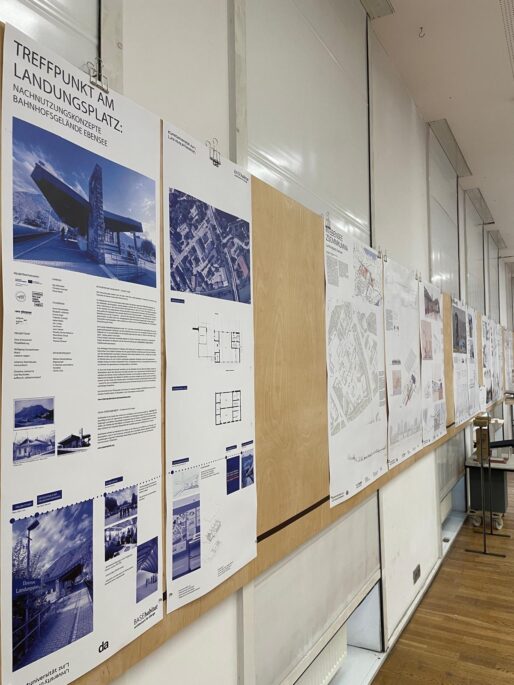
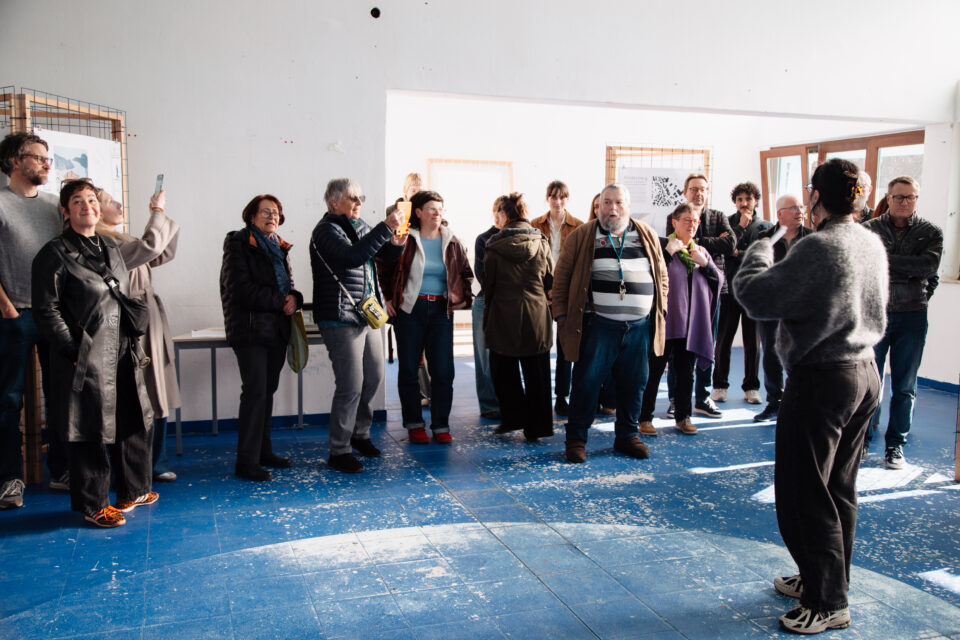
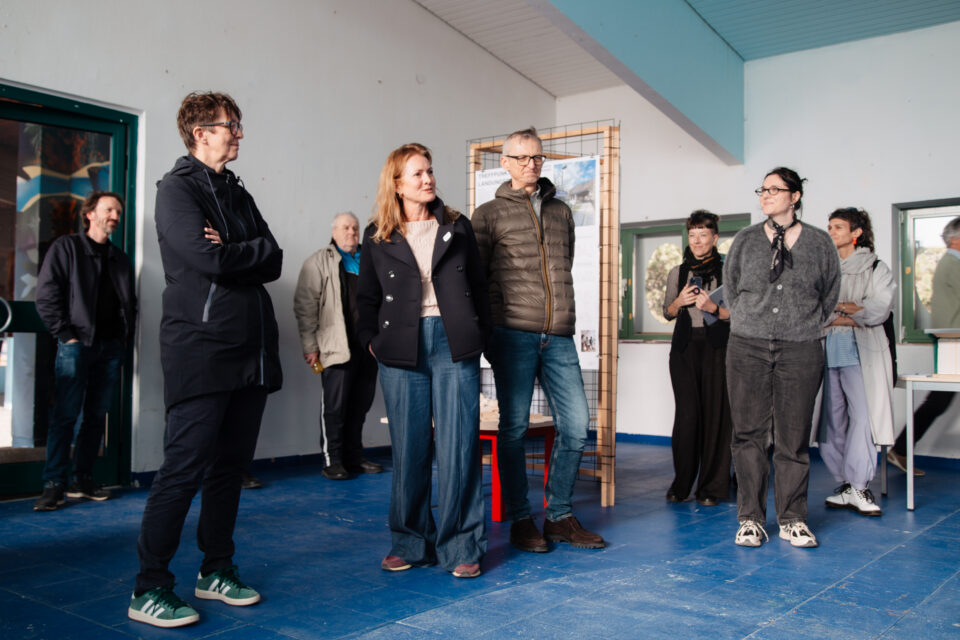
In March 2026, the results were shared with the public in the form of an exhibition in Ebensee.
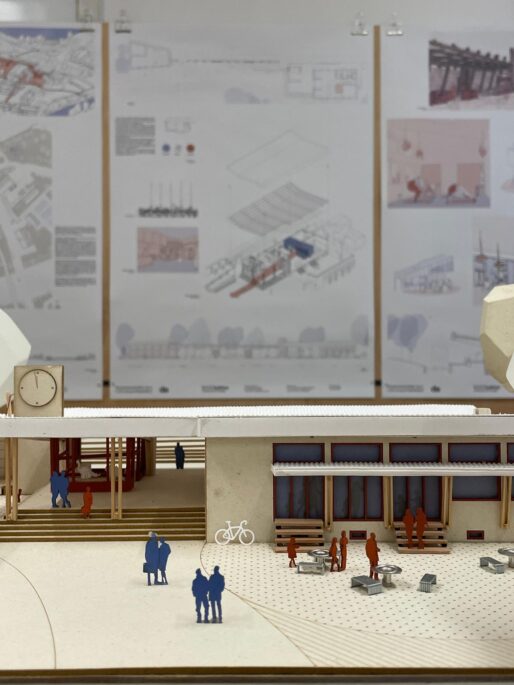
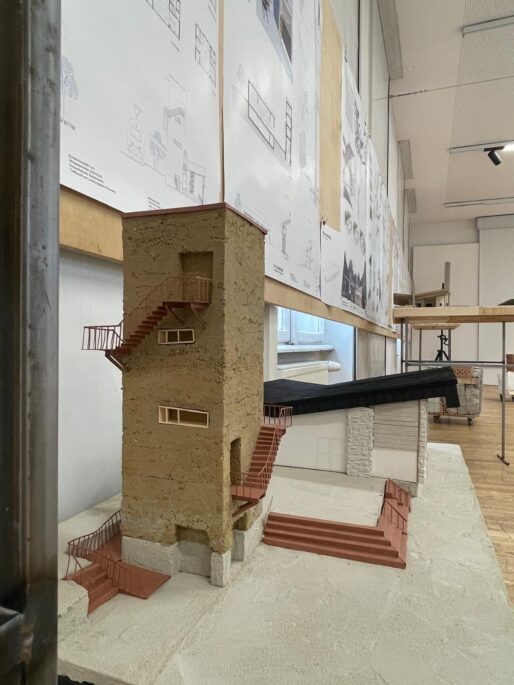
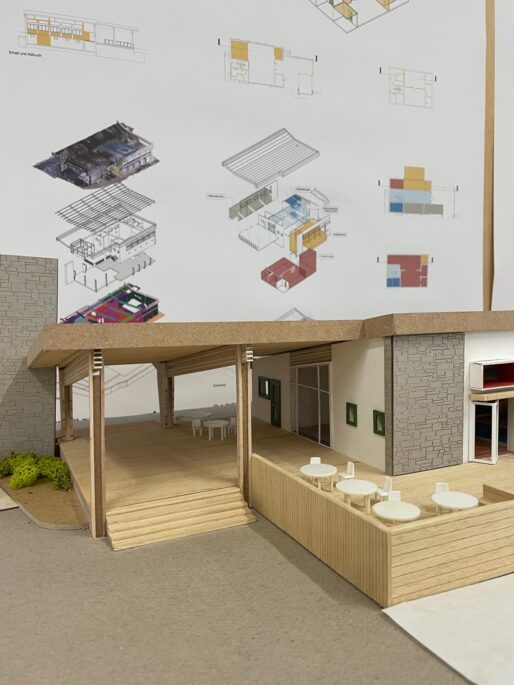
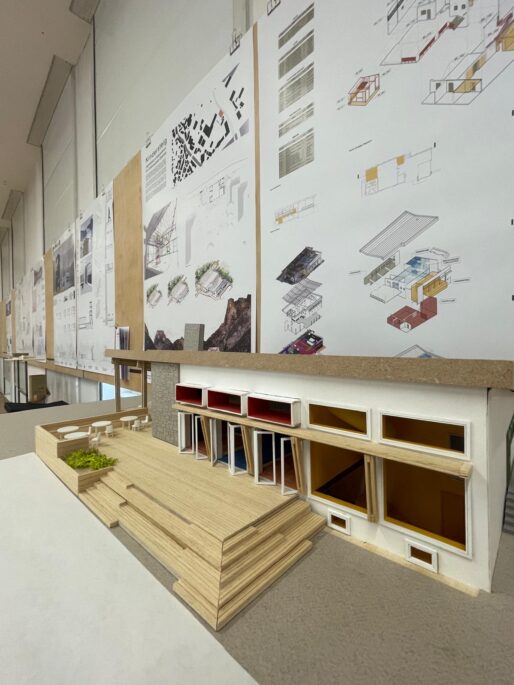
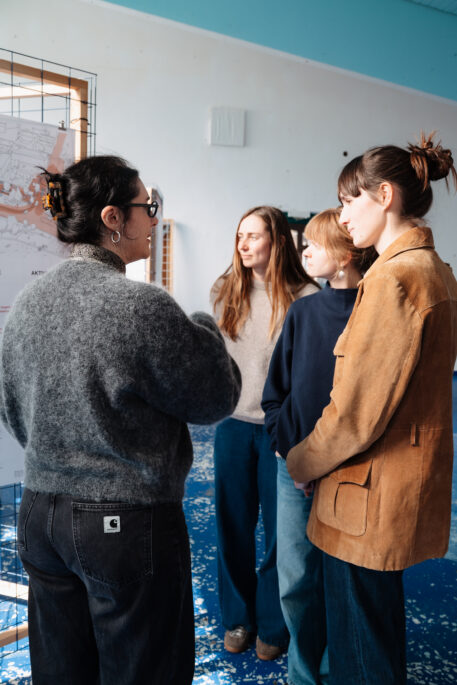
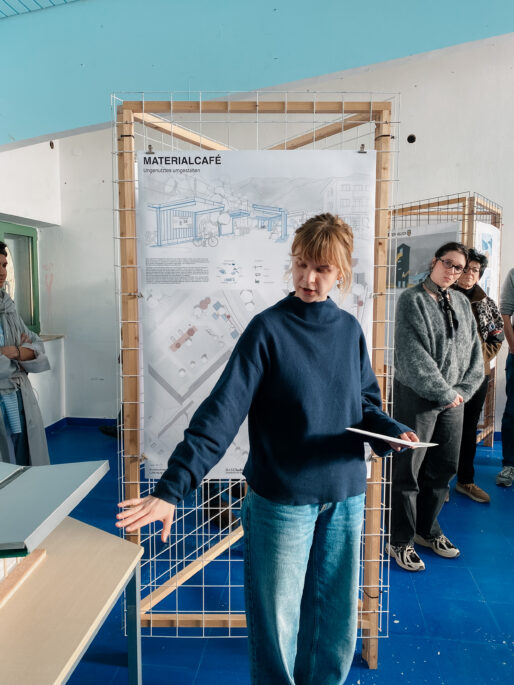
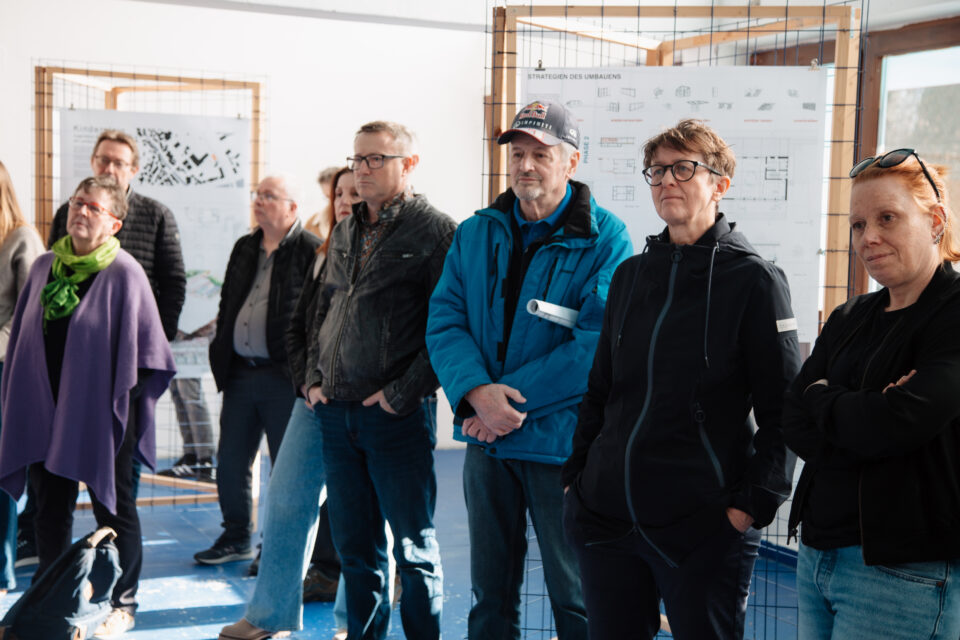
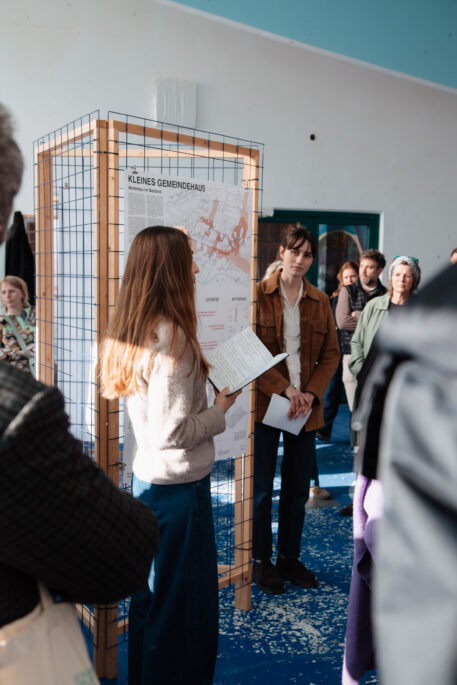
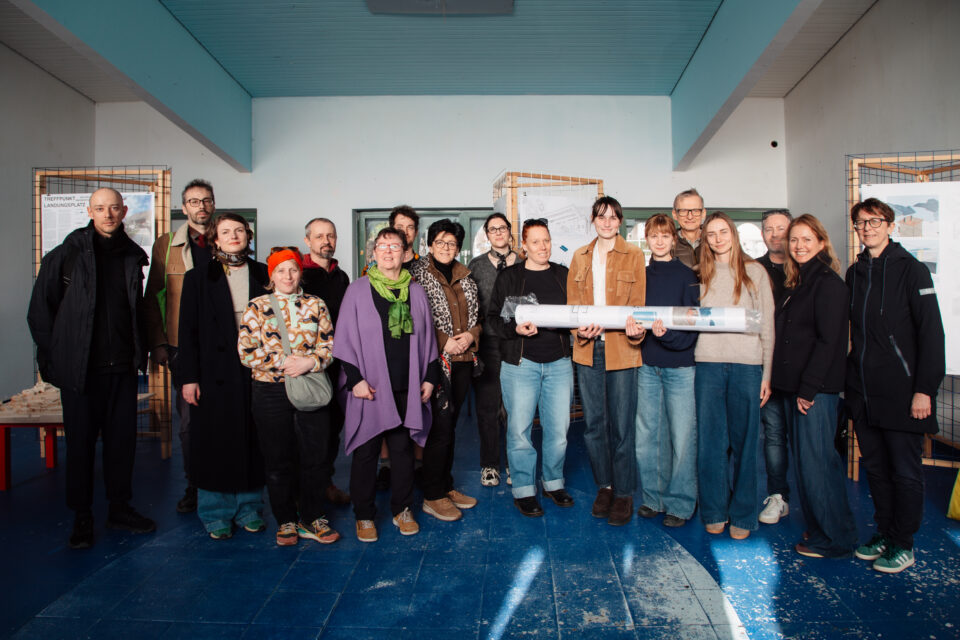
As part of the final presentation on March 6, 2026, the students of the University of Arts Linz (die Architektur / basehabitat) presented their ideas and future scenarios for a sustainable, resource-conscious and community-oriented use of the Landungsplatz station in Ebensee.
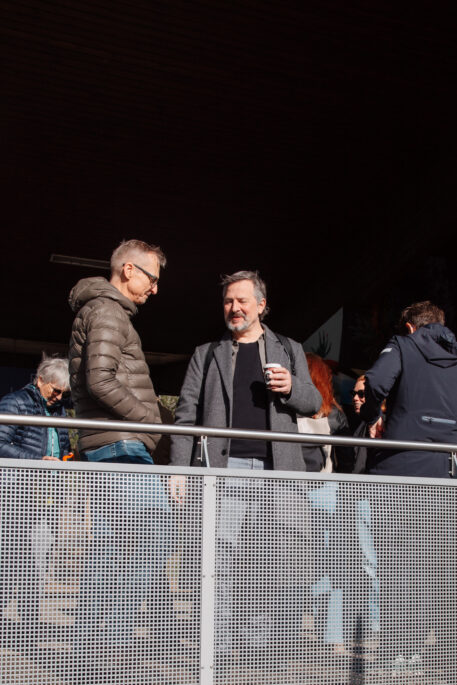
The event was attended by Mayor Sabine Promberger, members of the municipal council, Thomas Ferschmann (ÖBB Real Estate Management), as well as numerous interested citizens.
At the end of the event, the posters, models, and the exhibition were ceremonially handed over to the municipality. The exhibition will be on display at the Ebensee municipal office until mid-April.
„The vision is that, in the future, we can jointly develop a coherent reuse concept for these spaces in the station building that ÖBB no longer requires for railway operations. The goal is to find a suitable operator together and to ensure that the building, the property, and the square in front of it can be used sustainably in the long term.“ – Thomas Ferschmann, ÖBB-Immobilienmanagement GmbH
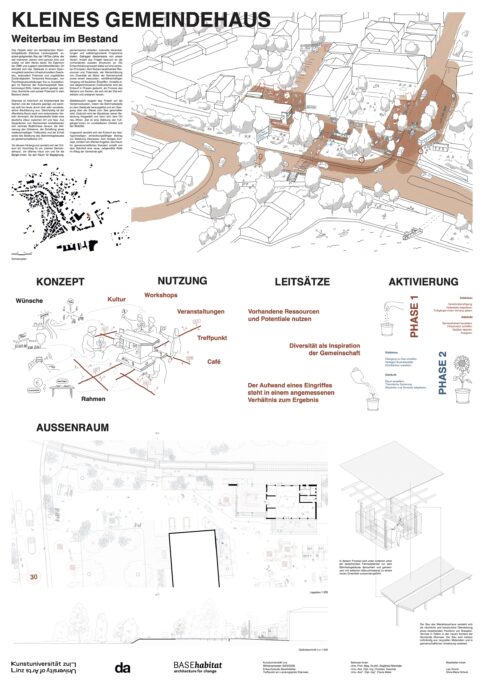
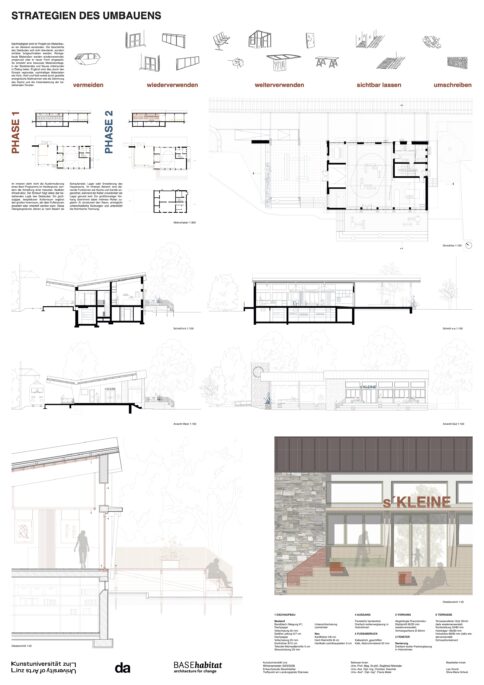
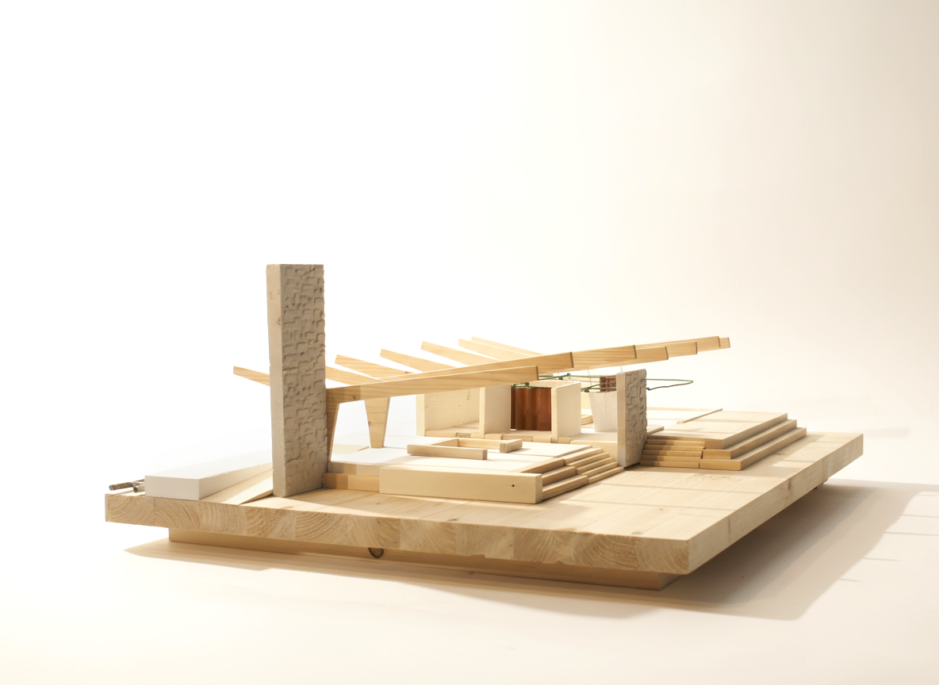
Project #1 – KLEINES GEMEINDEHAUS
by Lea Knoch & Silva-Maria Schulz
The project transforms the vacant railway station at Ebensee Landungsplatz into a “small community house” – an open, low-threshold place for civic life. Instead of proposing a fixed final state, it understands architecture as a gradual, collective process rooted in reuse, participation, and adaptability. The station becomes a shared space shaped by and for the people of Ebensee.
What is the new use?
The former station building is reimagined as an open civic house that offers space for meetings, shared work, cultural events, and self-organized programs. Rather than defining a strict program, the design provides a robust and flexible spatial infrastructure that can be adapted over time. Ideally supported by a local association, the building becomes a platform for community-driven activities and everyday use.
How does the space feel?
The atmosphere is intentionally open, inclusive, and evolving. Large, flexible interior spaces are complemented by transitional zones that can act as showcases, storage, or extensions of the main room. A large curtain element structures the interior, allowing different uses while supporting thermal separation. Outside, the building opens itself toward the town and the lake, strengthening pedestrian movement and making the station a visible and welcoming place once again.
What is reused or rethought?
Sustainability is understood as building further with what already exists. The history of the building remains visible and is consciously continued. Materials from partial deconstruction are reused or reinterpreted, creating a material collage where old and new enter into dialogue. Regional, sustainable materials such as wood, hemp, and lime are combined with targeted energy upgrades like roof insulation and window refurbishment. In a second phase, recycled materials are used to construct a new waiting shelter, built collectively and almost entirely from reused components.
“The design is conceived as a ‘small community house’ — an open place by and for the citizens, not a finished concept but an open invitation for collective action.” – Lea Knoch & Silva-Maria Schulz
Project #2 – MATERIALCAFÉ
by Friderike Schmidt, Emma Vogel & Elisabeth Lohbreier
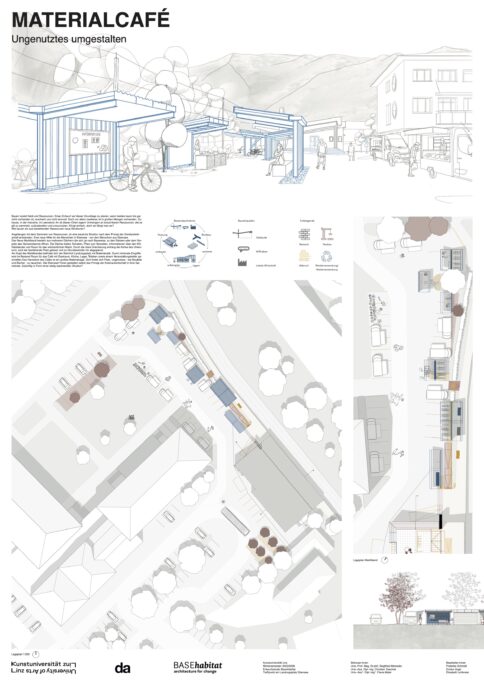
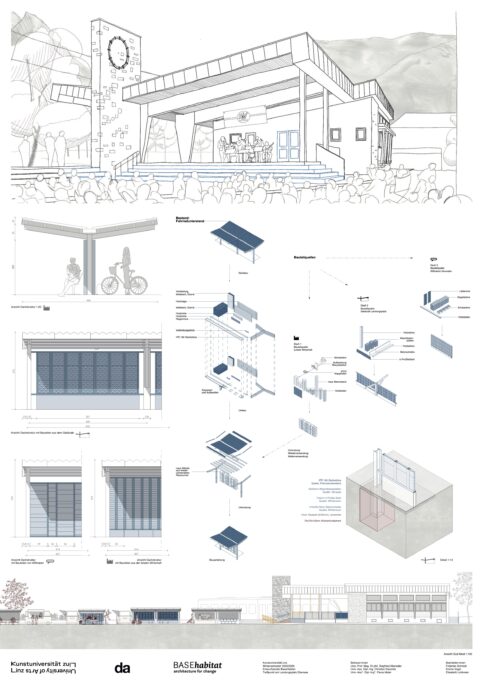
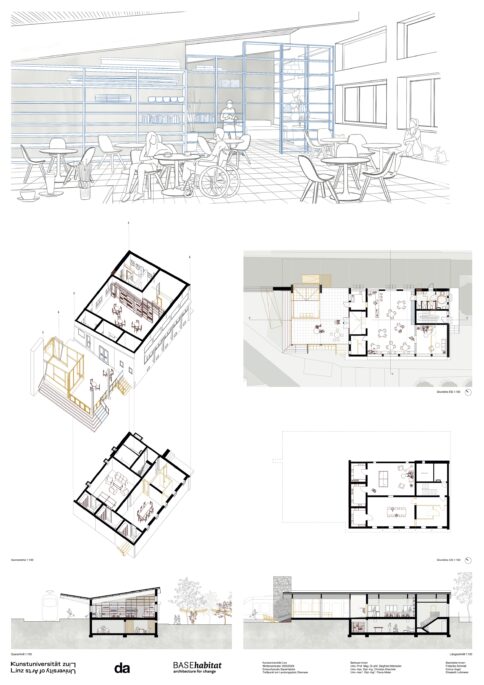
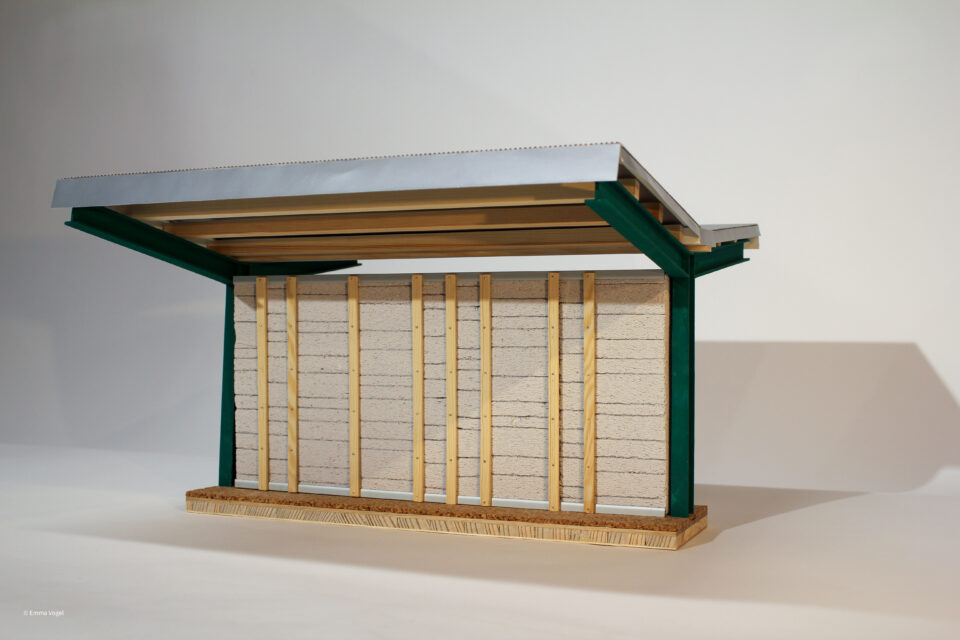
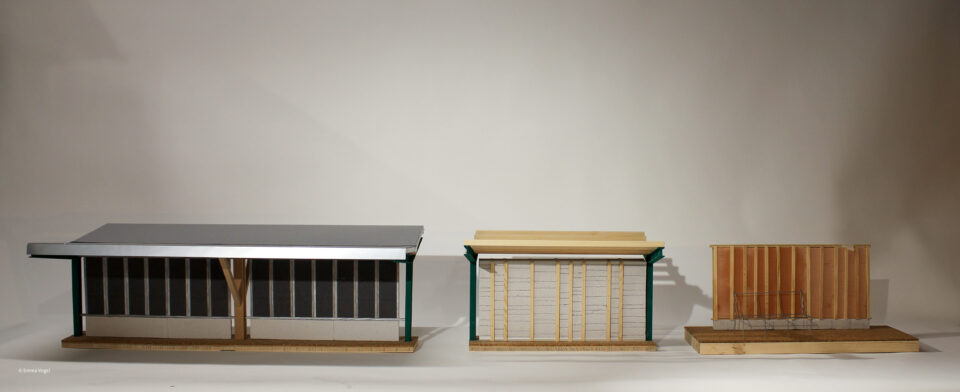
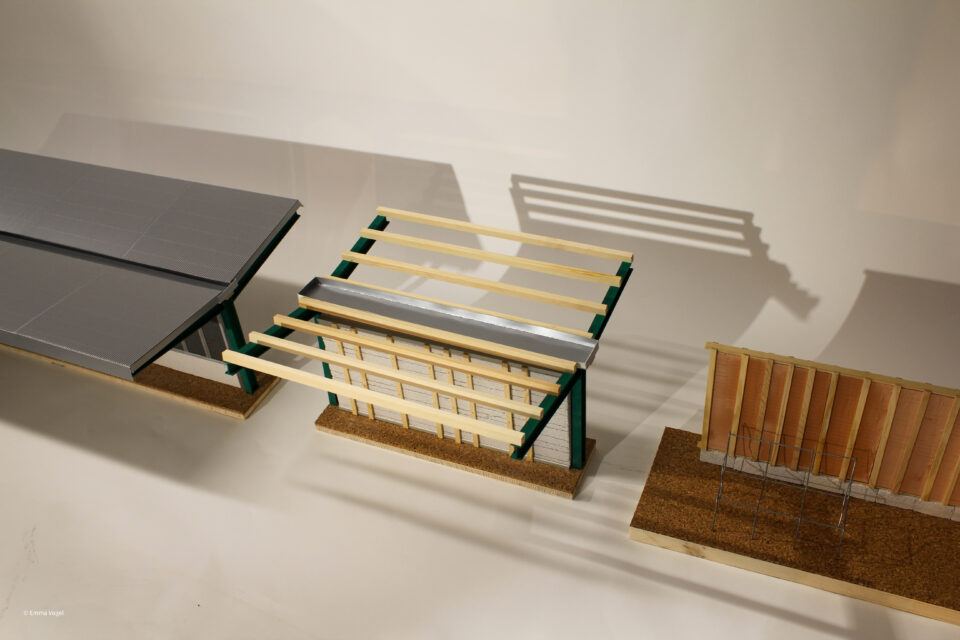
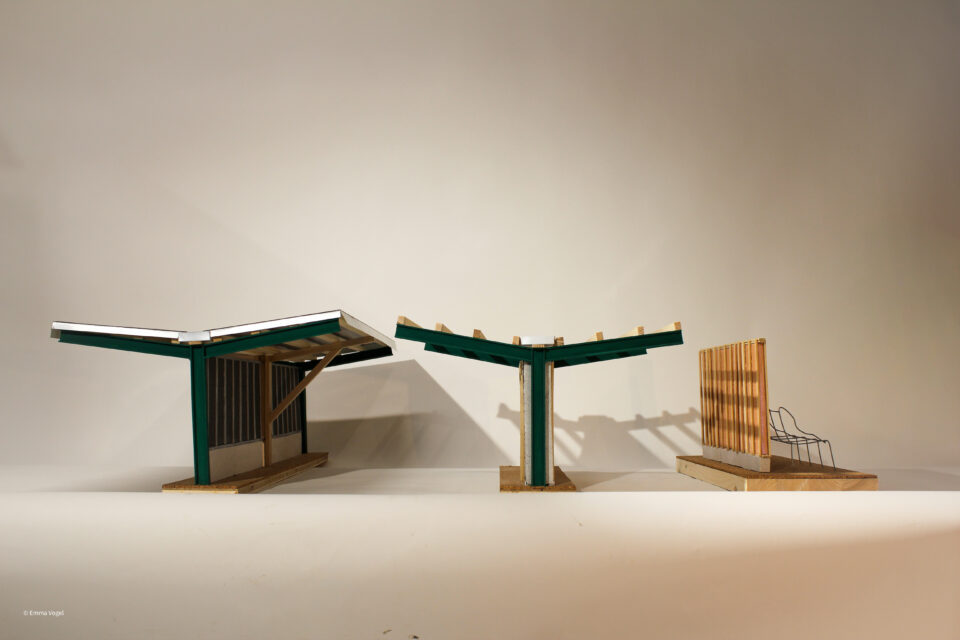
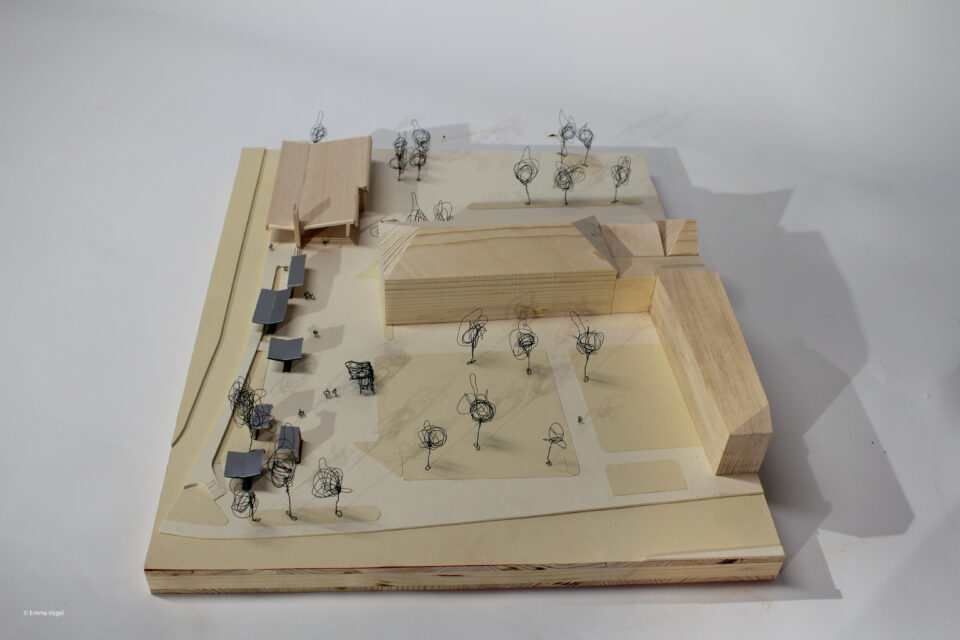
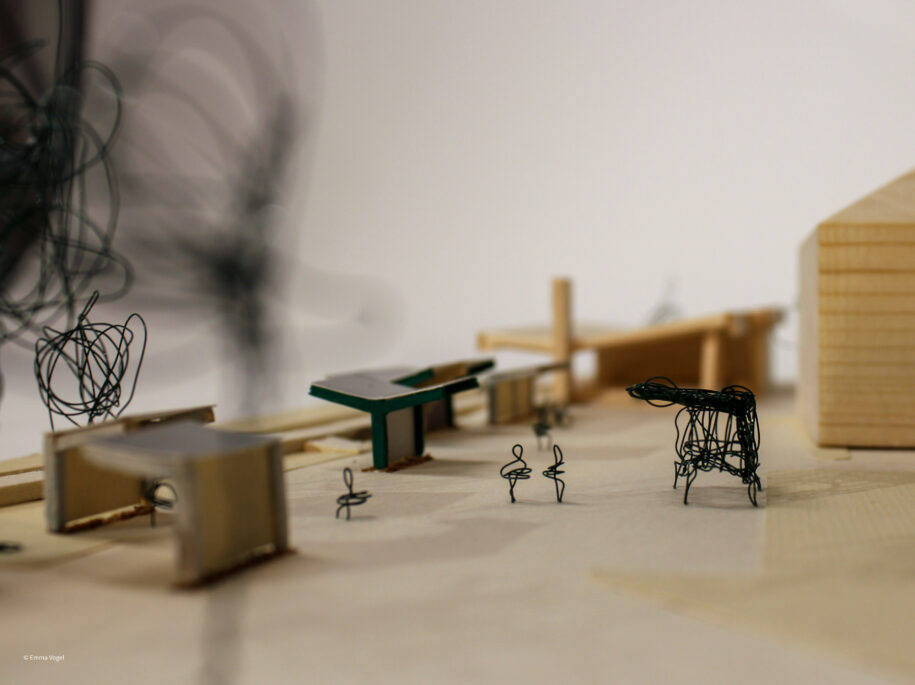
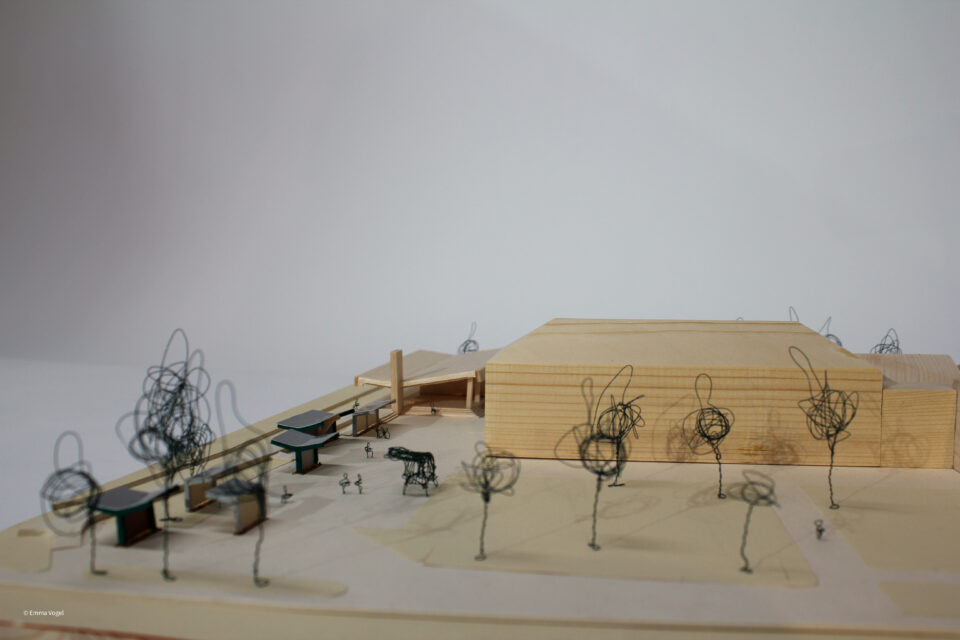
MATERIALCAFÉ places the reuse of resources at the core of its concept: What already exists becomes the starting point for new construction and community use. The design combines a repurposed café inside the station with an open, covered market structure made from reused materials. It invites the people of Ebensee to actively shape circular economy in their town.
What is the new use?
The former station building becomes a MaterialCafé through minimal intervention, including a café space, kitchen, storage, toilets, and an event cellar. At its core is a material exchange shelf where people can leave or take reusable items – building parts, books, and more. Outside, the market band provides shelter and space for weekly markets, local information, bike parking, and social interaction.
How does the space feel?
The market band frames the plaza between the station and the town hall. Its open roof structures orient toward either the tracks or the street, creating zones that are flexible, shaded, and welcoming. The atmosphere promotes community ownership, informal use, and self-organization – with a balance of utility and charm.
What is reused or rethought?
The entire project is built on the idea of resource reuse. Instead of designing from scratch, it collects and recombines what already exists – materials from households, industry, and abandoned buildings. Circularity is not just a goal here – it’s the very foundation of the design, both in material logic and in community empowerment.
“A new center for the people of Ebensee — created by the people of Ebensee — where knowledge, materials, and use are shared.” – Friderike Schmidt, Emma Vogel & Elisabeth Lohbreier
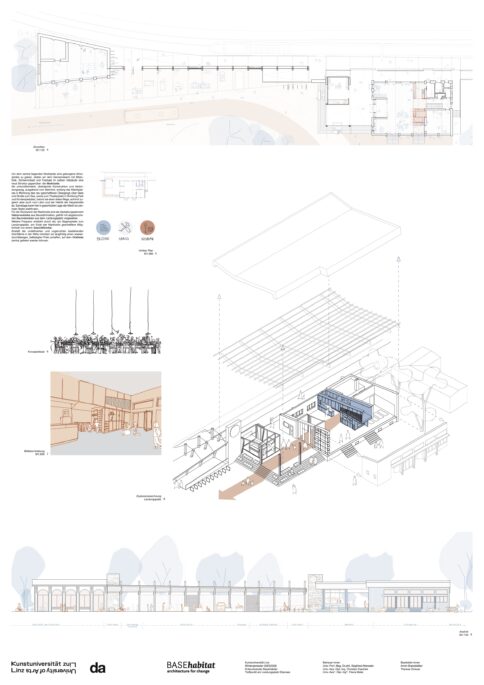
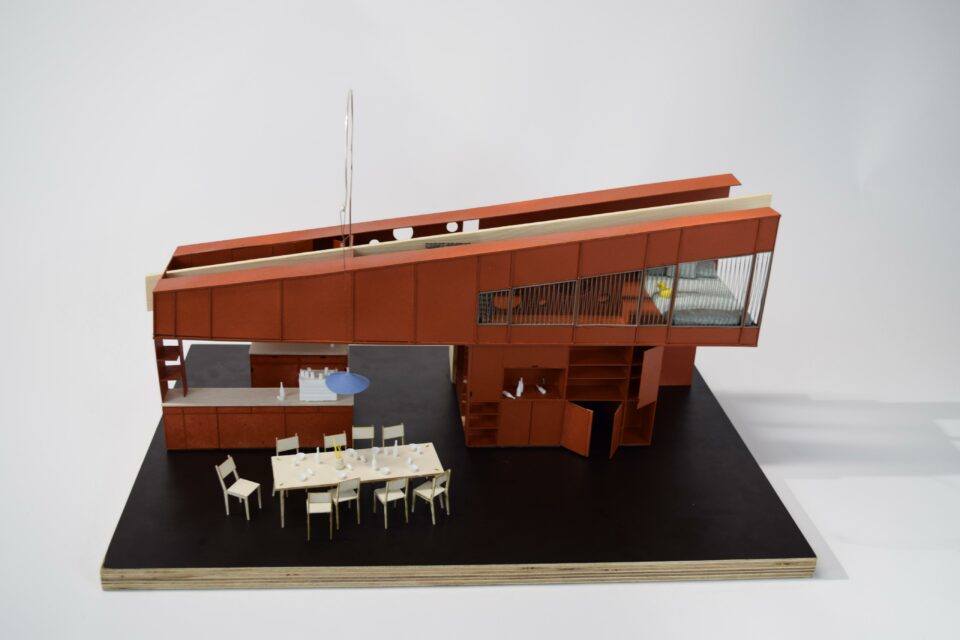
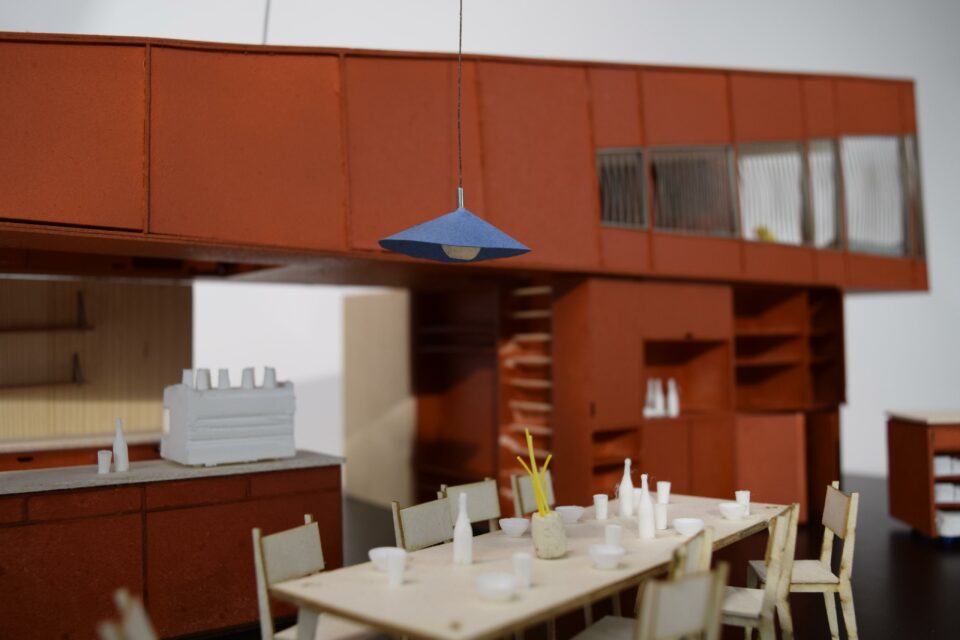
Project #3 – IN EBENSEE – ZSOMMKUMMA
by Armin Brandstätter & Theresa Dinauer
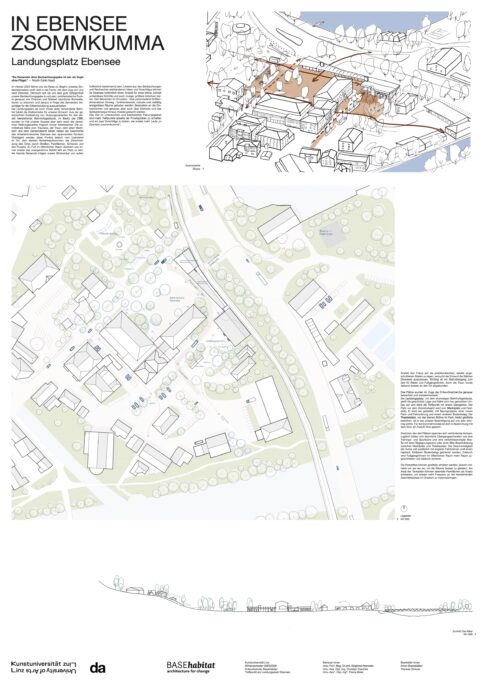
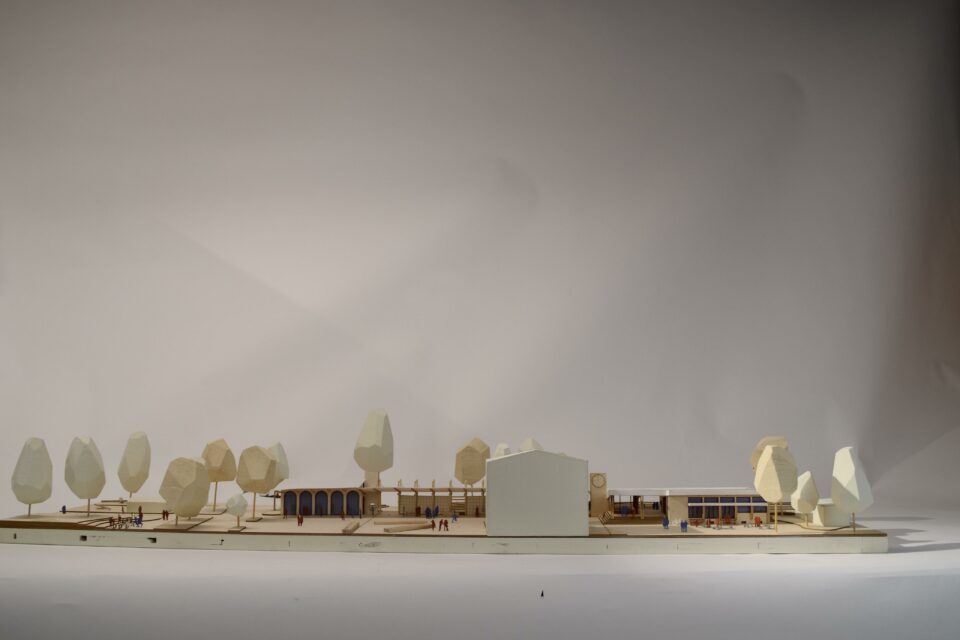
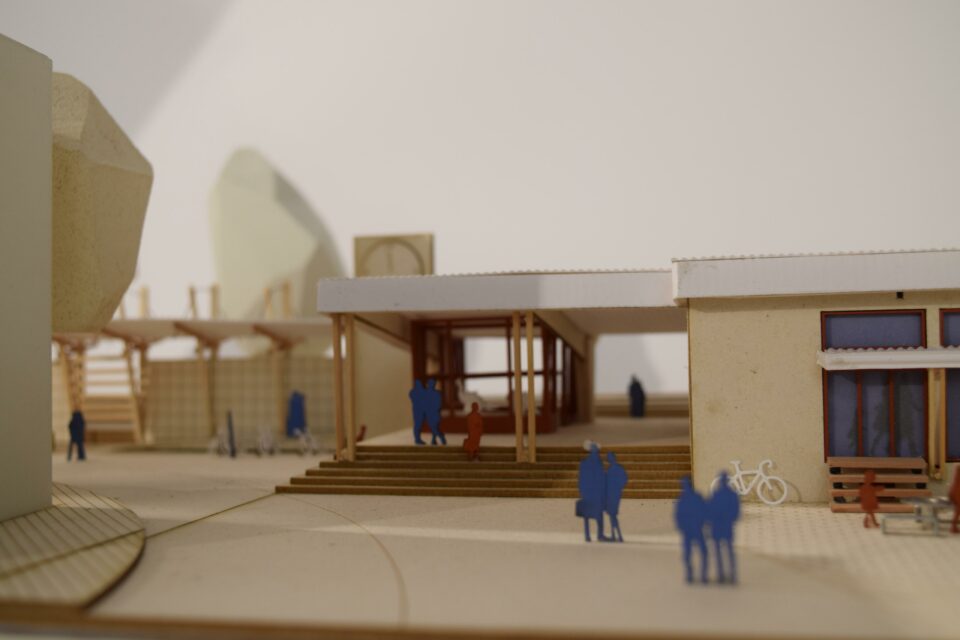
The project ZSOMMKUMMA approaches the Landungsplatz station not as an isolated building, but as part of a wider urban fabric. Three central public spaces in Ebensee – the Landungsplatz, market square, and theatre park – are spatially reconnected, atmospherically enhanced, and reprogrammed. Inside the station, a multifunctional furniture element enables community cooking, cultural events, and shared use.
What is the new use?
The station building is reimagined as a social and cultural gathering place. A large piece of built-in furniture structures the interior into two zones: a quiet side for yoga or therapy, and an active side for music practice, workshops, and shared meals. Surrounding this are redesigned public squares that offer spaces for markets, performances, and informal encounters.
How does the space feel?
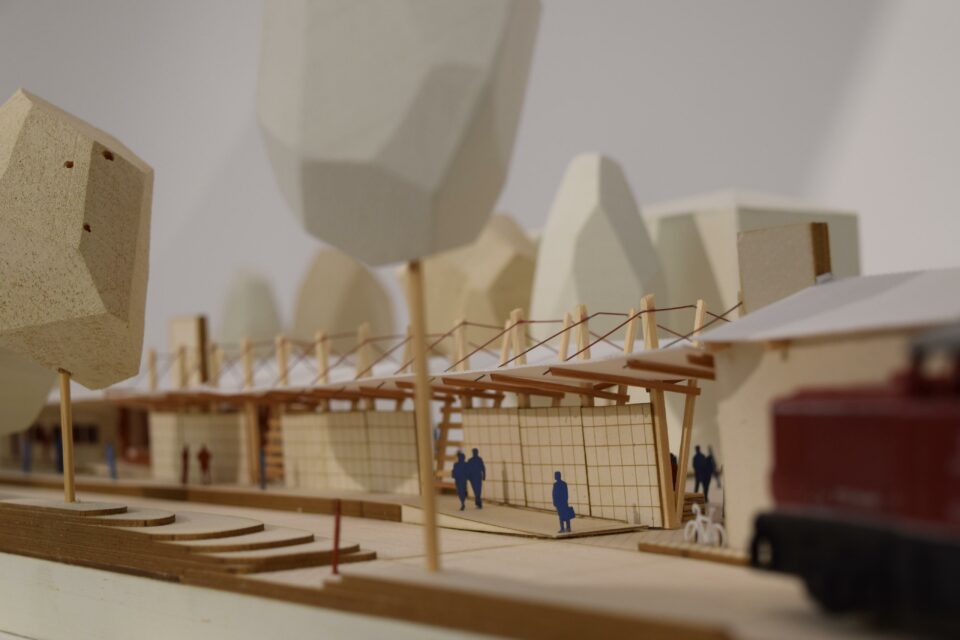
The intervention creates spaces that are open yet sheltered, calm yet social. The market walkway adds a sense of intimacy to the town square, while also buffering it from traffic. The central furniture acts as a spatial filter – creating zones while remaining playful and multifunctional. It includes details like a children’s loft, a coffee bar, and an extendable kitchen island, inviting people to gather and participate.
What is reused or rethought?
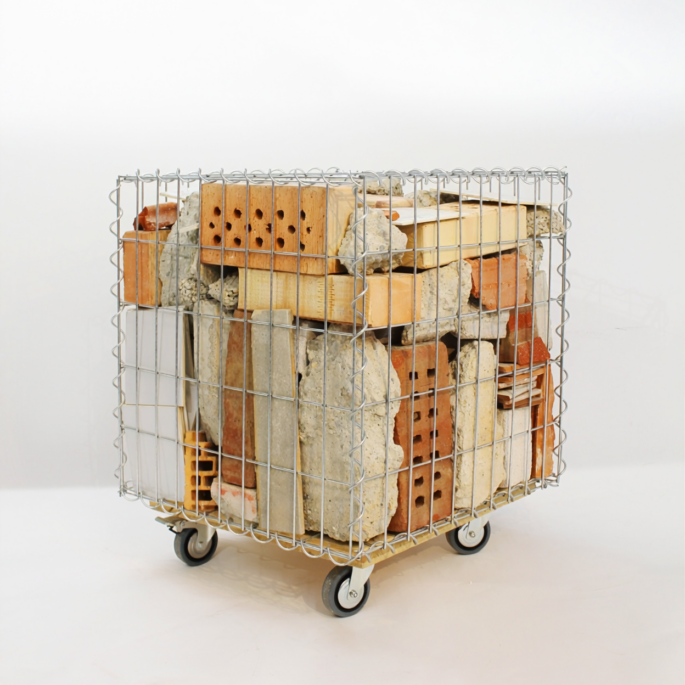
Rather than building anew, the project works with and around the existing. Gabion baskets filled with demolition rubble from the site form the rear wall of the new market structure. Instead of removing streets or parking, these are reorganized to create safer pedestrian areas and support local businesses. The whole concept is designed for temporary, low-impact, and flexible use.
“In the end, the ‘Treffpunkt Landungsplatz’ project became about much more than just the building itself: it was about giving people on foot and on bicycles more space again.” – Armin Brandstätter & Theresa Dinauer
Project #4 – FERNBLICK
by Isabel Mieke & Támi Forgó
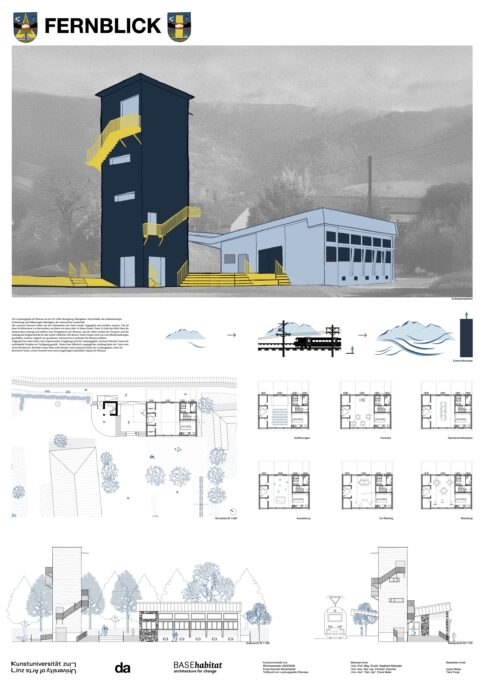
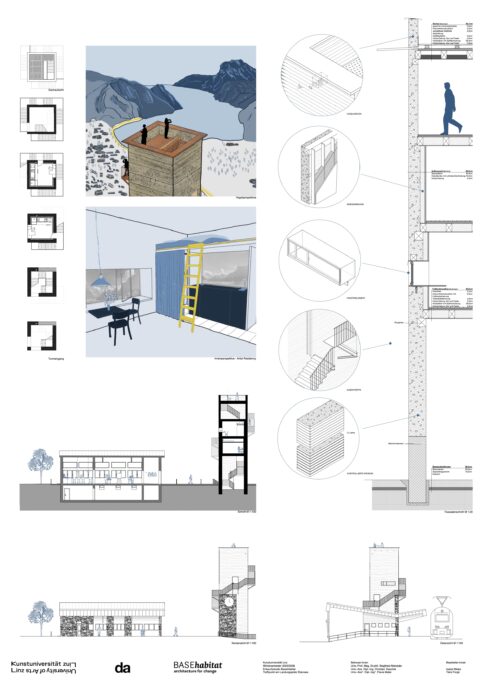
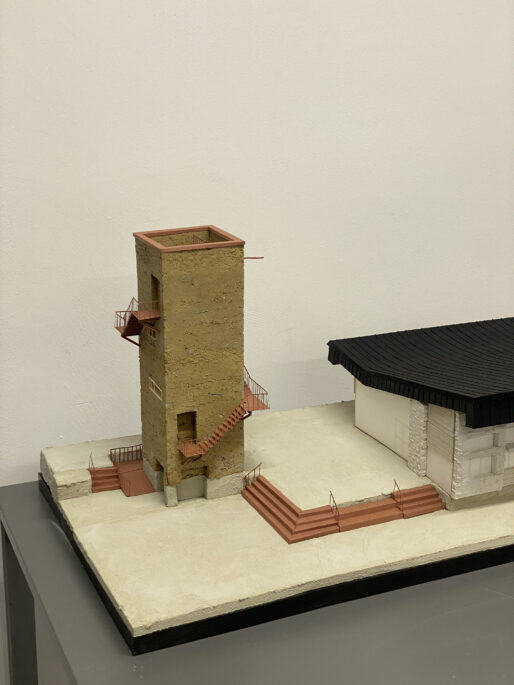
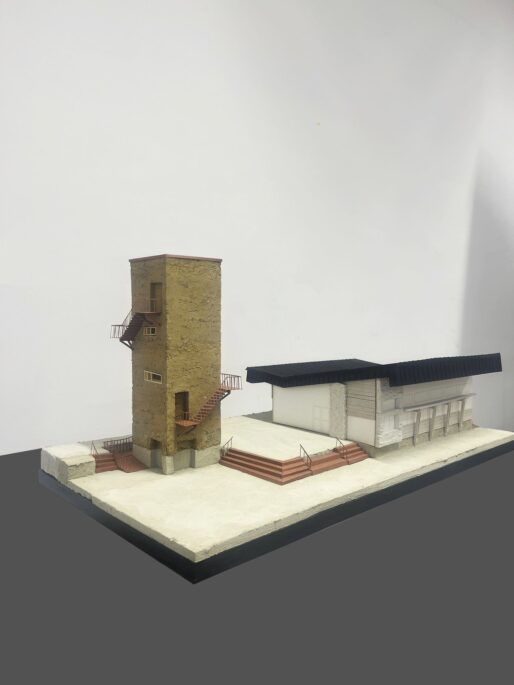
FERNBLICK transforms the busy Landungsplatz in Ebensee with a striking vertical intervention: a 16-meter-high tower that offers sweeping views of the lake and mountains. It restores visual access to the natural beauty of the area and houses two artist residencies, providing both public experience and cultural production. The tower becomes a new landmark – and a long-term cultural impulse for the town.
What is the new use?
A tall observation tower is constructed on the site to offer open access to panoramic views of Ebensee, the Traunsee, and the surrounding Alps. The tower includes two artist-in-residence studios, where international artists can live and work on temporary projects, embedded in the local setting. This dual program connects public experience with artistic creation.
How does the space feel?
The tower rises above the layers of infrastructure – railways, streets, buildings – and reconnects the site with the wider landscape. It creates a sense of vertical openness, inviting visitors to climb and rediscover the beauty of their surroundings. The design is both iconic and accessible: a place of reflection, perspective, and quiet inspiration.
What is reused or rethought?
Instead of reworking the existing building, the project reclaims the visual and cultural potential of the site itself. It reframes the location through elevation and minimal footprint, introducing new spatial and social relationships. With its long-term cultural function and low-impact footprint, the tower reimagines how a landmark can be both public infrastructure and artistic platform.
“The tower lifts the view above the surrounding infrastructure, opening new perspectives on Ebensee while creating a lasting cultural impulse through artist residencies.” – Isabel Mieke & Támi Forgó
Project #5 – KINDERSTEIG
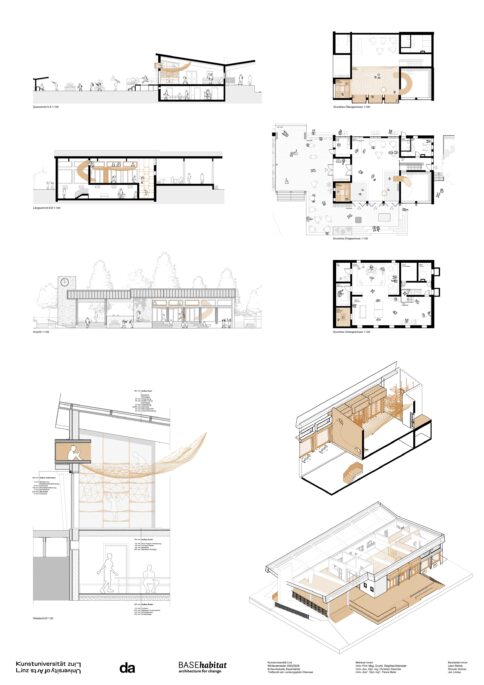
by Leon Steinle, Ricardo Gómez & Jon Lindau
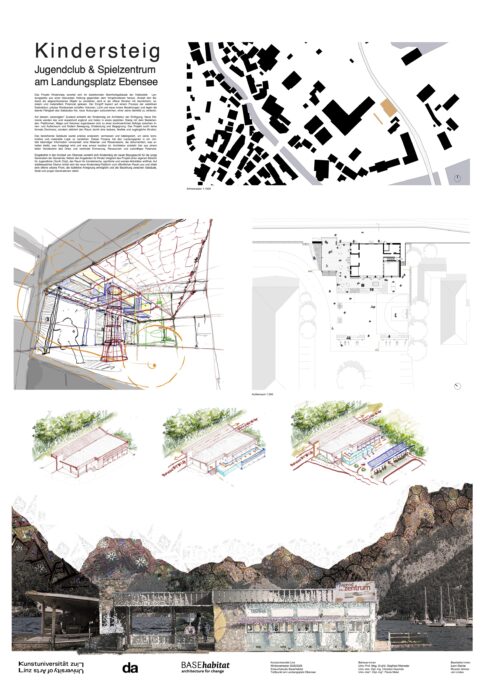
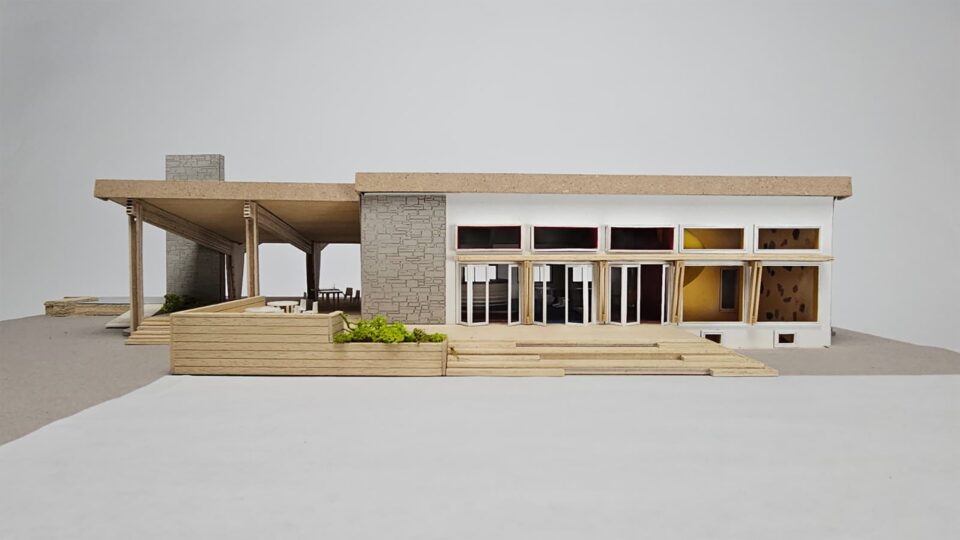
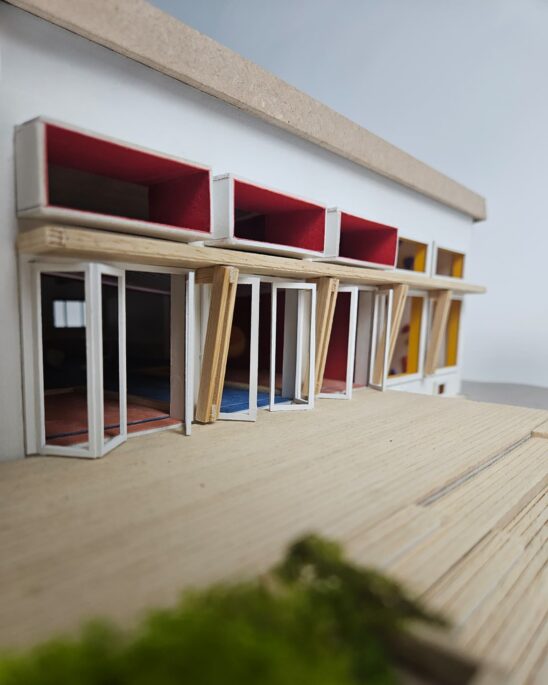
KINDERSTEIG reimagines the former train station as a youth-oriented civic space, grounded in respect for the existing structure. Through selective subtraction and thoughtful additions, the design creates open, flexible spaces for play, creativity, and connection. It becomes a new anchor point for Ebensee’s younger generation—open to discovery, movement, and collective use.
What is the new use?
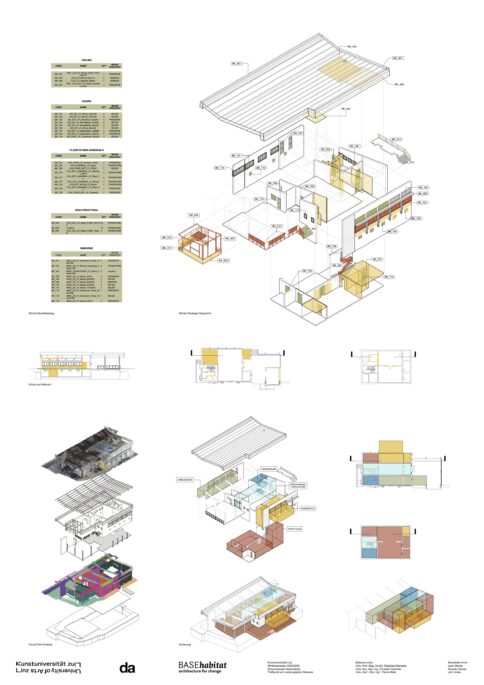
The project proposes a play center and youth club inside the existing station building. It offers space for both children and teenagers, enabling artistic, social, and sports activities. A newly added platform opens toward the public realm, strengthening the relationship between the building and the town—and giving young people a visible, active role in shaping local space.
How does the space feel?
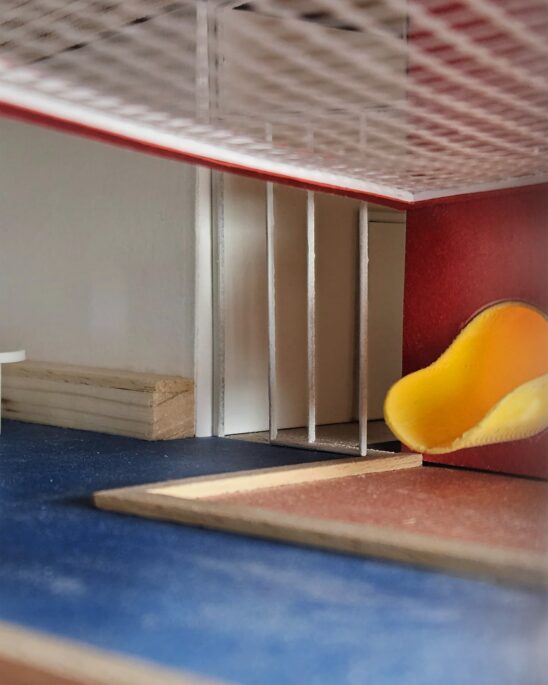
Rather than dominating the site, the intervention inserts itself gently and clearly. A sequence of platforms, volumes and walkways creates a flowing rhythm between indoor and outdoor areas—designed to invite movement, encounter, and curiosity. The design is accessible, legible, and playful—without losing the identity of the original structure.
What is reused or rethought?
KINDERSTEIG treats the existing building as an open structure full of material, spatial, and social potential. Through careful removal and targeted adaptations, the design reveals and reactivates what is already there. The building becomes a material and knowledge bank, documenting what is preserved, uncovered, and reused—creating a space that connects memory, resources, and future use.
“Our goal is for Landungsplatz to become a place people are happy to return to.” – Leon Steinle, Ricardo Gómez & Jon Lindau
Learnings & Outlook
Key learnings from the participatory process
- Landungsplatz is currently perceived mainly as a transit space.
Participants described the area primarily as a functional traffic node rather than a place to stay, with unclear arrival situations and conflicts between car, bicycle, and pedestrian movement. - There is a strong desire for a multifunctional community meeting place.
Citizens expressed interest in an open space for social, cultural, and educational activities – including workshops, repair initiatives, shared kitchens, exchange formats, courses, and low-threshold café uses. - Atmosphere and accessibility are essential for the success of the place.
Participants highlighted the importance of greenery, barrier-free design, comfortable seating areas, and a spatial mix of quiet and more lively zones to create an inviting environment for different user groups. - Practical constraints must be considered early in the process.
Issues such as vandalism prevention, the limited timeframe of interim use, flood risk, heritage protection, and fire safety regulations were identified as key challenges. - A gradual, experimental development approach is preferred.
Instead of a large permanent transformation, stakeholders recommended starting with temporary and reversible interventions that allow the place to evolve step by step while testing new uses together with the community.
Project partners

Funded by