Mit dem ausklingenden Jahr geht auch ein mehrjähriges internationales Projekt zu Ende: Re-FREAM, in dem an Fragen der Nachhaltigkeit, der Individualisierung und der urbanen Fertigung von Mode in den Kategorien 2D zu 3D (Linz), nachhaltige Veredelungen (Valencia), Elektronik und Textilien (Berlin) geforscht wurde.
Mode definiert nicht nur tragbare Objekte, sondern Kleidung als Praxis, als Kommunikation, als tägliches Ritual, als Kultur und als Wissen. In Verbindung mit neuen Technologien lenken die Re-FREAM Projekte den Blick auf Mode als Fürsorge, als Unterhaltung und als gesellschaftliches Handeln. Kleidung, die unsere Gewohnheiten in Frage stellt. Stoffe und Fertigungsverfahren, die unsere vorgefasste Modegrammatik verändern und neue Möglichkeiten des Tragens eröffnen. Eine neue Ära von Geschäftsmodellen und Herstellungsmethoden, die sich auf ein gemeinsames Verständnis und neue Wertesysteme konzentrieren – auf jeder Stufe der Wertschöpfungskette.
Hub Additive Manufacturing in Linz
Die Creative Region bildete seit 2019 gemeinsam mit der Kunstuniversität Linz, Haratech, Profactor, Statasys und Empa das Hub zur Erforschung additiver Fertigungsprozesse von Textilien: Unter dem Titel „From 2D to 3D“ forschten insgesamt zehn Künstler*innen und Designer*innen in Gemeinschaft mit Wissenschafter*innen an 3D-Druck-Technologien für spezifische Anwendungsgebiete um neue Herstellungsprozesse für die Modeindustrie zu finden.
Nach zwei Co-Creation-Durchgängen von je neun Monaten mit insgesamt zwanzig spannenden Projekten, von denen wir in Linz sieben begleitet haben, fand im November 2021 der Abschluss in Berlin statt.
Wie es weitergeht
Alle Forschungsergebnisse, Co-Creation-Prozesse und der technologische Werkzeugkasten werden veröffentlicht, um eine eigenständige und nachhaltige Innovationsgemeinschaft mit Künstler*innen und Technolog*innen aufzubauen.
In Kürze erscheint ein gedrucktes Booklet mit allen Projekten, Hintergrundinformationen und dem Re-FREAM Manifest. Schreib uns, wenn du daran Interesse hast!
Die sieben Linzer Projekte
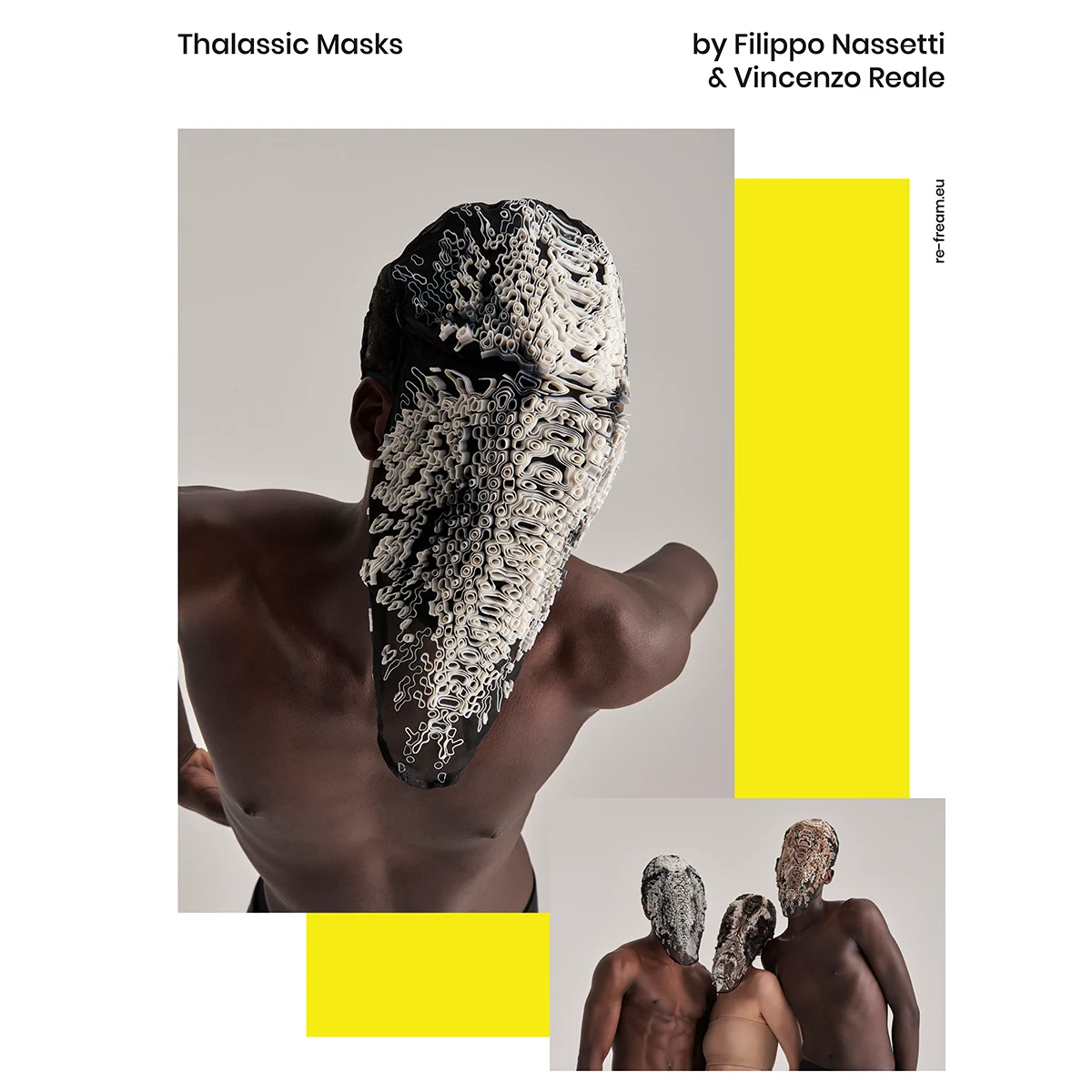
Thalassic Masks
by Filippo Nassetti & Vincenzo Reale
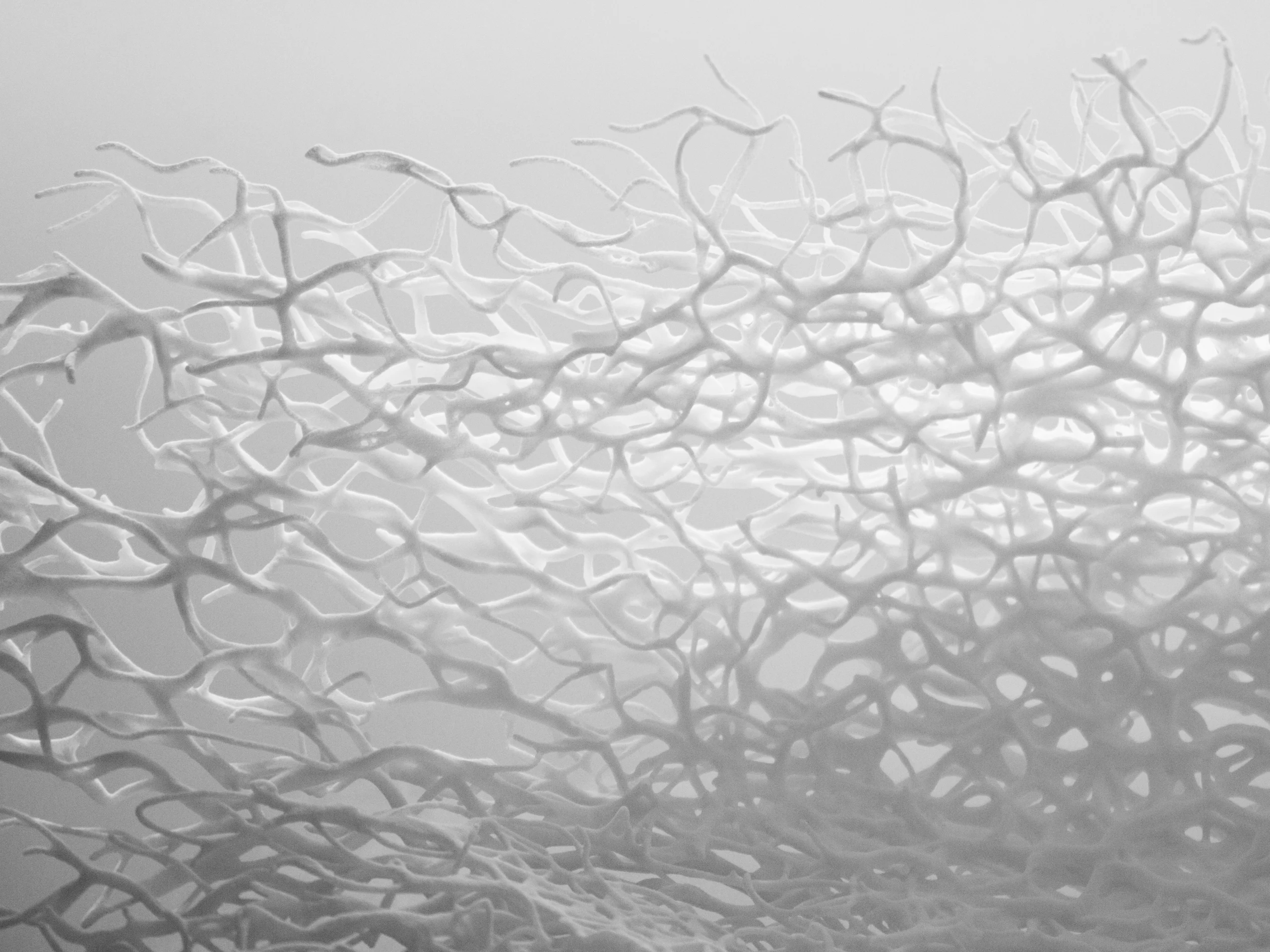
Can we print and wear the intricate filtering processes of underwater coral forests? The co-creation designs of Filippo Nasssetti and Vincenzo Reale draw on marine organisms to investigate the new visual languages for additive manufacturing. New materials and technologies become a means to augment respiratory masks, fusing functionality with aesthetics. Manufacturing becomes a measure for enhancing both survival and personal expression.

The Partners
Nassetti and Reale worked with Hub Additive Manufacturing (Linz), focused on urban manufacturing. They partnered with Stratasys, Haratech and the Fashion & Technology department at the Kunstuniversität Linz , using 3D scanning and the latest 3D printing innovation. Empa provided detailed bodily data analysis.
Syntropia – Manufacturing New Ecosystems
by Sophia Guggenberger & Eugenia Morpurgo
“It’s never just about the plant, or just about the shoe. It’s about the beginning and the end – and how the end becomes the beginning.”
Eugenia Mopurgo, Co-Researcherin im Projekt SYNTROPIA
Combining 3D fabrication with agronomics, the Syntropia Re-FREAM project initiated by Sophia Guggenberger and Eugenia Morpurgo investigates circular manufacturing from seed to shoe. The material components for their bio-based footwear can be harvested from one polycultural field. Flexible and modular, the design framework adapts to seasonal yields and differing plant constellations. As Guggenberger explains, their shoes do not only dress feet: “a product can be a tool for achieving other things”; a holistic manufacturing approach, which encourages the regeneration of ecosystems.

The Partners
The team worked with Hub Additive Manufacturing (Linz). The Re-FREAM partners Haratech, WoodKPlus and the Fashion & Technology department at the Kunstuniversität Linz collaborated on 3D printing techniques, and material development to produce the 3D-printed components of the shoes. Empa provided counsel on material properties and testing.
Footwear Time Based Design
by Assa Ashuach
Disrupting design, Assa Ashuach explains, means disrupting production: “we can no longer just make a shoe, put in a box, send it, and say goodbye!”. Central to his Re-FREAM design research is the long-term relationship between the fashion object, the user, the manufacturer, and the material. How can we produce not just fashion and accessories, but sustainable use? How can we make fashion items less disposable and make longevity more fashionable? Additive manufacturing has allowed him to steer footwear into several new directions: a flat-printed biodegradable shoe with replaceable parts, a repearable shoe in one piece, an evolutionary shoe with integrated sensors, which adapts to the user’s needs over time, and “shoeskins” printed on fabric. Each design uses manufacturing innovation to trigger new ways of consumption.

The Partners
Ashuach worked with Hub Additive Manufacturing (Linz), focused on urban manufacturing. He partnered with Stratasys, Haratech, and Profactor, using 3D scanning and the latest 3D printing innovation. The Hub and the Fashion & Technology department at the Kunstuniversität Linz provided a framework of networking opportunities and guidelines. Additional consulting was provided by Maximilian Müller from Moticon and footwear expert Camilla Petrocchi.
Needs-Based Clothing Design – Diversifying Clothing Design through Additive Manufacturing
by Silke Hofmann
A friend’s breast cancer experience and unmet bra needs sent Silke Hofmann on a design journey striving for inclusion and harmony. In her practice-based Ph.D. at the Royal College of Art, Hofmann works alongside affected women towards understanding and collaboratively manifesting the spectrum of bra needs. Within Re-FREAM, Hofmann developed a speculative, modular garment that questions current bra construction and proposes an alternative breast support structure, reaching beyond the concept of underwear. The creation and manufacture of clothing becomes an empowering and re-energizing experience of the self, supportive and devoid of judgement.

The Partners
Hofmann worked with the Hub Additive Manufacturing (Linz). Her collaborations included the Fashion & Technology department at UFG Linz (digital garment creation) and Empa (textile preferences, fiber testing, and textile digitizing). She also explored 3D printing trials with Profactor. In addition, Hofmann activated a community of experts, including character designers Nedim Šećeragić (digital avatar creation), engineered knit studio Case Studies (3D knit composition), and product design Studio Wint Design Lab collaborated on the breast support construction.
Digital Vogue – Between Synthetic and Organic Processes
by Julia Koerner
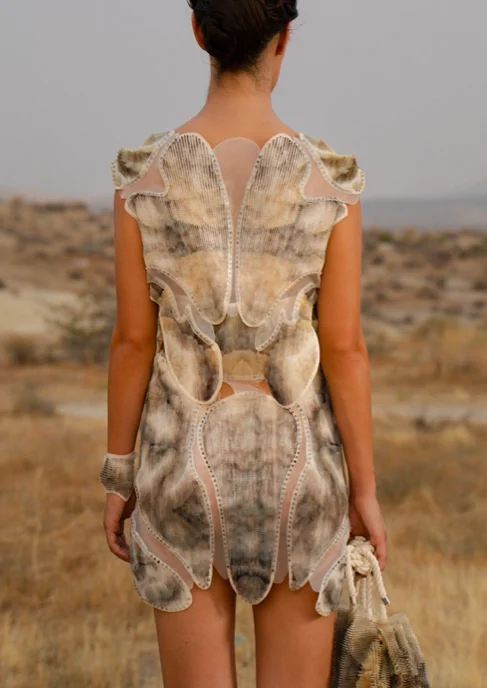
When the highly acclaimed designer Julia Koerner asked herself how computational design can improve fashion fabrication, she searched beyond 3D code. She sought and found answers in seams and muscle tissues, in sea crystals, and in the hot desert air. Her striking computational designs are the results of taking workflows apart to reconfigure more sustainable production processes. Highly specialized in the domain, she was able to create structures which reduce printing waste. Researching mass personalization through body scanning also led her to reconsider the joining of garments. How can clothing morph to remain adjustable – not only to each wearer, but also to the wearer’s changing bodies ? Can new forms of digital couture respect our environment – and allow for adaptation to both our bodies and to our surroundings ? Her multi-functional Arid collection provides us with first solutions.

The Partners
Koerner worked with Hub Additive Manufacturing (Linz) and focused on urban manufacturing. She partnered with Stratasys and Profactor for the latest 3D printing innovation, while Haratech and Kunstuniversität Linz consulted for 3D scanning.
WeAreAble – Multidimensional Couture Workflows
by Ganit Goldstein
Ganit Goldstein navigates multiple dimensions at all times: transitioning between 2D and 3D, then dipping into virtual reality. The ornate surfaces of her designs reflect her deep concern with craft, scale, and volume. In collaboration with her Re-FREAM partners, she developed highly customized new design workflows, creating both upcycled low-tech and high end multi-color Polyjet printed garments. Along the way, pandemic travel restrictions also pushed her towards entering the territory of virtual fashion display – in couture splendor. Her 3D-printed garments appear in virtual space in all their precious detail: a highly tactile display of digital manufacturing, eager for its closeup.

The Partners
Goldstein worked with Hub Additive Manufacturing (Linz). The Re-FREAM partners Stratasys, Haratech, Profactor, and the Fashion & Technology department at the Kunstuniversität Linz supported Goldstein using 3D scanning and 3D printing techniques to produce 3D-printed garments and a virtual display.
Re-Think Manufacturing – Performative Robotic Microfactories
by Yokai Studios
Making is mesmerizing. Yokai studio’s robotic fashion manufacturing melds design with automation, upcycling – and spectacle. The goal of the founders Michael Wieser and Viktor Weichselbaumer is to build a system for both localized and customized clothing production. Working with robotic arms and software, they transform traditional flat garment production into a three-dimensional and kinetic process. Their unique approach also allows us to watch machines play.

The Partners
Yokai Studios worked with Hub Additive Manufacturing (Linz), focused on urban manufacturing. Their manufacturing tech partners were Profactor and Haratech. EMPA in St. Gallen extensively tested samples, while the Kunstuniversität Linz facilitated networking and development.